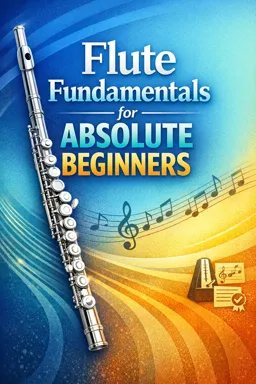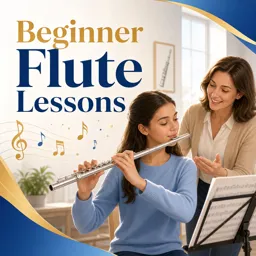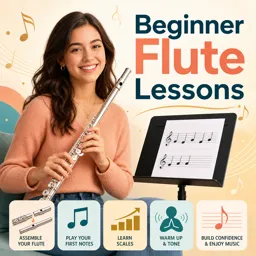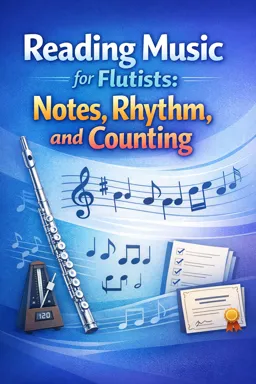

Free ebook for flutists on reading treble-clef notes, key signatures, rhythm, counting, notation markings, and sight-reading.
Free ebook content
-

Reading Music for Flutists: The Staff, Treble Clef, and How Flute Notes Live on the Page
+ Exercise: When identifying a note on the treble staff for flute, what is the recommended approach for finding its letter name quickly?
-
Treble Clef Note Recognition for Flute Range: From Low Register to Upper Notes
+ Exercise: When identifying notes above the treble staff, which note is located on the 1st ledger line above the staff?
-
Key Signatures for Flutists: Finding Do, Reading Flats and Sharps, and Staying in Key
+ Exercise: In F major (1 flat: B♭), a measure contains a B marked with a natural sign (♮). Later in the same piece, a B appears without any accidental. How should the later B be played?
-
Accidentals in Flute Music Reading: Sharps, Flats, Naturals, and Courtesy Signs
+ Exercise: In a measure with no key signature, you play G then see G♯, followed later in the same measure by another G in the same octave with no accidental. What pitch should you play for that later G?


-
Rhythm Values for Flutists: Notes, Rests, and Sound-to-Symbol Matching
+ Exercise: In 4/4, what is the best way to keep accurate timing when you encounter rests and need to re-enter cleanly?
-
Time Signatures and Strong Beats: Feeling Meter While Reading Flute Parts
+ Exercise: In 6/8, what approach best helps a beginner keep the meter steady at tempo while reading a flute part?
-
Counting Strategies for Flutists: Subdivision, Counting Aloud, and Staying Steady
+ Exercise: In 6/8 time, when the music feels fast or has a clear two-beat feel, which counting approach best matches the main pulse described?
-
Ties, Dots, and Syncopation: Reading Longer Notes and Off-Beat Rhythms
+ Exercise: In 4/4, what should you do when a note is tied across a barline (for example, a quarter note tied to a quarter note)?
-
Notation Markings in Flute Sheet Music: Dynamics, Articulation, and Tempo Words
+ Exercise: When you see a crescendo hairpin (
-
Repeats, Endings, and Roadmaps: Navigating Real Ensemble Notation for Flute
+ Exercise: When you encounter first and second endings (1st/2nd endings) in a repeated section, what should you do on the second pass?
About the free ebook
Reading Music for Flutists: Notes, Rhythm, and Counting
This free ebook helps flutists build the essential music-reading skills needed to approach exercises, solos, band parts, and ensemble music with greater confidence. It focuses on how notation works specifically on the flute’s treble-clef staff, connecting written symbols to practical playing decisions.
Read flute notes accurately
Learn how notes are placed on the staff, how the treble clef identifies pitch names, and how to recognize notes across the flute’s low, middle, and upper registers. The ebook also explains key signatures, accidentals, naturals, and courtesy signs so you can identify the notes that belong in a key and react correctly when a note changes.
Understand rhythm and meter
Reading pitches is only half of music reading. Explore note and rest values, time signatures, beat strength, and practical ways to match written rhythm with steady sound. Clear counting and subdivision strategies support accurate entrances, sustained notes, and consistent pulse.
Handle common notation with confidence
Discover how ties, dots, syncopation, dynamics, articulation marks, tempo words, repeats, and endings affect your performance. These symbols provide the roadmap for turning printed flute music into an intentional, musical performance.
Build useful sight-reading habits
The ebook brings notes, rhythm, counting, and notation markings together in a practical sight-reading approach. Use it to develop habits that help you scan a flute part, keep your place, recover from mistakes, and continue playing in time.
What you will strengthen
- Treble-clef note recognition throughout the flute range
- Reading key signatures and accidentals
- Counting rhythms and understanding meter
- Following expressive markings and ensemble roadmaps
- Applying music-reading skills while sight-reading
Reading music becomes easier when pitch, rhythm, and counting are practiced as connected skills.
How do flutists read notes in the treble clef?
Identify each note by its line or space position, then connect it to the appropriate flute fingering and register.
Do accidentals apply for the entire measure in flute music?
Yes. A sharp, flat, or natural normally affects that pitch for the rest of the measure unless it is changed again.
What is the best way to count syncopated flute rhythms?
Keep a steady subdivision aloud or internally so off-beat notes are placed accurately against the beat.
This ebook includes:

11 content chapters

Digital certificate of course completion (Free)

Exercises to train your knowledge

100% free, from content to certificate
Ready to get started?

 recommended
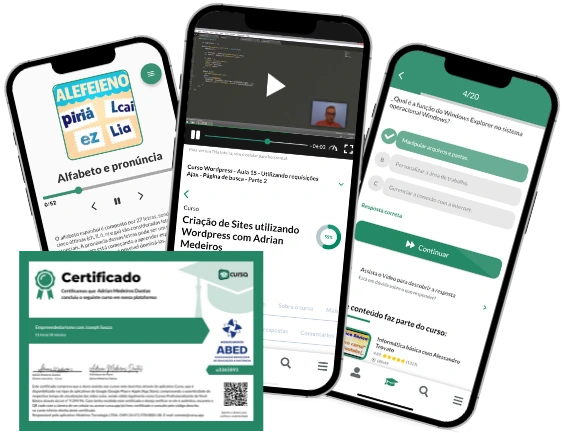
In the app you will also find...

Over 5,000 free courses
Programming, English, Digital Marketing and much more! Learn whatever you want, for free.

Study plan with AI
Our app's Artificial Intelligence can create a study schedule for the course you choose.

From zero to professional success
Improve your resume with our free Certificate and then use our Artificial Intelligence to find your dream job.
You can also use the QR Code or the links below.