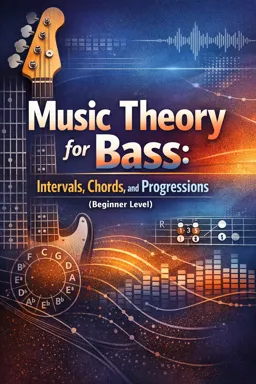

Free ebook for beginner bass players on notes, intervals, chords, scales, and progressions for building supportive bass lines.
Free ebook content
-

Bass Music Theory Basics: Notes, Strings, and Fretboard Landmarks
+ Exercise: You’re playing a note and want to grab the same note name one octave higher using a common bass shortcut. Which movement should you use?
-
Intervals on Bass: Hearing and Seeing Distance Between Notes
+ Exercise: When building a simple bass line, which group of notes is recommended as stable targets to land on strong beats?
-
Root-Focused Mapping: Interval Shapes You Can Move Anywhere
+ Exercise: When using root-focused mapping to outline a chord quickly, which note choice most directly confirms whether the chord is major or minor while keeping the same root?


-
How Chords Are Built: Triads and the Bass Player’s Job
+ Exercise: When outlining a triad on bass, which note most clearly determines whether the chord is major or minor?
-
Seventh Chords for Bass: Adding Color with One More Note
+ Exercise: What is the main difference between a major 7 chord and a dominant 7 chord when comparing their formulas?
-
Chord Symbols and Quick Translation to Fretboard Notes
+ Exercise: When you see the chord symbol Cadd9, which set of chord tones matches how you would decode it for bass (keeping the triad and adding the 9, with no implied 7th)?
-
Scales as Note Pools: Major Scale and the Key Center
+ Exercise: When creating a bass line in a major key using the scale as a “note pool,” which approach best matches the idea of “chord tones first, scale tones as decoration”?
-
Progressions in Popular Music: How Chords Move and Why Bass Matters
+ Exercise: When building a simple bassline over a chord progression in 4/4, what is the recommended plan for beats 1, 3, and 4?
-
Building Supportive Bass Lines: Roots, Fifths, Thirds, and Approaches
+ Exercise: In a beginner bass line over a repeating 4-chord loop, where should you typically place an approach note (half-step or whole-step away) so it connects smoothly into the next chord?
-
Practice Application Projects: Create Bass Parts from Chord Charts
+ Exercise: When adding a passing tone variation to a bass line, what approach best helps you hear the pitch change clearly and keep solid time?
About the free ebook
Music Theory for Bass: Intervals, Chords, and Progressions
This free beginner-level ebook helps bass players understand the theory behind the notes they play. Rather than treating the fretboard as a collection of isolated positions, it introduces practical ways to recognize notes, hear intervals, follow chord symbols, and support songs with confident bass choices.
Learn theory through the bass fretboard
Start with the names of notes on the strings and useful fretboard landmarks. Then explore intervals as both musical distances and movable shapes. This root-focused approach makes it easier to find fifths, thirds, octaves, and other essential tones in any key.
Understand chords and harmony
Discover how major and minor triads are built, why seventh chords create extra color, and how common chord symbols translate into playable notes. You will also see how the major scale acts as a note pool for a key center, helping you identify chord tones that fit the harmony.
Build bass lines that serve the song
Learn how progressions work in popular music and why the bass has a central role in connecting rhythm and harmony. Practical examples focus on choosing roots, fifths, thirds, and simple approach notes to create supportive lines without overcrowding the arrangement.
Put concepts into practice
The ebook finishes with hands-on projects for creating bass parts from chord charts. Use the ideas to map a progression, identify strong target notes, and develop musical lines that clearly outline each chord.
What you will be able to do
- Locate essential notes and interval shapes across the fretboard.
- Read common chord symbols and identify their key chord tones.
- Use major-scale notes to understand a key and its chords.
- Create clear bass parts for chord progressions.
Designed for new bass players, this ebook connects fundamental music theory directly to practical playing decisions.
How do I find intervals on the bass guitar fretboard?
Use a root note as your reference and learn movable fretboard shapes for tones such as thirds, fifths, and octaves.
What notes should a bass player use over a chord progression?
Begin with each chord’s root, then add fifths, thirds, and nearby approach notes when they support the harmony.
How do chord symbols help bass players create lines?
Chord symbols identify the chord quality and root, helping you choose chord tones that clearly outline each change.
This ebook includes:

10 content chapters

Digital certificate of course completion (Free)

Exercises to train your knowledge

100% free, from content to certificate
Ready to get started?

 recommended
In the app you will also find...

Over 5,000 free courses
Programming, English, Digital Marketing and much more! Learn whatever you want, for free.

Study plan with AI
Our app's Artificial Intelligence can create a study schedule for the course you choose.

From zero to professional success
Improve your resume with our free Certificate and then use our Artificial Intelligence to find your dream job.
You can also use the QR Code or the links below.