Duration of the online course: 5 hours and 25 minutes
New
Build solid drum grooves and timing with this free online course, from stick technique to fills, shuffles and independence—practice at your pace and earn a certificate.
In this free course, learn about
Drum kit components & roles, incl. bass drum pedal use in modern setups
Fundamental stick technique, grip, and beginner stick classification
Rock grooves: quarter-note and eighth-note beats; reading & counting 8ths
Dynamics/control via stick-height (stroke levels) rather than muscle force
Common drum fills and how to build tension/release with fill phrasing
Syncopation: accenting offbeats/weak parts of the bar for rhythmic interest
16th-note counting (4 hits per click) and applying 16ths/16th-triplets in grooves
Hi-hat patterns (one- vs two-handed), foot hi-hat notation, and key hat techniques
Triplet-based feels: 8th-note triplets, shuffle core rhythm, and blues shuffle grooves
Placement/orchestration: where to play “e/a” notes and moving the right hand around kit
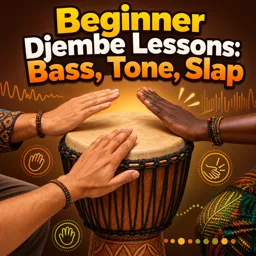
Djembe basics: correct hand positioning for tone and resonance
About the free online course
If you’ve ever wanted to sit at a drum kit and feel in control of the beat, this course is built to get you there step by step. You’ll start by getting comfortable with the parts of the kit and how they work together, then move into core stick technique so your hands develop clarity, balance, and endurance. From the beginning, the focus stays practical: learning to play musical patterns that immediately sound like real songs, while building habits that help you improve faster.
As you progress, you’ll train your timing through classic rock grooves, moving from simple quarter-note feels into steady eighth-note patterns and beyond. You’ll learn how subdivision changes the way a groove sits, why consistent hi-hat control matters, and how the bass drum pedal becomes the engine that drives modern beats. The lessons help you connect what you see in notation with what you play, so reading rhythms feels useful instead of intimidating.
To keep your playing creative, the course develops fills and variations that create motion, tension, and release without losing the pulse. You’ll explore syncopation, triplet-based grooves, blues and shuffle feels, and stylistic studies that strengthen your musical vocabulary. Rudiments such as flams, drags, ruffs, and rolls are introduced as tools for expression, giving you cleaner starts, stronger accents, and smoother transitions around the kit.
Independence is a major theme throughout: coordinating hands and feet, practicing one-handed and two-handed patterns, and developing control over dynamics so you can play softer or louder on purpose. You’ll also expand into funk-oriented bass drum work and exercises designed to sharpen precision while keeping your groove relaxed. By the end, you’ll have a practice-ready toolkit for playing along to music, jamming with others, and continuing your drumming journey with confidence. It’s a free online course you can follow at your own pace, with structured guidance to help your progress feel measurable and rewarding.
Course content
Video class: Learn Drums Lesson 01 - Introduction to the kit13m
Exercise: What is the purpose of the bass drum pedal in a modern drum kit?
Video class: Learn Drums Lesson 02 - Introduction to stick technique17m
Exercise: What is the most commonly used drumstick classification for beginners?
Video class: Learn Drums Lesson 03 - 1/4 note rock groove17m
Exercise: Which drumming technique relies on stick height rather than muscular force to generate different volumes?
Video class: Learn Drums Lesson 04 - 1/8 note rock groove12m
Exercise: What is the characteristic of eighth notes in music notation?
Exercise: When practicing two-handed 16th note patterns on the drums, where should notes falling on the 'E' or 'a' of the beat be played?
Video class: Learning Drums Lesson - Stylistic Studies #109m
Video class: Learn Djembe - Lesson 0100m
Exercise: What is the correct technique for hand positioning to ensure good tone and resonance when playing a drum?
Video class: Ian Matthews Drum Workshop #100m
Video class: Ian Matthews Drum Workshop #200m
Exercise: Which concept mentioned in the text had a profound effect on the speaker's drum playing?
Video class: Ian Matthews Drum Workshop #300m
Video class: Ian Matthews Drum Workshop #500m
Exercise: Why is it important to maintain a strong accent on the beat with the left hand while playing drums?
Video class: Ian Matthews Drum Workshop #400m
Video class: Ian Matthews Drum Workshop #600m
Exercise: When reworking the exercise mentioned, what does the right hand do?
Video class: Ian Matthews Drum Workshop #700m
Video class: Ian Matthews Drum Workshop #800m
Exercise: Which of the following techniques is suggested for practicing accents within a paradiddle on the drums?
Video class: Ian Matthews Drum Workshop #900m
Video class: Ian Matthews Drum Workshop #1000m
Exercise: When playing a simple eighth note pattern on the high-hats over a sixteenth note bass drum pattern, how is the high-hat struck compared to the bass drum hits?
Video class: Ian Matthews Drum Workshop #1100m
Video class: Ian Matthews Drum Workshop #1200m
Exercise: In the context of drumming, what is the effect of delaying the '1e' to the 'up' at the end of the sixteenth notes?
Video class: Ian Matthews Drum Workshop #1300m
Video class: Ian Matthews Drum Workshop #1400m
Exercise: In drumming terminology, what does the term 'ride cymbal' refer to?
Video class: Ian Matthews Drum Workshop #1500m
Video class: Ian Matthews Drum Workshop #1600m
Exercise: In the context of drumming exercises, why is it recommended to move your right hand around the drum kit?
Video class: Ian Matthews Drum Workshop #1700m
Video class: 'Led Balloon' - Learn the Drum Part02m
This free course includes:
5 hours and 25 minutes of online video course
Digital certificate of course completion (Free)
Exercises to train your knowledge
100% free, from content to certificate
What drumstick size is most commonly recommended for new drummers?
5A drumsticks are a common beginner choice because they offer a balanced weight and versatile feel.
What is syncopation in drumming?
Syncopation places accents or notes between the main beats, creating an off-beat rhythmic feel.
How are sixteenth-note triplets written in drum notation?
They are usually grouped with a bracket or beam and marked with a small “3” to show three notes fit into the usual note value.
Ready to get started?Download the app and get started today.