
Exercises
Explore the principles and practical variables of resistance spot welding. This quiz examines how weld nuggets form, why copper-alloy electrodes are used, how squeeze and hold times affect a weld, and how excessive current can cause expulsion. You will also interpret electrode wear, electrical shunting, destructive test results, and the relationship between current and heat. The questions combine foundational concepts with realistic production and troubleshooting scenarios.
Answer the questions below and check the explanation for each answer.
0/11 answered
Auto audio on: the next questions will be read aloud when you click Continue.
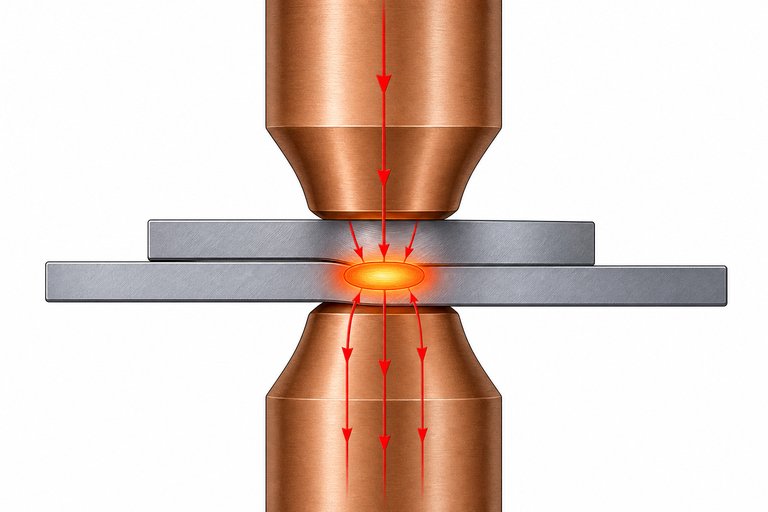
Current encounters resistance as it passes through the workpieces, especially at their contacting interface. The resulting resistance heating forms the molten weld nugget.
Copper alloys carry high current efficiently and remove heat from the electrode tips. Suitable alloys also resist deformation under repeated force and heating.
Electrode force is first established during squeeze time. Current then flows during weld time, and pressure remains during hold time while the nugget solidifies.
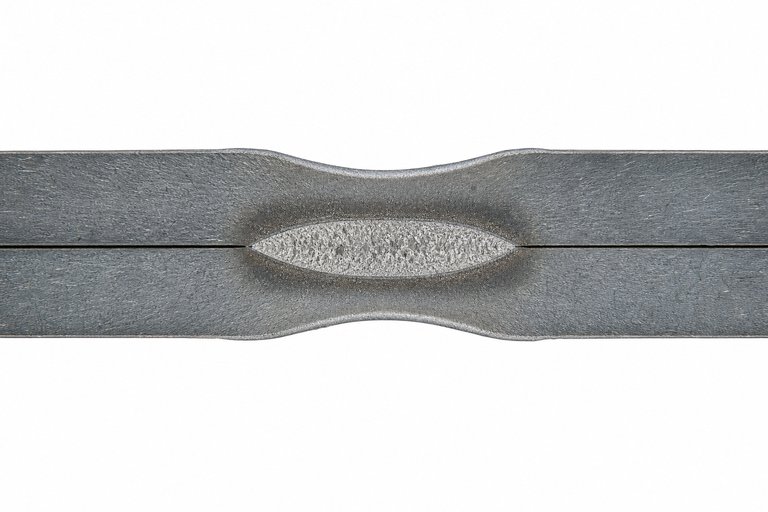
The fused, lens-shaped region between the overlapping sheets is the weld nugget. It forms when resistance heating melts material at the interface.
Excessive heat input can enlarge the molten region faster than the electrode force can contain it. Molten metal may then be expelled from between the sheets.
Squeeze time lets the electrodes close and reach the specified force before current begins. Stable contact helps control resistance and reduces arcing or expulsion.
During hold time, the electrodes continue compressing the hot joint as the nugget cools and solidifies. Releasing force too early can reduce weld integrity.
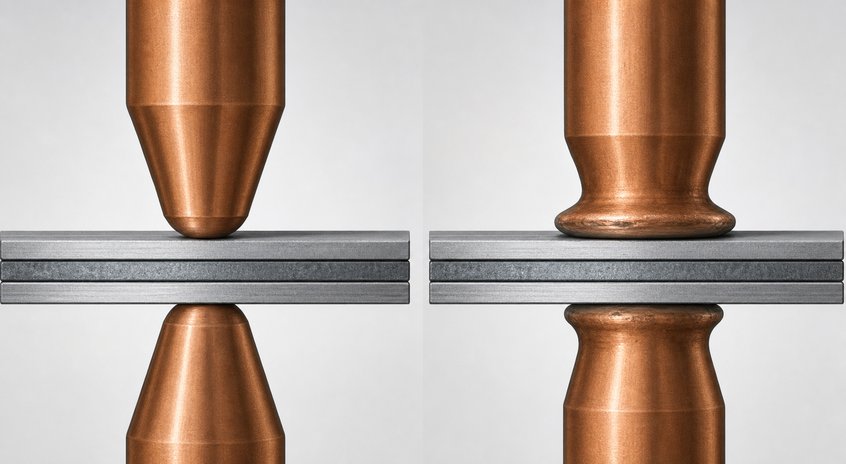
A mushroomed tip spreads current over a larger area, reducing current density. Without compensation or tip dressing, this can produce a smaller or weaker weld nugget.
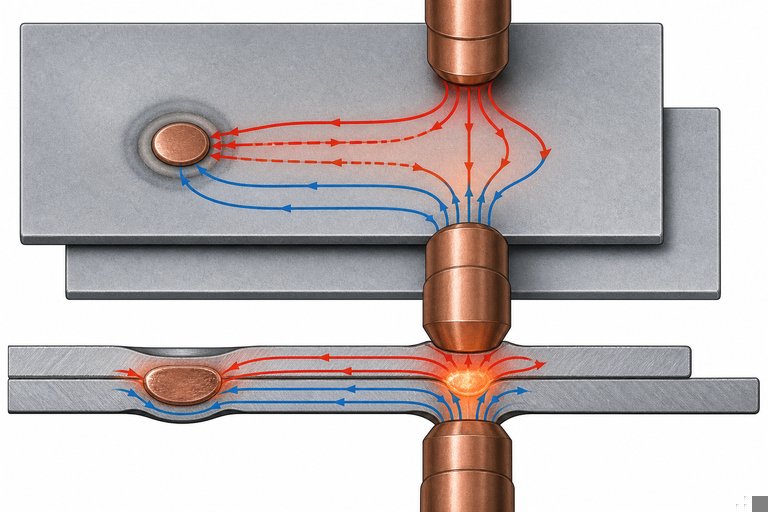
This effect is called shunting. An existing nearby weld provides an alternate conductive path, so less current may pass through the intended interface at the new weld location.
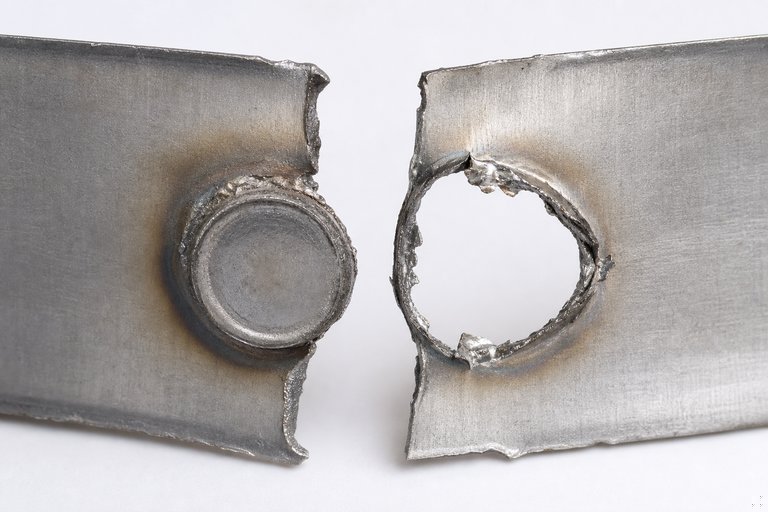
This is button pullout: the nugget remains attached while a plug is pulled from one sheet. It is distinct from a fracture that separates directly through the sheet interface.
Heat varies with the square of current. Increasing current to 1.10 times its original value gives 1.10² = 1.21, or about a 21% heat increase under the stated assumptions.

Free CourseWelding Safety
5

(3)

1h08m

6 exercises

Free CourseLearn Welding
4.8
(5)
7h02m
31 exercises

Free CourseStick Welding basics
4.8

(12)
59m
6 exercises

Free CourseWelding Beginner Basics
4.8
(4)
1h39m
20 exercises
Free CourseWelding Basics
4.4
(9)
1h00m
18 exercises
Free CourseFundamental of welding
4.2
(49)
20h51m
20 exercises
Free CourseHow To TIG Weld
4
(2)
22m
5 exercises
Free CourseLearn How to MIG Weld
3
(1)
47m
6 exercises
Thousands of online courses in video, ebooks and audiobooks.
To test your knowledge during online courses
Generated directly from your cell phone's photo gallery and sent to your email

Download our app via QR Code or the links below:.



Carry knowledge in your pocket.
Download the Cursa app.
There are hundreds of free courses available, with a free certificate of completion that is saved in your mobile image gallery.
Download the app to access the Course Completion Certificate for Free.


+ 10 million
students

Free and Valid
Certificate

60 thousand free
exercises

4.8/5 rating in
app stores

Free courses in
video and ebooks