Exercises
Develop practical knowledge of ukulele setup and troubleshooting. This quiz covers scale-length measurement, intonation diagnosis, string action, nut-slot height, neck relief, fret buzz, string installation, humidity, and saddle adjustment. The questions combine visual interpretation with common workshop scenarios to help you recognize setup problems and understand how adjustments affect playability and tuning.
Answer the questions below and check the explanation for each answer.
0/14 answered
Auto audio on: the next questions will be read aloud when you click Continue.
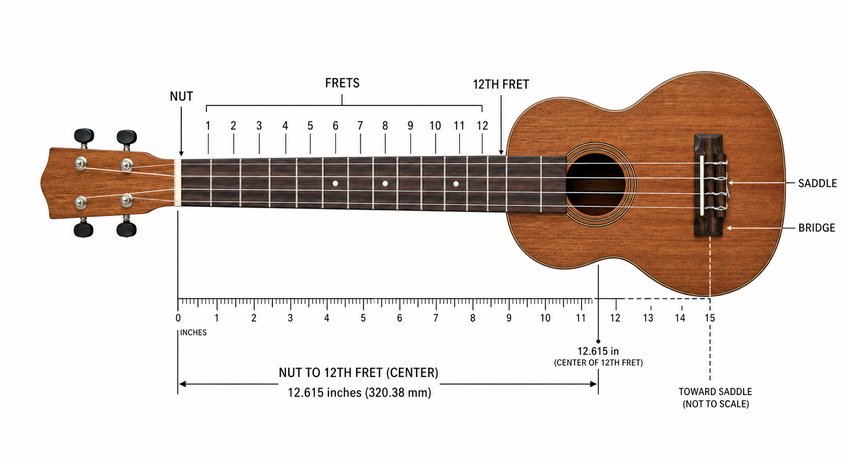
The 12th fret is located at approximately half the scale length. Measuring from the nut's fretboard edge to the center of that fret and doubling the distance gives the nominal scale length.
A sharp fretted octave indicates that the string's effective speaking length is too short. Moving the saddle contact point away from the nut lengthens the string and lowers the fretted pitch.
New strings often drift while stretching, and high action stretches a string farther when it is fretted. Both factors can distort intonation readings, so they should be stabilized first.
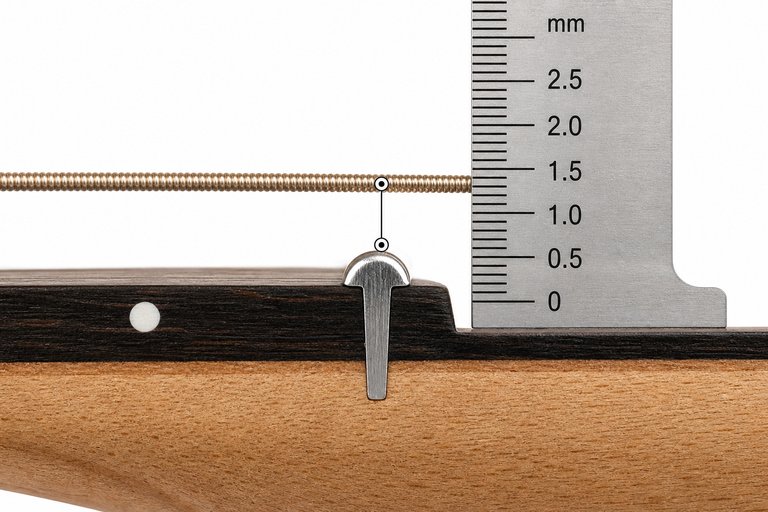
Action is the playable clearance between a string and a fret. At the chosen fret, it is measured from the fret's crown to the underside of the string.
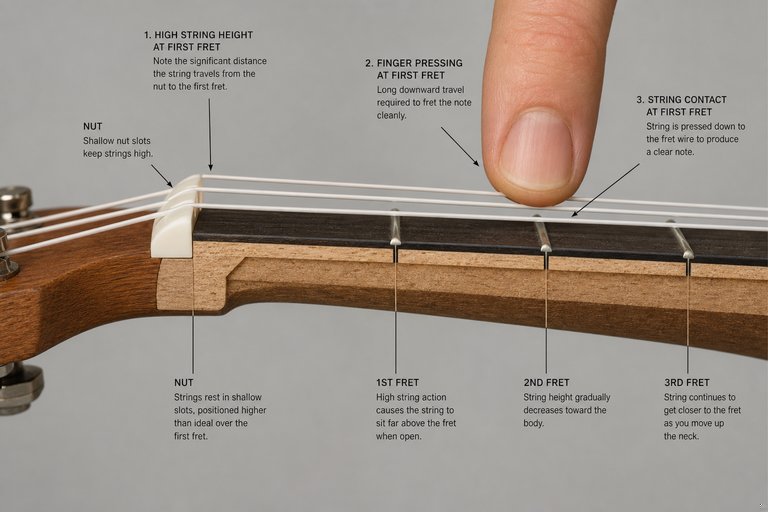
High nut slots make the player push strings farther down at the first few frets. This extra stretching raises pitch and makes first-position chords feel unnecessarily stiff.
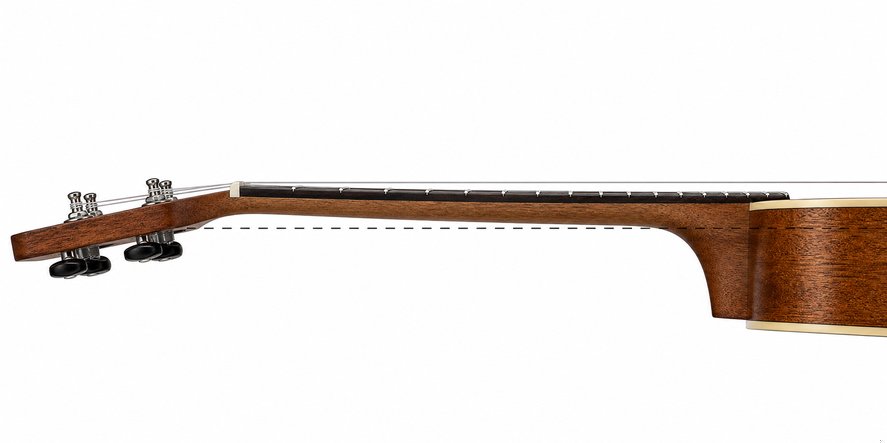
When the middle of the neck curves toward the strings, the neck has back-bow. This reduces clearance over the middle frets and can cause buzzing, especially in lower positions.
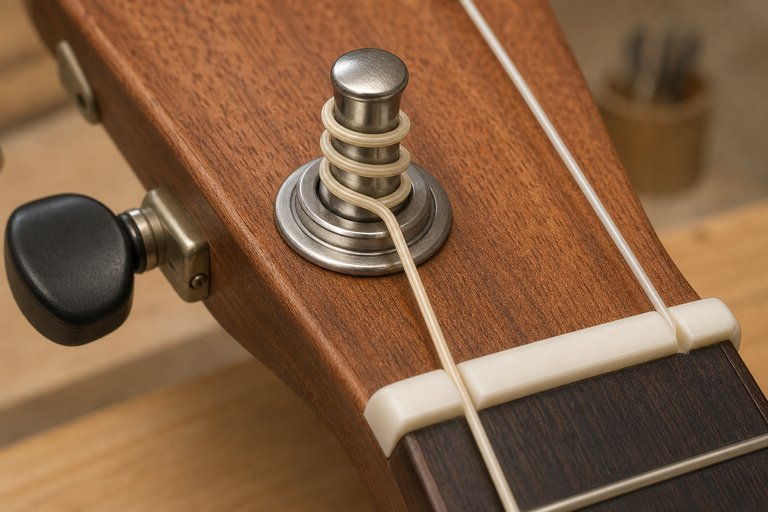
Orderly wraps that progress downward guide the string lower on the post. This supports a firm break angle over the nut and helps the string settle securely without overlapping coils.
A range near 40% to 55% relative humidity is generally safe for wooden instruments. Very dry air can cause shrinkage or cracks, while excessive humidity can cause swelling and deformation.
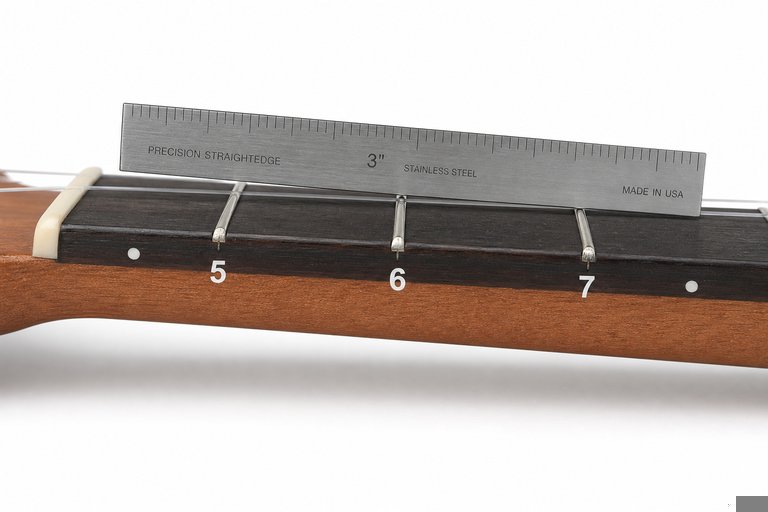
A rocker should contact three level frets without moving. If it pivots on the middle fret, that fret stands higher than the two neighboring frets and may cause localized buzzing.
Neck relief affects string clearance, and action affects how much strings stretch when fretted. Relief should therefore be evaluated before action, with intonation checked near the end.
The 12th fret lies near the midpoint of the scale. As a practical approximation, removing 1 mm from the saddle lowers the action there by about half that amount, or 0.5 mm.
String sets can differ in tension, thickness, stiffness, and stretch. These properties influence neck load, playing clearance, and the compensation needed for accurate fretted notes.
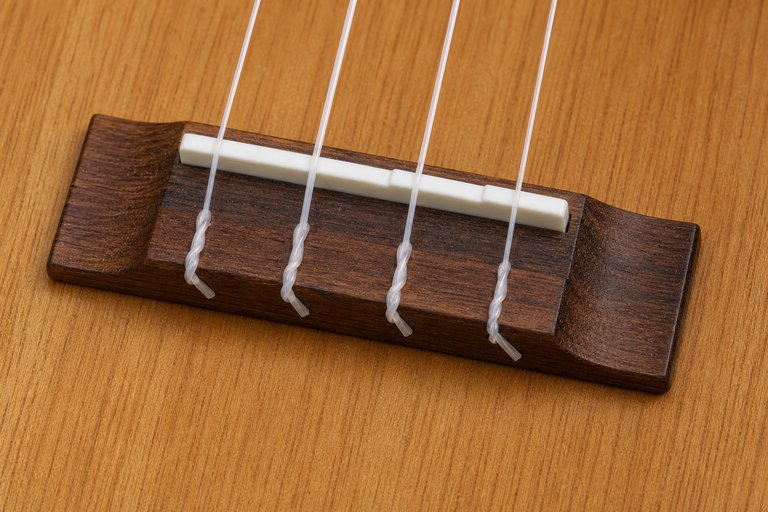
Strings do not all require exactly the same compensation. Stepped or angled contact points alter their effective lengths slightly, improving agreement between open and fretted pitches.
A nut slot that is filed too deeply can cause an open string to buzz against the first fret. Material cannot simply be added back, so filing should be done gradually with frequent measurements.
Thousands of online courses in video, ebooks and audiobooks.
To test your knowledge during online courses
Generated directly from your cell phone's photo gallery and sent to your email

Download our app via QR Code or the links below:.



Carry knowledge in your pocket.
Download the Cursa app.
There are hundreds of free courses available, with a free certificate of completion that is saved in your mobile image gallery.
Download the app to access the Course Completion Certificate for Free.


+ 10 million
students

Free and Valid
Certificate

60 thousand free
exercises

4.8/5 rating in
app stores

Free courses in
video and ebooks