
Exercises
Put your intermediate Portuguese grammar skills to the test with this quiz on irregular verbs in the present tense. Practice choosing the correct forms of essential verbs such as dizer, ter, vir, poder, saber, fazer, trazer, ler, dar, and ser. Questions cover a range of subject pronouns, including eu, tu, ele/ela, nós, vós, and eles, helping you recognize common irregular patterns and build confidence using Portuguese in everyday contexts. Review your conjugations, focus on stem changes and unique endings, and see how well you can use these high-frequency verbs.
Answer the questions below and check the explanation for each answer.
0/10 answered
Auto audio on: the next questions will be read aloud when you click Continue.
In Portuguese, the present tense conjugation of the verb dizer for ele or ela is diz. Therefore, the correct answer is Option 1: ele diz.
The correct conjugation of the verb ter in the present tense for nós (we) is temos. Therefore, option 3 is the correct answer. The verb ter in Portuguese follows irregular conjugation patterns, and temos is specifically used for the first person plural.
The correct present tense conjugation of the verb 'vir' for 'tu' is vens (option 2). The verb 'vir' is irregular, and in the present tense for 'tu', it changes to 'vens' to match the subject correctly.
In Portuguese, the correct present tense form of the verb poder (to be able to) for the pronoun eles (they) is podem. Therefore, the correct answer is option 2: eles podem.
The correct present tense conjugation of saber for eu is eu sei. Eu saiba is incorrect as it is in the subjunctive mood, and eu sabo is not a valid conjugation.
The correct present tense form for the pronoun vós with the verb fazer is fazeis. This follows the conjugation pattern for vós in Portuguese, which typically uses the ending -eis for regular and irregular verbs in the present tense.
The correct present tense conjugation of the verb trazer for ela is ela traz. In Portuguese, the verb trazer is an irregular verb, and its conjugation for the third person singular is traz.
The verb ler is an irregular verb in Portuguese. In the present tense, the correct conjugation for ele (he) is lê. Option 1, ele leio, is incorrect because leio is the first-person singular form (I read), and option 3, ele lemos, uses the first-person plural form (we read), which is also incorrect for ele.
The verb dar is an irregular verb. When conjugated in the present tense for vós, the correct form is dais. So, the correct answer is option 2, vós dais. This follows the regular pattern of conjugation for verbs in the present tense for vós.
The correct present tense form of the verb ser for eu is eu sou. In the Portuguese language, each subject pronoun has its own unique conjugation for verbs. For the first-person singular pronoun eu, the verb ser (to be) is sou. The other options given do not correctly conjugate ser in the present tense for eu.

Free CourseEuropean Portuguese
5

(2)

4h22m

9 exercises

Free CourseEuropean Portuguese for beginners
5
(3)
2h37m
25 exercises

Free CoursePortuguese listening
4.9
(116)
48m

Free CourseBrazilian portuguese
4.4

(37)
11h06m
1 exercises

Free CourseEuropean Portuguese for beginners
3
(2)
4h58m
3 exercises

Free CourseLearn Portuguese
1
(1)
3h49m
28 exercises

Free CourseBrazilian Portuguese basics
New
3h16m
19 exercises

Free CourseBrazilian Portuguese basics
New
8h41m
1 exercises
Thousands of online courses in video, ebooks and audiobooks.
To test your knowledge during online courses
Generated directly from your cell phone's photo gallery and sent to your email

Download our app via QR Code or the links below:.


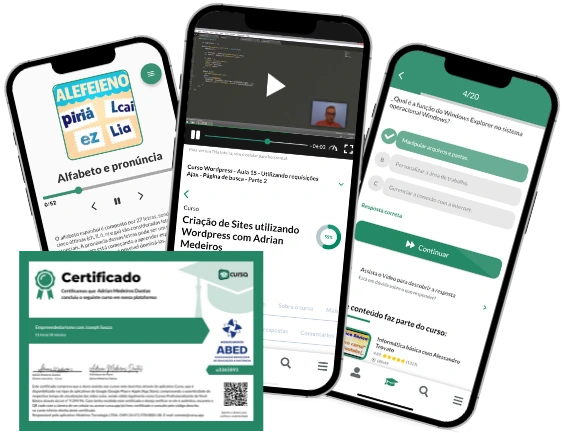
Carry knowledge in your pocket.
Download the Cursa app.
There are hundreds of free courses available, with a free certificate of completion that is saved in your mobile image gallery.
Download the app to access the Course Completion Certificate for Free.


+ 10 million
students

Free and Valid
Certificate

60 thousand free
exercises

4.8/5 rating in
app stores

Free courses in
video and ebooks