
Exercises
Put your advanced Portuguese knowledge to the test with this quiz on cultural and idiomatic expressions. Explore widely used Brazilian phrases such as “pé na jaca,” “de boas,” “comer com os olhos,” and “quebrar o galho.” You’ll identify meanings, translations, implied attitudes, and the situations where each expression fits naturally. From describing a person who talks too much to understanding expressions about expense, confidence, waiting, and adaptability, these questions will help you recognize the color and nuance of everyday Portuguese. Ideal for learners who want to move beyond literal translation and communicate with greater fluency and cultural awareness.
Answer the questions below and check the explanation for each answer.
0/10 answered
Auto audio on: the next questions will be read aloud when you click Continue.
The expression Pé na jaca literally translates to foot in the jackfruit, but it is used figuratively to describe someone who overindulges or engages in excessive behavior.
De boas means everything is fine or cool. It's used in informal contexts to express that everything is under control or that someone is relaxed.
The expression Comer com os olhos means to be visually tempted by food, or to be amazed by its appearance, literally translating to eat with your eyes.
The phrase Pau para toda obra implies that someone is versatile and can handle a variety of tasks or challenges, making them flexible and resourceful.
The expression Maria-vai-com-as-outras is used to describe someone who follows the crowd without thinking or questioning the actions they're following.
Chá de cadeira literally translates to tea (served) from a chair, but it means making someone wait for a long period, usually while sitting.
The expression Custar os olhos da cara is equivalent to costing an arm and a leg in English, indicating that something is very expensive.
The phrase Não está com essa bola toda suggests that someone or something is not as great as perceived, tempering expectations or overestimations.
Quebrar o galho means to find a workaround or an improvised solution to a problem, often with limited resources.
The expression Falar pelos cotovelos translates to talking through the elbows and is used to describe someone who talks excessively or incessantly.

Free CourseEuropean Portuguese
5

(2)

4h22m

9 exercises

Free CourseEuropean Portuguese for beginners
5
(3)
2h37m
25 exercises

Free CoursePortuguese listening
4.9
(116)
48m

Free CourseBrazilian portuguese
4.4

(37)
11h06m
1 exercises

Free CourseEuropean Portuguese for beginners
3
(2)
4h58m
3 exercises

Free CourseLearn Portuguese
1
(1)
3h49m
28 exercises

Free CourseBrazilian Portuguese basics
New
3h16m
19 exercises

Free CourseBrazilian Portuguese basics
New
8h41m
1 exercises
Thousands of online courses in video, ebooks and audiobooks.
To test your knowledge during online courses
Generated directly from your cell phone's photo gallery and sent to your email

Download our app via QR Code or the links below:.


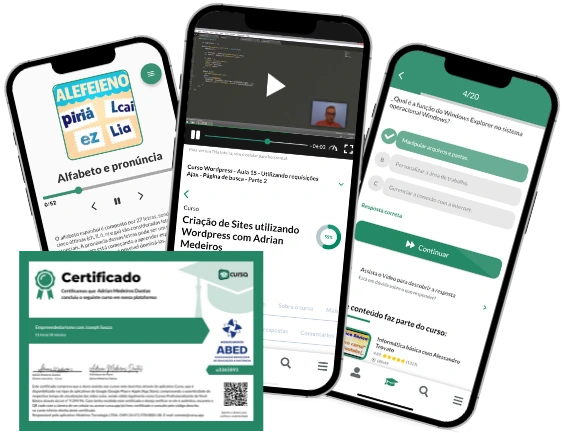
Carry knowledge in your pocket.
Download the Cursa app.
There are hundreds of free courses available, with a free certificate of completion that is saved in your mobile image gallery.
Download the app to access the Course Completion Certificate for Free.


+ 10 million
students

Free and Valid
Certificate

60 thousand free
exercises

4.8/5 rating in
app stores

Free courses in
video and ebooks