Exercises
Challenge your Polish grammar skills with this Polish Sentence Structure and Composition Test. Explore essential topics including standard word order, forming questions, subject-verb-object sentences, noun-adjective agreement, and verb forms. Practice using the nominative, accusative and genitive cases, as well as correct prepositional phrases, plural nouns and negation. You will also work with practical translations such as “I am reading a book,” “They will visit us,” and “He does not see the car.” Whether you are a beginner building a foundation or a learner reviewing core Polish composition rules, this quiz is a helpful way to test your understanding and identify areas for improvement.
Answer the questions below and check the explanation for each answer.
0/10 answered
Auto audio on: the next questions will be read aloud when you click Continue.
In Polish, the most natural and common word order for conveying the sentence .I am reading a book. is Czytam książkę, dropping the pronoun as it is implied by the verb conjugation.
To form a question in Polish, the word order can often remain the same, but it's common to start with .czy. for yes-no questions. Therefore, Czy on jest nauczycielem? is a correct form.
In Polish, adjectives must agree in gender, number, and case with the nouns they modify. Since .róża. is feminine singular nominative, it requires the feminine form Czerwona róża.
The typical Polish sentence order for Oni nas odwiedzą aligns with the subject-verb-object structure, making it a clear and standard translation.
In Polish, the genitive case is used after negation. Therefore, Nie mam kota correctly uses the genitive to express 'I do not have a cat.'
The correct form of the verb 'to be' for 'we' is jesteśmy in the present tense, making My jesteśmy studentami the right choice.
In Polish, the genitive case is used with negations. Therefore, On nie widzi samochodu correctly expresses the sentence.
The noun Dziewczyny is the correct nominative plural form in Polish for 'girls'.
For prepositional phrases indicating 'about', the correct form is o książce, meaning 'about the book', using the locative case.
The accusative case is used for direct objects in Polish, affecting the form of the adjective and the noun, thus Mam dużego psa is the correct usage.
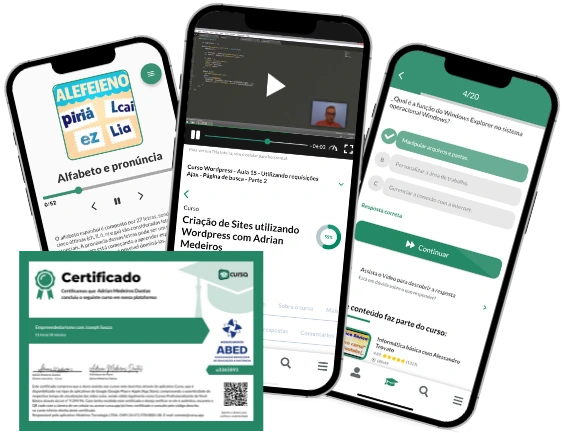
Thousands of online courses in video, ebooks and audiobooks.
To test your knowledge during online courses
Generated directly from your cell phone's photo gallery and sent to your email

Download our app via QR Code or the links below:.


Carry knowledge in your pocket.
Download the Cursa app.
There are hundreds of free courses available, with a free certificate of completion that is saved in your mobile image gallery.
Download the app to access the Course Completion Certificate for Free.


+ 10 million
students

Free and Valid
Certificate

60 thousand free
exercises

4.8/5 rating in
app stores

Free courses in
video and ebooks