
Exercises
Explore the essential components and functions of a central processing unit (CPU) with this educational quiz. Test your understanding of how the control unit directs operations, how the arithmetic logic unit (ALU) processes calculations, and why registers and cache are vital for fast data access. Questions also cover the program counter, instruction decoding, multicore processors, clock speed, pipelining, and CPU data buffers. Whether you are learning computer architecture for the first time or reviewing core hardware concepts, this quiz is a practical way to check your knowledge of how a CPU executes instructions and processes data.
Answer the questions below and check the explanation for each answer.
0/10 answered
Auto audio on: the next questions will be read aloud when you click Continue.
The primary function of the CPU's control unit is to manage the execution of instructions. It directs the operation of the processor by interacting with the Arithmetic Logic Unit (ALU), memory, and input/output devices to ensure instructions are processed correctly and efficiently.
The Arithmetic Logic Unit (ALU) is the component of the CPU responsible for performing arithmetic operations such as addition, subtraction, multiplication, and division. It also performs logical operations. The Control Unit (CU) does not perform arithmetic operations; it directs the operation of the processor. Cache Memory is used for storing frequently accessed data to speed up processing, not for performing arithmetic operations.
Registers are small storage locations within the CPU designed to provide temporary storage for immediate data processing. They allow the processor to access and manipulate data quickly and efficiently during computations, enhancing the CPU's performance by minimizing the need to fetch data from main memory repeatedly.
Cache in CPU architecture refers to high-speed storage that allows for quick access to frequently used data and instructions. It is a smaller, faster memory component located inside or close to the CPU to improve processing efficiency.
The program counter is a CPU register that serves a critical role in the execution of programs. It holds the address of the next instruction that needs to be executed, ensuring the CPU processes instructions in the correct sequence.
Option 1 is incorrect because the program counter doesn't count programs. Option 3 is incorrect as adjusting fan speed is related to hardware management rather than instruction processing.
A CPU with multiple cores can perform more than one task simultaneously. Each core can handle its own task, allowing for efficient multitasking and parallel processing, which enhances overall performance. This is especially beneficial for running multiple applications at the same time or handling complex computing tasks.
The CPU component responsible for decoding fetched instructions is the decoder. The decoder takes the binary instruction and translates it into signals that can initiate various activities within the processor, effectively transforming the fetch stage input into the appropriate control signals for the execution phase.
Clock speed refers to the rate at which a CPU can execute instructions. Measured in hertz (Hz), it indicates how many cycles per second a CPU can perform. A higher clock speed means more instructions can be processed per second, contributing to faster performance.
Pipelining is a technique used in CPU design to improve the overall processing speed by allowing the execution of multiple instructions simultaneously. This is achieved by dividing the instruction execution process into separate stages, each handled by different parts of the CPU pipeline. As one instruction completes a stage, another instruction can enter it, resulting in more efficient utilization of CPU resources and faster processing.
The Registers in a CPU act as a 'waiting area' for data that will be processed by the Arithmetic Logic Unit (ALU). They provide a small amount of temporary storage to hold the operands and results of ALU operations. This enables quicker access than retrieving the data from the main memory.
Thousands of online courses in video, ebooks and audiobooks.
To test your knowledge during online courses
Generated directly from your cell phone's photo gallery and sent to your email

Download our app via QR Code or the links below:.


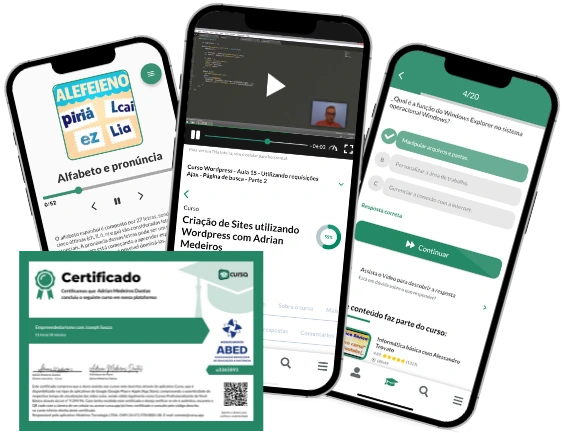
Carry knowledge in your pocket.
Download the Cursa app.
There are hundreds of free courses available, with a free certificate of completion that is saved in your mobile image gallery.
Download the app to access the Course Completion Certificate for Free.


+ 10 million
students

Free and Valid
Certificate

60 thousand free
exercises

4.8/5 rating in
app stores

Free courses in
video and ebooks