
Exercises
Build practical command of the standard four-string bass fretboard. This quiz tests open-string tuning, natural and accidental notes, octave shapes, unisons, and common intervals across and along the strings. Questions range from basic note identification to applying interval formulas in useful playing positions.
Answer the questions below and check the explanation for each answer.
0/14 answered
Auto audio on: the next questions will be read aloud when you click Continue.
Standard four-string bass tuning is E–A–D–G from the thickest, lowest-pitched string to the thinnest, highest-pitched string.
Each fret raises the pitch by one semitone. Moving five semitones above open E produces A, matching the pitch of the open A string.
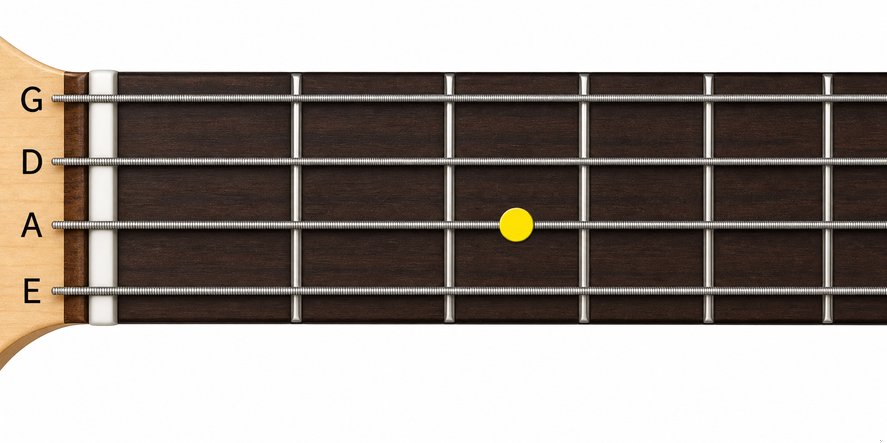
The marker is at the third fret of the A string. The notes rise A, B-flat, B, then C across the first three frets.
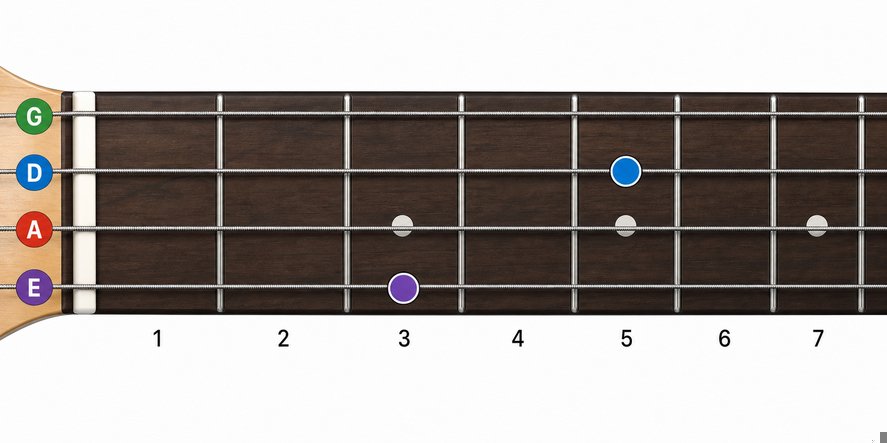
The third fret of the E string and fifth fret of the D string both produce C in different registers. Their pitch relationship is one octave.
B–C and E–F are each one semitone apart, so their notes occupy adjacent fret positions. Other neighboring natural notes are usually two frets apart.
Seven frets equal seven semitones, which form a perfect fifth. The seventh fret of the A string is E.
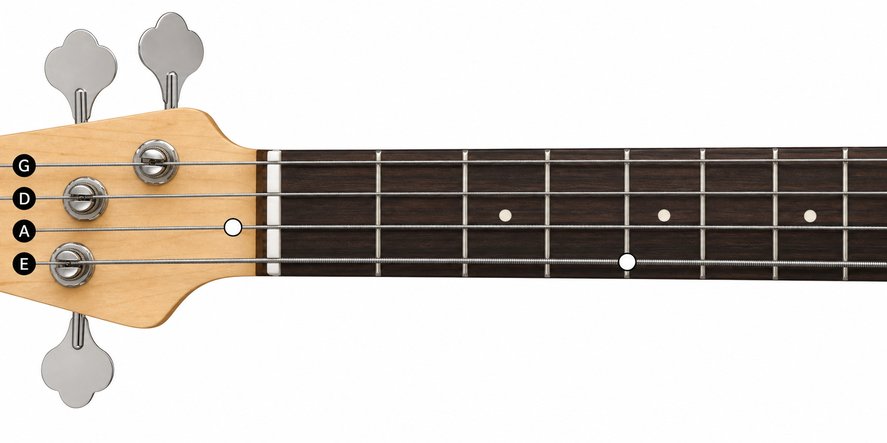
The fifth fret of the E string and the open A string produce the same A at the same pitch. This relationship is a unison.
Twelve frets equal twelve semitones, or one octave. Therefore, each note at the twelfth fret has the same letter name as its open string.
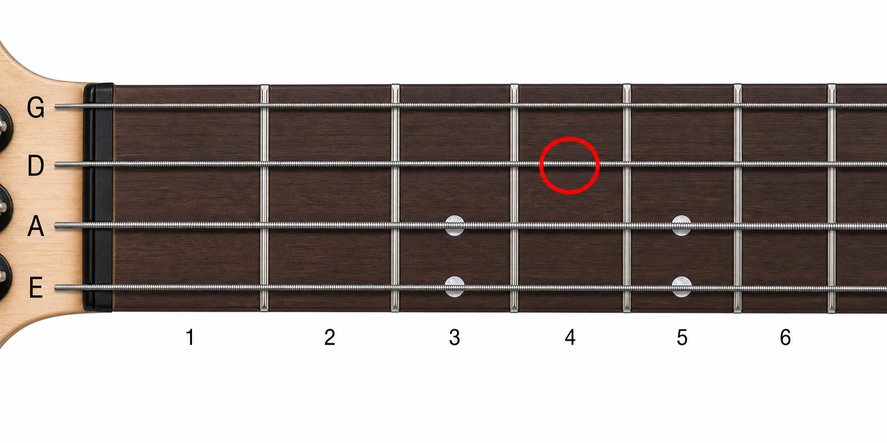
Starting from open D, four frets ascend through E-flat, E, F, and F-sharp. The same pitch can also be named G-flat.
One fret raises a note by one semitone. One semitone above G is G-sharp, which is enharmonically equivalent to A-flat.
The major third of C is E. On a standard-tuned bass, E is found at the second fret of the D string.
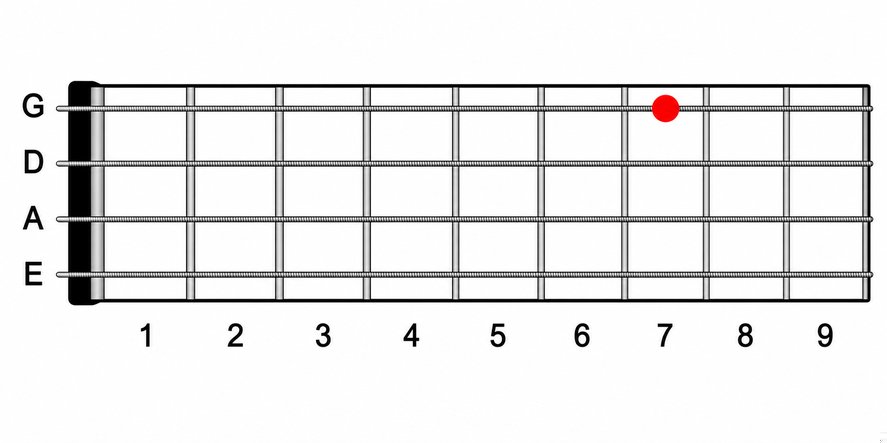
Counting seven semitones above open G reaches D. This note is a perfect fifth above G.
Four frets represent four semitones. The interval from G to B is therefore a major third.
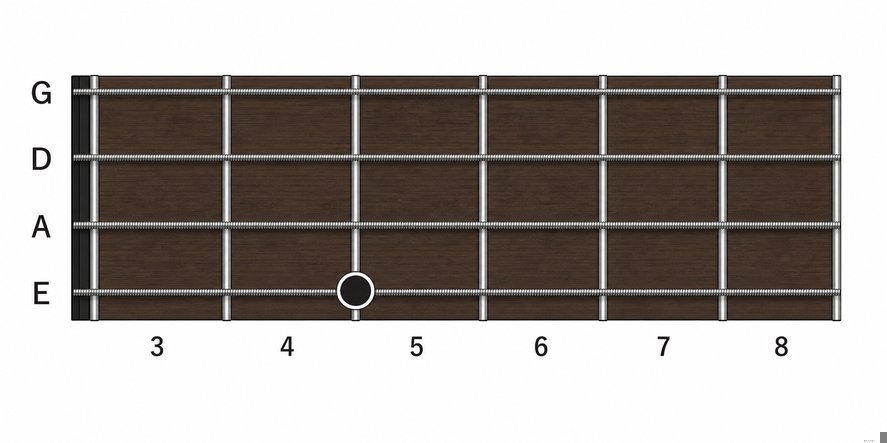
The perfect fifth above A is E. A common bass shape places that E two frets higher on the next thinner string: the seventh fret of the A string.

Free CourseBeginner Bass Lesson
5

(1)

22m

4 exercises

Free CourseBass
4.6

(22)
10h49m
47 exercises

Free CourseBass lessons
New
1h29m
20 exercises

Free CourseBeginner Bass lessons
New
8h45m
29 exercises
Free CourseMusic theory for Bass Guitar
New
15h15m
30 exercises

Free CourseBeginner Bass Guitar
New
1h12m
6 exercises

Free CourseBeginner Bass Lessons
New
2h32m
32 exercises
Thousands of online courses in video, ebooks and audiobooks.
To test your knowledge during online courses
Generated directly from your cell phone's photo gallery and sent to your email

Download our app via QR Code or the links below:.



Carry knowledge in your pocket.
Download the Cursa app.
There are hundreds of free courses available, with a free certificate of completion that is saved in your mobile image gallery.
Download the app to access the Course Completion Certificate for Free.


+ 10 million
students

Free and Valid
Certificate

60 thousand free
exercises

4.8/5 rating in
app stores

Free courses in
video and ebooks