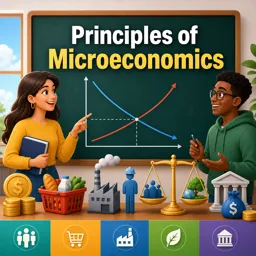


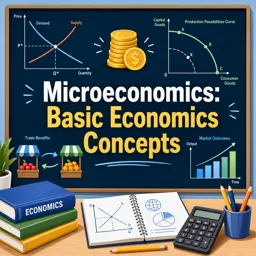

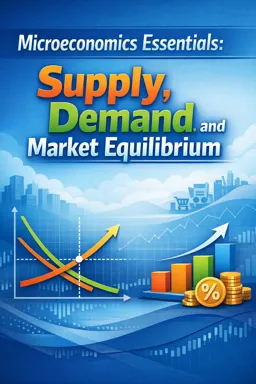
Microeconomics studies how individuals, households, and businesses make decisions about scarce resources, prices, and markets.

2

1


Opportunity Cost and Trade-Off Thinking: The Economics Skill That Improves Every Decision
Learn how opportunity cost and trade-off thinking improve decisions in money, time, and career planning with practical examples and frameworks.

An Introduction to Microeconomics: Understanding Individual Choices
Learn the basics of microeconomics, including supply and demand, elasticity, market structures, and consumer choice, to understand individual economic decisions.

Elasticity in Microeconomics: Measuring Responsiveness in Markets
Learn about elasticity in microeconomics, including price, income, and cross-price elasticity, and how it affects markets, pricing, and policy decisions.

How Market Structures Shape Microeconomic Outcomes
Explore how different market structures—perfect competition, monopoly, oligopoly, and monopolistic competition—impact pricing, efficiency, and consumer choice.

The Role of Supply and Demand in Microeconomics
Explore the basics of supply and demand in microeconomics and learn how they determine prices, market equilibrium, and resource allocation.
Explore our selection of free online Microeconomics courses designed for students, professionals, entrepreneurs, and anyone interested in understanding how individuals, households, and firms make economic decisions. These educational courses provide accessible learning opportunities, practical exercises, and free certification to help you develop valuable economic analysis skills at your own pace.
Microeconomics examines how limited resources are allocated and how choices influence markets. Through structured lessons, you can study fundamental topics such as supply and demand, opportunity cost, scarcity, consumer behavior, production, market equilibrium, elasticity, pricing, and resource allocation. The courses also introduce the economic reasoning used to evaluate incentives, competition, and business decisions.
Every course in this Microeconomics learning collection is free and includes educational content that supports independent study. The courses include exercises that reinforce core concepts, test your understanding, and encourage the practical application of economic models. After meeting the course requirements, you can also obtain free certification, providing a useful record of your learning and professional development.
These online Microeconomics courses are suitable for beginners, university students, business learners, job seekers, and professionals seeking continuing education. They can support academic preparation in economics, finance, administration, accounting, public policy, and entrepreneurship while strengthening analytical thinking and decision-making abilities.
To access and study these free Microeconomics courses, it is necessary to install the Cursa application. Android users can install it through Google Play using Download for Android. iPhone users can install it through the App Store using Download for iOS / iPhone.
Choose a course, complete the lessons and exercises, and expand your knowledge of markets, consumers, firms, and economic policy. Begin your free online education today and earn free certification while building practical Microeconomics skills.
What is microeconomics?
Microeconomics studies how individuals, households, and businesses make decisions about scarce resources, prices, and markets.
What will I learn in a Principles of Microeconomics course?
You will learn core ideas such as supply and demand, consumer choice, production costs, competition, and market efficiency.
Do I need prior economics knowledge to study microeconomics?
No. Introductory microeconomics courses usually begin with basic economic concepts and require no previous economics background.
What are supply and demand in microeconomics?
Supply is the amount producers are willing to sell, while demand is the amount consumers are willing to buy at different prices.
What is market equilibrium?
Market equilibrium occurs when the quantity supplied equals the quantity demanded, creating an equilibrium price and quantity.
Why is microeconomics important?
Microeconomics helps explain everyday choices, business pricing decisions, competition, taxes, and the effects of government policies on markets.
What is the difference between microeconomics and macroeconomics?
Microeconomics focuses on individual consumers, firms, and specific markets, while macroeconomics examines the overall economy, including inflation, unemployment, and economic growth.

Complete any course and issue your certificate via the app — at no cost.

Download the app! to have access to more than 4,000 Online Courses + Certificate, all free!
Download the app! 100% free courses.


Carry knowledge in your pocket.
Download the Cursa app.
There are hundreds of free courses available, with a free certificate of completion that is saved in your mobile image gallery.
Download the app to access the Course Completion Certificate for Free.


+ 10 million
students

Free and Valid
Certificate

60 thousand free
exercises

4.8/5 rating in
app stores

Free courses in
video and ebooks

What are people saying about free online courses of Microeconomics
Anas Aljofi
Thanks from the bottom of my heart ❤️. great job continuing your support for us.
CoursePrinciples of Microeconomics