Bitcoin uses a public transaction ledger, digital signatures, and proof-of-work consensus to make the network agree on one valid transaction history.

Duration of the online course: 11 hours and 8 minutes
New
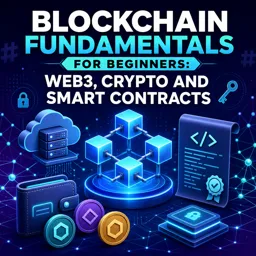
Build Web3-ready skills fast with a free blockchain course—learn crypto basics, consensus, and smart contracts, plus quizzes to earn a certificate.
Blockchain is more than buzzwords. It is a practical set of ideas that power cryptocurrencies, decentralized applications, and new ways for networks to agree on truth without a central authority. This free online course helps you move from vague concepts to clear understanding, so you can talk about Web3 with confidence and evaluate real-world use cases in tech, finance, and cloud-based systems.
You will start by connecting the history of blockchain technology to the core problem it set out to solve: establishing trust on the internet when participants may not trust each other. From there, you will build the cryptographic foundations that make blockchains work, including public-key cryptography and hashing. You will learn why these tools matter, how they are used to secure ownership, and how tamper-evidence is achieved when blocks are linked together through hash pointers and structures like Merkle trees.
As you progress, the course explains decentralization and why consensus is challenging in open networks. You will explore proof of work and mining, including what makes a block valid and how incentives keep the system running. You will also examine cryptocurrency mechanics and networking basics, making sense of transaction verification models, propagation across peer-to-peer networks, and what it really means to own digital assets such as BTC.
To help you understand the broader ecosystem, the course discusses privacy and why many popular chains are pseudonymous rather than fully anonymous. You will compare alternative proof-of-work approaches and learn why memory-hard designs can influence hardware advantages. You will then move into proof of stake and key ideas used to reduce attacks such as nothing at stake, highlighting the tradeoffs modern networks consider.
Finally, you will see blockchain as a platform for applications. You will examine why certain app features, like randomness, are hard to achieve on-chain, and how sidechains and cross-chain communication attempt to connect separate networks securely. You will also get a practical introduction to smart contracts in Ethereum, including the role of gas in preventing infinite execution and how core language features support data management. Short exercises throughout reinforce understanding and help you build vocabulary and intuition that transfer to product work, engineering discussions, and further specialization.

11 hours and 8 minutes of online video course

Digital certificate of course completion (Free)

Exercises to train your knowledge

100% free, from content to certificate
How does Bitcoin prevent double spending without a bank?
Bitcoin uses a public transaction ledger, digital signatures, and proof-of-work consensus to make the network agree on one valid transaction history.
What is the difference between proof of work and proof of stake?
Proof of work selects block producers through computational effort, while proof of stake selects validators based on locked cryptocurrency and protocol rules.
How do Ethereum smart contracts avoid running forever?
Ethereum charges gas for computation. When a contract exhausts its gas limit, execution stops and the transaction fails or reverts.
Ready to get started?Download the app and get started today.
Install the app now
to access the course
Over 5,000 free courses
Programming, English, Digital Marketing and much more! Learn whatever you want, for free.

Study plan with AI
Our app's Artificial Intelligence can create a study schedule for the course you choose.

From zero to professional success
Improve your resume with our free Certificate and then use our Artificial Intelligence to find your dream job.
You can also use the QR Code or the links below.



Free CourseCompTIA Network N10-009 Complete Training and Exam Prep Course
5

(1)

12h54m

43 exercises
Free CourseCCNA 200-301 Full Course: Cisco Networking Fundamentals, Labs and Exam Prep
5
(2)
32h34m
46 exercises

Free CourseComputer Networking
5
(4)
4h01m
40 exercises
Free CourseNetworking Fundamentals
5
(1)
3h25m
15 exercises

Free CourseFoundations of IT support
5
(6)
4h48m
11 exercises

Free CourseWindows server 2012
5
(26)
9h15m
29 exercises
Free CourseActive Directory
5
(22)
14h51m
36 exercises

Free CourseCloud computing - beginner to advance
4.9
(17)
51h10m
5 exercises

Free CourseMicrosoft Azure Fundamentals (AZ-900) Full Course
4.9
(7)
7h15m
30 exercises
Free CourseCCNA 200-301 complete
4.8
(34)
44h20m
24 exercises
Carry knowledge in your pocket.
Download the Cursa app.
There are hundreds of free courses available, with a free certificate of completion that is saved in your mobile image gallery.
Download the app to access the Course Completion Certificate for Free.


+ 10 million
students

Free and Valid
Certificate

60 thousand free
exercises

4.8/5 rating in
app stores

Free courses in
video and ebooks