


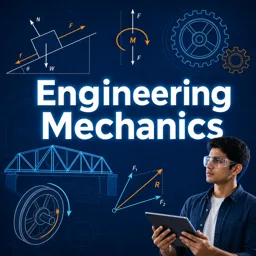
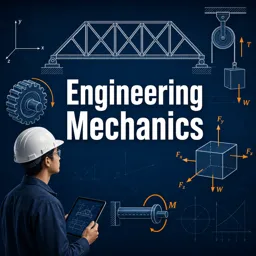
Engineering Mechanics studies how forces, motion, and loads affect bodies and structures.

3


Exercises
Test your machine design fundamentals knowledge, including gears, shafts, stresses, materials, bearings, flywheels, and belt drives.
Start exercisesTest your engineering knowledge of control systems, feedback, PID controllers, stability, damping, sensors, and system analysis.
Start exercisesTest your solid mechanics knowledge of stress, strain, elasticity, beam bending, shear forces, material failure, ductility, creep, and toughness.
Start exercisesTest your engineering mechanics knowledge with questions on forces, free-body diagrams, statics, Newton’s laws, energy, Hooke’s Law and SI units.
Start exercisesTest your classical mechanics knowledge with questions on motion, forces, work, collisions, vectors, graphs, and gravity.
Start exercises
Applications of Robotics and Mechatronics in Modern Industry
Discover how robotics and mechatronics revolutionize modern industry with applications in automation, quality control, and collaborative robotics.

Fundamentals of Actuators and Sensors in Robotics and Mechatronics
Learn the fundamentals of actuators and sensors in robotics and mechatronics, from types and functions to their integration in intelligent systems.

Introduction to Robotics and Mechatronics: Exploring the Future of Engineering
Discover how robotics and mechatronics are driving innovation in engineering and learn the skills needed for a successful career in these fields.

Robotic Control Systems: Integrating Intelligence in Mechatronic Design
Discover how robotic control systems integrate intelligence into mechatronic design, driving automation and innovation in engineering.

Understanding the Basics of Fluid Mechanics: Principles and Applications
Learn the core principles and real-world applications of fluid mechanics—essential knowledge for engineers across civil, mechanical, chemical, and aerospace fields.

The Role of Fluid Mechanics in Modern Engineering Systems
Discover how fluid mechanics powers modern engineering—from aircraft and HVAC to water systems—bridging theory, design, and real-world impact.

Essential Equations and Laws in Fluid Mechanics: A Practical Guide
Explore the core fluid mechanics equations—continuity, Bernoulli, Pascal, and Reynolds—and their essential role in modern engineering applications.

Advanced Fluid Flow Analysis: Exploring Laminar and Turbulent Flows
Explore the differences between laminar and turbulent flows, and how mastering them helps engineers design efficient systems across industries.
Develop essential technical knowledge with our selection of free online Engineering Mechanics courses. These educational courses are designed for engineering students, technicians, educators, and independent learners who want to study forces, motion, equilibrium, structures, and mechanical systems. Learn at your own pace through organized lessons, practical exercises, and accessible study materials.
Engineering Mechanics applies mathematical and physical principles to the analysis of objects and systems. The courses introduce fundamental concepts and advance toward practical problem-solving methods used in civil, mechanical, structural, aerospace, and industrial engineering. Depending on the selected course, you can study statics, dynamics, kinematics, kinetics, vectors, moments, friction, centroids, and mechanical equilibrium.
These Engineering Mechanics courses include exercises that help reinforce theory and develop analytical reasoning. Practice identifying forces, creating free-body diagrams, calculating reactions, and solving equilibrium or motion problems. The exercises support academic revision, professional development, technical training, and preparation for engineering examinations.
All courses listed on this page are free and also offer free certification. After completing an eligible course, learners can obtain a certificate to document their educational progress, strengthen a résumé, support university activities, or demonstrate continued professional learning.
To access the free Engineering Mechanics courses, lessons, exercises, and free certificates, it is necessary to install the Cursa application. Android users can install it through Google Play: Download for Android. iPhone users can install it through the App Store: Download for iOS / iPhone.
Choose a course, follow the educational content, complete the exercises, and expand your understanding of engineering analysis. Begin your free online learning journey today and build a stronger foundation for further study or a technical career.
What is Engineering Mechanics?
Engineering Mechanics studies how forces, motion, and loads affect bodies and structures.
What topics are covered in an Engineering Mechanics course?
Typical topics include statics, dynamics, force systems, equilibrium, friction, moments, and basic particle motion.
Is Engineering Mechanics difficult for beginners?
It can be challenging because it uses algebra, trigonometry, and physics, but step-by-step practice makes it manageable.
What math is needed for Engineering Mechanics?
Students should be comfortable with algebra, geometry, trigonometry, vectors, and basic calculus.
What is the difference between statics and dynamics?
Statics analyzes bodies in equilibrium, while dynamics examines bodies that are moving or accelerating.
Why is Engineering Mechanics important in engineering?
It helps engineers calculate forces and motion to design safe, stable, and efficient machines, structures, and components.
Who should take an online Engineering Mechanics course?
It is suitable for mechanical, civil, aerospace, and other engineering students, as well as learners building physics-based design skills.

Complete any course and issue your certificate via the app — at no cost.

Download the app! to have access to more than 4,000 Online Courses + Certificate, all free!
Download the app! 100% free courses.


Carry knowledge in your pocket.
Download the Cursa app.
There are hundreds of free courses available, with a free certificate of completion that is saved in your mobile image gallery.
Download the app to access the Course Completion Certificate for Free.


+ 10 million
students

Free and Valid
Certificate

60 thousand free
exercises

4.8/5 rating in
app stores

Free courses in
video and ebooks


What are people saying about free online courses of Engineering Mechanics
Clementinah Nkhabanyane
best course I did today
CourseMechanical - Metal Casting