Modern physics studies physical theories developed in the 20th century and beyond, including quantum mechanics, relativity, atomic physics, nuclear physics, and cosmology.

7


Free CourseModern Physics
New

11h56m

6 exercises
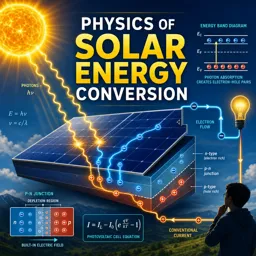
Free CoursePhysics of Solar Energy Conversion
5

(4)
4h59m
16 exercises
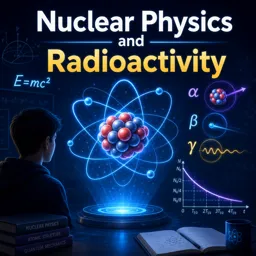
Free CourseNuclear Physics and Radioactivity
New
1h24m
4 exercises
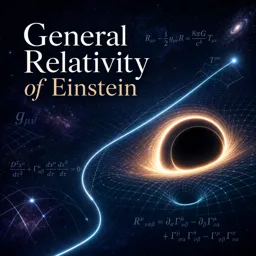
Free CourseGeneral Relativity of Einstein
New
30h22m
8 exercises
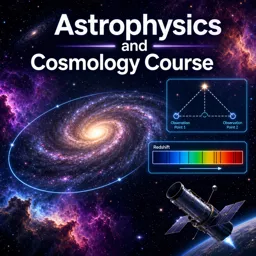
Free CourseAstrophysics and Cosmology Course
5
(1)
1h24m
5 exercises
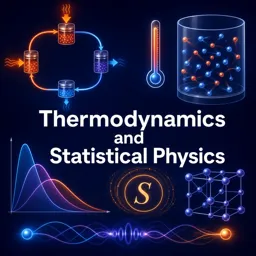
Free CourseThermodynamics and Statistical Physics
5
(1)
14h53m
23 exercises
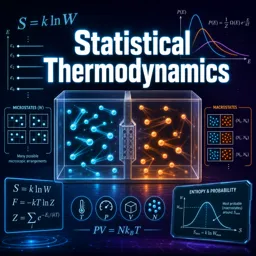
Free CourseStatistical Thermodynamics
New
3h52m
39 exercises
Explore free online Modern Physics courses designed for students, educators, science enthusiasts, and lifelong learners. This educational course collection introduces the theories and discoveries that transformed our understanding of matter, energy, space, and time. Study at your own pace through accessible lessons that support school learning, university preparation, academic revision, and professional development.
Modern Physics extends beyond classical mechanics to examine physical phenomena at atomic, subatomic, and cosmic scales. These free courses provide structured educational content on quantum mechanics, relativity, nuclear physics, particle physics, atomic theory, wave-particle duality, and other important topics. Learners can strengthen their scientific reasoning while developing a clearer understanding of the mathematical models and experimental evidence behind contemporary physics.
Every learner can access these free Modern Physics courses without paying tuition. The courses include exercises that help reinforce theoretical knowledge, improve problem-solving skills, and prepare students for academic assessments. They also offer free certification, allowing you to document your learning and add a valuable educational achievement to your resume, academic portfolio, or professional profile.
This collection is suitable for high school and university students, teachers seeking supplementary teaching resources, and anyone interested in science education. Whether you are beginning with fundamental concepts or reviewing advanced subjects, online learning provides the flexibility to study whenever and wherever you prefer.
To access the lessons, exercises, and free certificates, it is necessary to install the Cursa application. Android users can get it from Google Play through Download for Android. iPhone users can install it from the App Store through Download for iOS / iPhone.
Start studying today and build a stronger foundation in Modern Physics with free educational resources, practical exercises, flexible online learning, and free certification.
What is modern physics?
Modern physics studies physical theories developed in the 20th century and beyond, including quantum mechanics, relativity, atomic physics, nuclear physics, and cosmology.
What topics are covered in an online modern physics course?
Courses commonly cover special and general relativity, quantum phenomena, atoms, nuclei, radioactivity, particles, and applications in astronomy and energy.
Can I learn Einstein’s general relativity online?
Yes. Online general relativity courses explain spacetime, gravity as curvature, black holes, gravitational waves, and cosmological models.
What will I learn in a nuclear physics and radioactivity course?
You can learn about nuclear structure, radioactive decay, half-life, fission, fusion, radiation detection, and nuclear energy applications.
How is modern physics used in solar energy conversion?
Modern physics explains how photons interact with semiconductor materials in solar cells, enabling the conversion of sunlight into electrical energy.
What is the difference between astrophysics and cosmology?
Astrophysics applies physics to stars, planets, galaxies, and other celestial objects, while cosmology studies the origin, evolution, and large-scale structure of the universe.
Why are thermodynamics and statistical physics important in modern physics?
They connect microscopic particle behavior with measurable properties such as temperature, entropy, energy, phase changes, and heat transfer.

Complete any course and issue your certificate via the app — at no cost.

Download the app! to have access to more than 4,000 Online Courses + Certificate, all free!
Download the app! 100% free courses.


Carry knowledge in your pocket.
Download the Cursa app.
There are hundreds of free courses available, with a free certificate of completion that is saved in your mobile image gallery.
Download the app to access the Course Completion Certificate for Free.


+ 10 million
students

Free and Valid
Certificate

60 thousand free
exercises

4.8/5 rating in
app stores

Free courses in
video and ebooks