


You will study stars, galaxies, black holes, planetary systems, radiation, and the physical laws that govern the universe.

2



Understanding General Relativity: A Beginner’s Guide
A beginner-friendly guide to Einstein’s General Relativity, explaining spacetime curvature, key effects, and its importance for science and technology.

The Key Concepts of Einstein’s General Relativity Explained
Explore Einstein’s General Relativity, its core concepts of spacetime curvature, key predictions, and vital role in technology and astrophysics.

Gravity Redefined: The Essence of General Relativity
Discover how Einstein’s General Relativity redefines gravity as curved spacetime, its key predictions, and its vast impact on science and technology.

Exploring the Foundations and Impact of Einstein’s General Relativity
Explore Einstein’s General Relativity, its revolutionary view of gravity as spacetime curvature, key confirmations, and impact on modern science and technology.

The Role of Black Holes in Astrophysics: Gateways to Extreme Physics
Descubra como os buracos negros moldam o universo e revelam os limites da física moderna, conectando relatividade, cosmologia e tecnologia.

Key Concepts in Astrophysics: Exploring Stars, Galaxies, and Cosmic Phenomena
Explore estrelas, galáxias e fenômenos cósmicos e descubra como a astrofísica revela os segredos do universo por meio da ciência e da observação.

How Telescopes Revolutionized Astrophysics: Gazing Deeper Into the Cosmos
Telescopes transformed astrophysics by expanding our view of the universe and unlocking discoveries from galaxies to black holes.
Explore the universe through free online Astrophysics courses designed for students, educators, science enthusiasts, and lifelong learners. Develop your knowledge of stars, planets, galaxies, black holes, cosmology, and the physical laws that shape space. These educational courses support independent learning with accessible lessons, structured study materials, practical exercises, and free certification.
Build a strong foundation in astronomical science while studying at your own pace. The course collection may cover introductory astronomy, classical mechanics, gravity, electromagnetism, thermodynamics, relativity, quantum physics, stellar evolution, planetary science, observational astronomy, and modern cosmology. Whether you are beginning your science education or expanding existing academic skills, these free courses offer flexible learning opportunities.
Each learning pathway is intended to encourage active study. The courses include exercises that help reinforce scientific concepts, review essential terminology, and assess your understanding. After completing an eligible course, you can also receive free certification to document your educational progress, strengthen your academic portfolio, or demonstrate your commitment to continuing education.
These online classes are suitable for beginners, high school and university students, teachers seeking complementary resources, and curious learners interested in space science. Study schedules are flexible, allowing you to review lessons and complete activities according to your availability.
To access the Astrophysics courses, complete the exercises, and obtain free certificates, you must install the Cursa application. Android users can install it through Google Play at Download for Android. Apple users can install it through the App Store at Download for iOS / iPhone.
Start learning today with free online Astrophysics courses and transform your curiosity about the cosmos into structured scientific knowledge.
What will I learn in an online astrophysics course?
You will study stars, galaxies, black holes, planetary systems, radiation, and the physical laws that govern the universe.
Is physics required to study astrophysics?
Yes. A basic understanding of algebra, calculus, mechanics, and electromagnetism is helpful, especially for advanced courses.
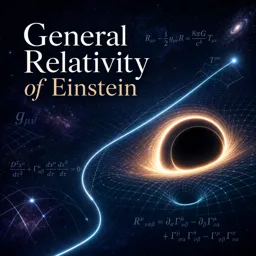
What is covered in a General Relativity of Einstein course?
It covers spacetime, gravity as curvature, Einstein’s field equations, black holes, gravitational waves, and cosmological applications.
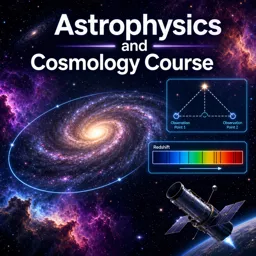
What topics are included in an astrophysics and cosmology course?
Typical topics include stellar evolution, galaxies, dark matter, dark energy, the Big Bang, and the expansion of the universe.
Can beginners take an astrophysics course online?
Yes. Introductory courses often explain core astronomical concepts before moving into mathematical models and advanced theory.
What is the difference between astrophysics and cosmology?
Astrophysics applies physics to celestial objects and processes, while cosmology focuses on the origin, structure, evolution, and fate of the universe.
Are black holes studied in astrophysics courses?
Yes. Courses commonly examine black hole formation, event horizons, accretion disks, relativity, and gravitational-wave observations.

Complete any course and issue your certificate via the app — at no cost.

Download the app! to have access to more than 4,000 Online Courses + Certificate, all free!
Download the app! 100% free courses.


Carry knowledge in your pocket.
Download the Cursa app.
There are hundreds of free courses available, with a free certificate of completion that is saved in your mobile image gallery.
Download the app to access the Course Completion Certificate for Free.


+ 10 million
students

Free and Valid
Certificate

60 thousand free
exercises

4.8/5 rating in
app stores

Free courses in
video and ebooks