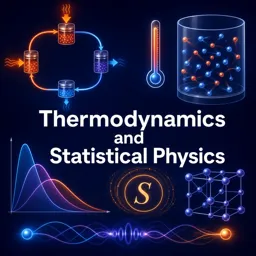


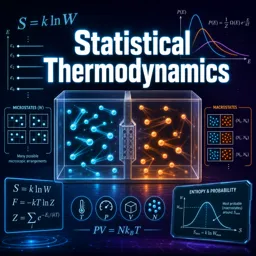
Statistical physics explains the macroscopic behavior of matter by using probability and the collective behavior of many particles.

2



Exploring Ensembles in Statistical Physics: Microcanonical, Canonical, and Grand Canonical Approaches
Ensembles link microscopic behavior to macroscopic laws in physics. Learn how microcanonical, canonical, and grand canonical ensembles model real systems.

Introduction to Statistical Physics: Bridging Microscales and Macroscales
Statistical physics connects microscopic randomness with macroscopic order, explaining phase changes, entropy, and material behavior through probability.

Key Concepts and Applications of Statistical Physics
Statistical physics explains macroscopic phenomena using probabilities of microscopic states, with broad applications from physics to biology.

The Role of Probability in Statistical Physics: From Randomness to Predictability
Probability explains how microscopic randomness leads to predictable macroscopic behavior in statistical physics and beyond.
Explore our selection of free online Statistical Physics courses designed for students, educators, researchers, and anyone interested in understanding how microscopic interactions produce macroscopic physical phenomena. These educational courses combine theoretical lessons, practical examples, and exercises to support effective learning at your own pace.
Statistical Physics connects mechanics, probability, thermodynamics, and mathematics to explain the behavior of systems containing large numbers of particles. Through these free courses, learners can study essential concepts such as statistical ensembles, entropy, temperature, phase transitions, probability distributions, kinetic theory, and equilibrium systems. The lessons can complement university studies, strengthen academic preparation, or provide continuing education for professionals.
All listed courses are completely free and also offer free certification. A certificate can help document your educational progress, enrich your résumé, and demonstrate your commitment to learning Statistical Physics. The courses also include exercises that encourage problem-solving, concept review, mathematical reasoning, and practical application of the studied principles.
The content is suitable for undergraduate and graduate students, physics enthusiasts, teachers, engineering learners, and professionals seeking accessible educational resources. Previous knowledge of calculus, thermodynamics, classical mechanics, or probability may be useful for advanced lessons, while introductory options help new learners build a strong foundation.
To access the courses, exercises, and free certification, it is necessary to install the Cursa application. Android users can install it through Google Play at Download for Android. Apple users can install it through the App Store at Download for iOS / iPhone.
Choose a free Statistical Physics course, organize your study routine, complete the educational activities, and expand your knowledge of thermodynamics and Statistical Mechanics with flexible online learning.
What is statistical physics?
Statistical physics explains the macroscopic behavior of matter by using probability and the collective behavior of many particles.
What is the difference between thermodynamics and statistical physics?
Thermodynamics describes bulk properties such as heat, work, and entropy, while statistical physics derives these properties from microscopic particle behavior.
What will I learn in a Thermodynamics and Statistical Physics course?
You will study energy, entropy, temperature, thermodynamic laws, probability distributions, and the link between microscopic states and macroscopic properties.
What is statistical thermodynamics?
Statistical thermodynamics uses statistical methods to connect molecular-level states with thermodynamic quantities such as entropy, free energy, and heat capacity.
What are ensembles in statistical physics?
Ensembles are collections of possible states used to model systems, including the microcanonical, canonical, and grand canonical ensembles.
Why is entropy important in statistical physics?
Entropy measures the number of accessible microscopic arrangements and helps predict the natural direction of physical processes.
What prerequisites are useful for studying statistical physics?
Useful prerequisites include calculus, probability, basic mechanics, and introductory thermodynamics.

Complete any course and issue your certificate via the app — at no cost.

Download the app! to have access to more than 4,000 Online Courses + Certificate, all free!
Download the app! 100% free courses.


Carry knowledge in your pocket.
Download the Cursa app.
There are hundreds of free courses available, with a free certificate of completion that is saved in your mobile image gallery.
Download the app to access the Course Completion Certificate for Free.


+ 10 million
students

Free and Valid
Certificate

60 thousand free
exercises

4.8/5 rating in
app stores

Free courses in
video and ebooks