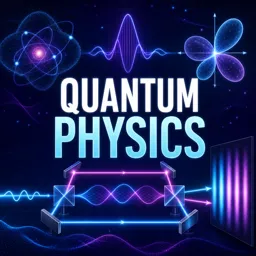


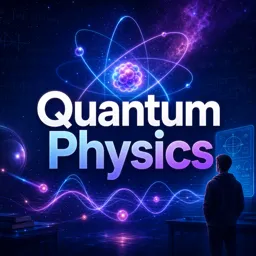
Quantum physics is the study of matter and energy at atomic and subatomic scales, where particles can behave like waves and outcomes are described by probabilities.

5

1

Explore free online Quantum Physics courses designed to support structured learning in one of the most fascinating areas of modern science. These educational courses introduce essential theories, mathematical methods, scientific experiments, and practical applications related to quantum mechanics. Study at your own pace, complete exercises to reinforce each lesson, and earn free certification after meeting the course requirements.
This course collection helps students develop knowledge of wave-particle duality, quantum states, probability amplitudes, uncertainty, atomic structure, energy quantization, and the behavior of matter at microscopic scales. Depending on the selected course, lessons may also address Schrödinger equations, operators, spin, quantum tunneling, entanglement, particle physics, and introductory quantum computing.
Quantum Physics education encourages analytical reasoning, mathematical interpretation, problem-solving, and a deeper understanding of contemporary science. The free lessons can benefit beginners seeking an introduction, students reviewing academic topics, and independent learners interested in advanced technologies. Exercises help transform theory into active learning, while free certification provides evidence of your educational progress.
To access and study these Quantum Physics courses, it is necessary to install the Cursa application. Android users can install it through Google Play by selecting Download for Android. Apple users can access the App Store by selecting Download for iOS / iPhone. After installation, browse the educational catalog, choose a Quantum Physics course, follow the lessons, answer the exercises, and complete the learning path to request free certification.
Choose a free online course and begin expanding your understanding of quantum theory today. With accessible lessons, educational exercises, flexible study options, and free certification, this collection offers a convenient way to develop scientific knowledge and support your academic, personal, or professional learning goals.
What is quantum physics?
Quantum physics is the study of matter and energy at atomic and subatomic scales, where particles can behave like waves and outcomes are described by probabilities.
Do I need advanced math to start learning quantum physics?
Basic algebra and calculus are helpful. More advanced courses may also use linear algebra, differential equations, and probability.
What topics are covered in an introductory quantum physics course?
Introductory courses commonly cover wave-particle duality, the Schrödinger equation, uncertainty, quantum states, tunneling, and atomic structure.
What is the difference between quantum physics and quantum mechanics?
Quantum physics is the broad field, while quantum mechanics is the mathematical framework used to describe quantum systems.
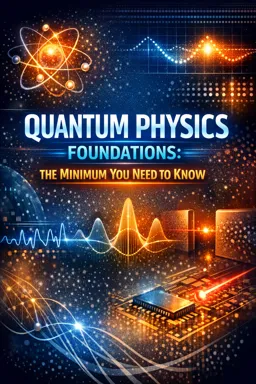
Can I study quantum physics foundations without a physics degree?
Yes. Foundation courses can introduce the essential concepts with minimal prerequisites, though mathematical preparation helps with deeper study.
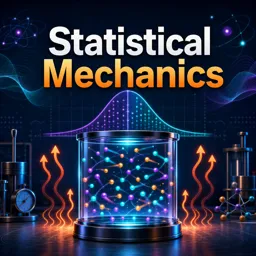
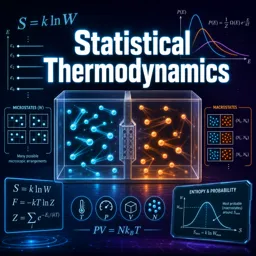
How is statistical mechanics related to quantum physics?
Statistical mechanics explains the collective behavior of many particles. Quantum statistical mechanics applies quantum rules to systems such as electrons, photons, and solids.
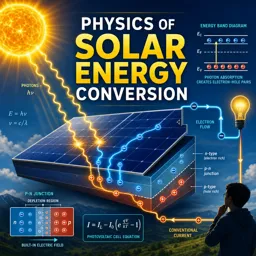
How does quantum physics relate to solar energy conversion?
Quantum physics explains how light interacts with electrons in materials, which is essential for understanding photovoltaic cells and solar energy conversion.

Complete any course and issue your certificate via the app — at no cost.

Download the app! to have access to more than 4,000 Online Courses + Certificate, all free!
Download the app! 100% free courses.


Carry knowledge in your pocket.
Download the Cursa app.
There are hundreds of free courses available, with a free certificate of completion that is saved in your mobile image gallery.
Download the app to access the Course Completion Certificate for Free.


+ 10 million
students

Free and Valid
Certificate

60 thousand free
exercises

4.8/5 rating in
app stores

Free courses in
video and ebooks