Stocks represent ownership and offer growth potential; bonds are loans that pay interest; ETFs hold baskets of investments; cash equivalents prioritize stability and liquidity.

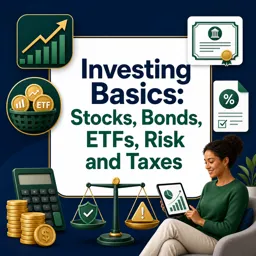
Duration of the online course: 1 hours and 44 minutes
New
Build confidence with a free investing course—learn stocks, bonds, ETFs, diversification, fees, taxes, and risk so you can start investing smarter.
Investing can feel intimidating when every headline sounds urgent and every product comes with jargon. This free online course helps you replace noise with clarity by grounding you in the essentials: how the main investment building blocks work, why markets behave the way they do, and how everyday decisions like costs, taxes, and risk management shape real results over time. If you want to move from guessing to making informed choices, this course offers a practical starting point.
You’ll explore what makes investing important for long-term goals and how diversification is meant to reduce the impact of surprises without pretending uncertainty disappears. The course walks through the core categories investors commonly use—bonds, stocks, and cash equivalents—so you can understand how each one can contribute to an overall plan, what kinds of returns they can provide, and the tradeoffs involved. Along the way, you’ll connect market concepts to intuitive examples, such as how changing interest rates affect existing bonds and why equity ownership can generate gains in more than one way.
To help you invest efficiently, the course explains managed solutions like mutual funds and ETFs, how rebalancing works in practice, and the difference between active and passive approaches so you can evaluate strategies on their merits rather than hype. You’ll also learn why fees matter more than many beginners realize and how fixed versus variable costs can quietly change your long-term outcome.
Because good investing isn’t only about picking assets, you’ll look at taxes and the role of registered or tax-advantaged accounts, plus what it means for an account to be tax-exempt. You’ll then bring everything together with a clear framework for getting started, including how consistent, automated contributions can support disciplined habits. Finally, behavioral finance highlights the common emotional patterns that lead people to buy high and sell low—so you can recognize these traps and build a process designed to outlast them.

1 hours and 44 minutes of online video course

Digital certificate of course completion (Free)

Exercises to train your knowledge

100% free, from content to certificate
How do stocks, bonds, ETFs, and cash equivalents differ in an investment portfolio?
Stocks represent ownership and offer growth potential; bonds are loans that pay interest; ETFs hold baskets of investments; cash equivalents prioritize stability and liquidity.
Why do existing bond prices usually fall when interest rates rise?
New bonds offer higher interest payments, making older lower-rate bonds less attractive unless their market price declines.
How can diversification reduce investment risk?
By spreading investments across companies, sectors, and regions, diversification helps reduce the impact of a single investment or market area performing poorly.
Ready to get started?Download the app and get started today.
Install the app now
to access the course
Over 5,000 free courses
Programming, English, Digital Marketing and much more! Learn whatever you want, for free.

Study plan with AI
Our app's Artificial Intelligence can create a study schedule for the course you choose.

From zero to professional success
Improve your resume with our free Certificate and then use our Artificial Intelligence to find your dream job.
You can also use the QR Code or the links below.



Video Courses










Exercises
Test your knowledge of bond prices, yields, duration, convexity, credit spreads, and interest-rate risk.
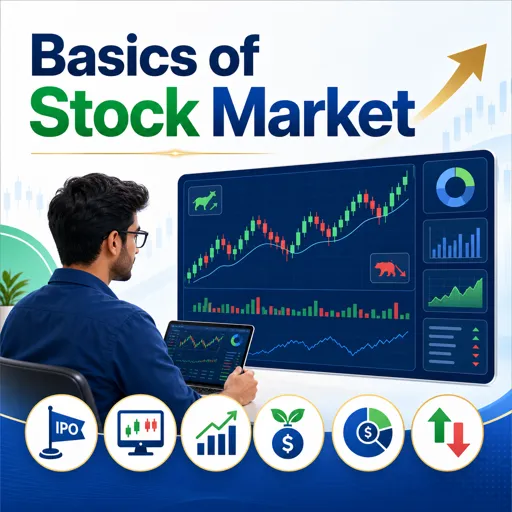
Start exercisesTest your stock market basics knowledge: stocks, IPOs, dividends, P/E ratios, liquidity, bear markets, blue-chip stocks, and market capitalization.
Start exercisesTest your knowledge of investment market analysis, including fundamental, technical, sentiment analysis, market trends, and economic indicators.
Start exercisesEbooks and audiobooks
Carry knowledge in your pocket.
Download the Cursa app.
There are hundreds of free courses available, with a free certificate of completion that is saved in your mobile image gallery.
Download the app to access the Course Completion Certificate for Free.


+ 10 million
students

Free and Valid
Certificate

60 thousand free
exercises

4.8/5 rating in
app stores

Free courses in
video and ebooks