

Rust is used to build fast, reliable software such as systems tools, web services, command-line applications, embedded software, and performance-critical applications.

4



Concurrency in Rust: Building Safe and Fast Multithreaded Applications
Discover how Rust’s concurrency model ensures safe and efficient multithreaded programming with compile-time guarantees and powerful abstractions.

Getting Started with Rust: A Modern Approach to Systems Programming
Learn how to get started with Rust, the fast and memory-safe programming language transforming systems development, from setup to real-world use cases.

Why Choose Rust for Your Next Project? Exploring Rust’s Unique Advantages
Discover why Rust is the language of choice for modern development. Learn its key advantages, real-world applications, and how it bridges speed and safety.
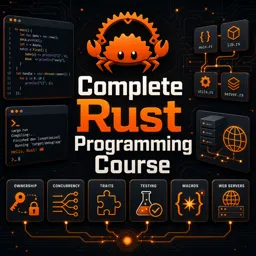
Develop modern programming skills with our selection of free online Rust courses. These educational courses are designed for learners who want to study the Rust programming language, understand its core concepts, and practice writing reliable, efficient, and secure software. Whether you are a beginner starting a programming education or a developer expanding your technical knowledge, this learning path offers accessible lessons, practical exercises, and free certification.
Rust is a powerful systems programming language recognized for performance, memory safety, concurrency, and dependable software development. Through these free Rust classes, you can explore essential educational topics such as variables, data types, functions, control flow, ownership, borrowing, references, structs, enums, pattern matching, traits, modules, error handling, collections, lifetimes, and asynchronous programming.
The courses include exercises that reinforce each lesson and help you apply programming theory to practical development tasks. By completing guided activities and coding practice, you can improve problem-solving abilities, learn how the Rust compiler supports safe development, and gain confidence when building command-line tools, backend services, embedded applications, or other software projects.
Every listed course is free and also provides free certification. A course certificate can support your professional portfolio, curriculum, academic development, or continuing education record. Study at your own pace, review lessons whenever needed, complete the included exercises, and strengthen your knowledge without paying tuition or certification fees.
To access and study these Rust courses, it is necessary to install the Cursa application. Android learners can use Download for Android on Google Play. Apple users can use Download for iOS / iPhone on the App Store.
Install the application, choose a free online Rust course, follow the educational modules, complete the exercises, and earn your free certificate. Start learning Rust today and build valuable software development skills through structured, practical, and accessible online education.
What is Rust programming language used for?
Rust is used to build fast, reliable software such as systems tools, web services, command-line applications, embedded software, and performance-critical applications.
Is Rust a good language for beginners?
Rust can be challenging at first because of ownership and borrowing rules, but beginner courses can teach its concepts step by step.
What will I learn in a Rust for beginners course?
You will typically learn Rust syntax, variables, functions, control flow, structs, enums, error handling, ownership, borrowing, and basic projects.
Why is Rust known for memory safety?
Rust prevents many common memory errors at compile time through its ownership, borrowing, and lifetime system, without requiring a garbage collector.
Do I need programming experience to learn Rust?
No, although prior programming experience can help. A beginner-focused Rust course can introduce the core programming concepts you need.
What is covered in an advanced Rust programming course?
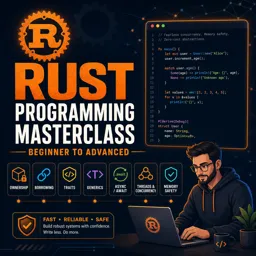
Advanced Rust courses often cover lifetimes, traits, generics, concurrency, async programming, smart pointers, macros, testing, and production project design.
How long does it take to learn Rust?
You can learn Rust fundamentals in a few weeks of regular practice. Becoming comfortable with ownership, concurrency, and advanced features may take several months.

Complete any course and issue your certificate via the app — at no cost.

Download the app! to have access to more than 4,000 Online Courses + Certificate, all free!
Download the app! 100% free courses.


Carry knowledge in your pocket.
Download the Cursa app.
There are hundreds of free courses available, with a free certificate of completion that is saved in your mobile image gallery.
Download the app to access the Course Completion Certificate for Free.


+ 10 million
students

Free and Valid
Certificate

60 thousand free
exercises

4.8/5 rating in
app stores

Free courses in
video and ebooks