Replace an independent voltage source with a short circuit and an independent current source with an open circuit. Dependent sources remain active.

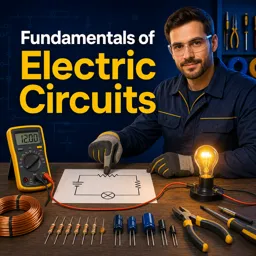
Duration of the online course: 9 hours and 14 minutes
New
Build real circuit-analysis skills fast with this free online course—master current, voltage, Thevenin, RC/RLC response and AC basics, plus a certificate.
Strengthen the electrical skills that matter on the job by learning how circuits behave, how to analyze them confidently, and how to predict real outcomes before you ever touch a tool. This free online course is designed for anyone aiming to work as an electrician, technician, or hands-on problem solver who wants to move beyond rules of thumb and understand the why behind current, voltage, and power in practical networks.
You will develop a clear mathematical view of electric current and the relationships that govern circuits, then translate that understanding into reliable methods for solving networks with resistors, sources, and combinations that appear in everyday installations and equipment. As you progress, you will practice the reasoning used by professionals to set up correct circuit equations, reduce complex networks into simpler equivalents, and verify results logically instead of guessing. Along the way, you will gain comfort with essential analysis techniques, including nodal reasoning and superposition, and you will learn how to interpret what turning off sources actually means when isolating effects in a circuit.
The course also helps you build intuition for equivalent circuits and measurement-ready models such as Thevenin form, making it easier to diagnose faults, estimate load behavior, and choose components wisely. You will connect that foundation to the way capacitors and inductors influence circuit behavior over time, including natural responses in RC and RLC circuits and the conditions that distinguish overdamped, critically damped, and underdamped behavior. Finally, you will step into sinusoidal steady-state concepts and understand how angular frequency shapes waveforms in AC analysis—key for working with power systems, filters, and signal-driven devices.
With short videos and targeted exercises, you will reinforce each concept immediately and build the confidence to approach circuit diagrams systematically. By the end, you will be better prepared to interpret schematics, communicate using standard electrical terms, and apply core circuit fundamentals to real-world electrical work.

9 hours and 14 minutes of online video course

Digital certificate of course completion (Free)

Exercises to train your knowledge

100% free, from content to certificate
How do you turn off independent sources when applying superposition or finding Thevenin resistance?
Replace an independent voltage source with a short circuit and an independent current source with an open circuit. Dependent sources remain active.
Which law is used for nodal analysis in electric circuits?
Nodal analysis uses Kirchhoff’s Current Law (KCL), which states that the total current entering a node equals the total current leaving it.
How can you tell whether a series RLC circuit is overdamped, critically damped, or underdamped?
Compare the damping factor α with the natural frequency ω₀: α > ω₀ is overdamped, α = ω₀ is critically damped, and α < ω₀ is underdamped.
Ready to get started?Download the app and get started today.
Install the app now
to access the course
Over 5,000 free courses
Programming, English, Digital Marketing and much more! Learn whatever you want, for free.

Study plan with AI
Our app's Artificial Intelligence can create a study schedule for the course you choose.

From zero to professional success
Improve your resume with our free Certificate and then use our Artificial Intelligence to find your dream job.
You can also use the QR Code or the links below.




Free CourseInstall Your Own Solar Power System
5

(2)

59m

6 exercises
Free CourseElectronic Circuits Course
5
(7)
43h25m
49 exercises

Free CourseWind Turbines
5
(4)
3h49m
19 exercises
Free CourseEngineering Circuits Analysis
5
(6)
3h11m
20 exercises

Free CourseElectronics - Nanoelectronics: Devices and Materials
4.8
(44)
40h15m
31 exercises
Free CourseBasic electronics
4.8
(23)
6h04m
30 exercises

Free CourseElectrical engineering
4.8
(27)
11h53m
20 exercises

Free CourseElectrical - Fabrication of Silicon
4.8
(26)
35h10m
28 exercises
Free CourseBeginner Electronics
4.8
(85)
5h27m
24 exercises
Free CourseElectricity course
4.8
(58)
31h41m
6 exercises
Carry knowledge in your pocket.
Download the Cursa app.
There are hundreds of free courses available, with a free certificate of completion that is saved in your mobile image gallery.
Download the app to access the Course Completion Certificate for Free.


+ 10 million
students

Free and Valid
Certificate

60 thousand free
exercises

4.8/5 rating in
app stores

Free courses in
video and ebooks