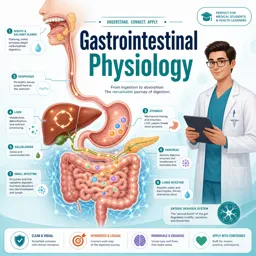


Gastrointestinal physiology is the study of how the digestive tract moves food, secretes digestive substances, absorbs nutrients, and eliminates waste.

1


Understanding Gastrointestinal Physiology: How Your Digestive System Works
Discover how the gastrointestinal system breaks down food, absorbs nutrients, and supports overall health through coordinated digestion, motility, and the gut-brain connection.

The Enteric Nervous System: The ‘Second Brain’ of Gastrointestinal Physiology
Explore the Enteric Nervous System—the gut’s ‘second brain’—and its vital role in controlling digestion, communication with the brain, and implications for gastrointestinal health.

Key Hormonal Regulators of Gastrointestinal Physiology
Explore the key hormones that regulate digestion, their roles, and how they affect gastrointestinal health and balance.

Gut Motility: The Science Behind Food Movement Through the Digestive Tract
Learn how gut motility moves food through your digestive tract and discover tips to support a healthy, efficient digestive system.
Explore our selection of free online Gastrointestinal Physiology courses and develop a structured understanding of how the digestive system functions. These educational courses are ideal for medical students, nursing students, healthcare professionals, biology learners, and anyone interested in human physiology. Study important physiological processes at your own pace, complete exercises to reinforce your knowledge, and receive free certification after meeting the course requirements.
Gastrointestinal physiology examines the mechanisms responsible for digestion, absorption, secretion, motility, and regulation throughout the gastrointestinal tract. The free courses available on this page can help learners review the functions of the mouth, esophagus, stomach, small intestine, large intestine, liver, gallbladder, and pancreas. Educational content also supports the study of neural, hormonal, muscular, and biochemical processes involved in digestive health.
All listed learning opportunities are free online courses. They include exercises that allow you to practice key concepts, identify areas for further study, and strengthen your understanding of gastrointestinal function. Learners can also obtain free certification, making these courses useful for personal development, academic review, continuing education, and demonstrating independent study.
These Gastrointestinal Physiology courses are suitable for beginners and learners seeking revision materials in anatomy and physiology, medicine, nursing, nutrition, pharmacy, biomedical science, and related health sciences. Flexible online access makes it easier to study digestive physiology whenever it fits your schedule.
To access and complete the free courses, it is necessary to install the Cursa application. Android users can install it through Google Play: Download for Android. iPhone users can install it through the App Store: Download for iOS / iPhone.
Choose a course, follow the educational lessons, complete the included exercises, and expand your knowledge with accessible free Gastrointestinal Physiology training and free certification.
What is gastrointestinal physiology?
Gastrointestinal physiology is the study of how the digestive tract moves food, secretes digestive substances, absorbs nutrients, and eliminates waste.
What topics are covered in a gastrointestinal physiology course?
Courses commonly cover motility, digestion, secretion, absorption, gut hormones, neural control, blood flow, and fluid-electrolyte balance.
How does the gastrointestinal tract control digestion?
Digestion is regulated by the enteric nervous system, autonomic nerves, gut hormones, and local chemical and mechanical signals.
What is gastrointestinal motility?
Gastrointestinal motility refers to coordinated muscle contractions that mix food, propel it through the tract, and support defecation.
Where are nutrients absorbed in the gastrointestinal tract?
Most nutrient absorption occurs in the small intestine, while the large intestine mainly absorbs water and electrolytes.
What role do gastrointestinal hormones play?
Gastrointestinal hormones regulate secretion, motility, appetite, digestion, and the release of bile and pancreatic enzymes.
Why is gastrointestinal physiology important for healthcare students?
It provides the foundation for understanding normal digestion, nutrient absorption, fluid balance, and many digestive disorders.

Complete any course and issue your certificate via the app — at no cost.

Download the app! to have access to more than 4,000 Online Courses + Certificate, all free!
Download the app! 100% free courses.


Carry knowledge in your pocket.
Download the Cursa app.
There are hundreds of free courses available, with a free certificate of completion that is saved in your mobile image gallery.
Download the app to access the Course Completion Certificate for Free.


+ 10 million
students

Free and Valid
Certificate

60 thousand free
exercises

4.8/5 rating in
app stores

Free courses in
video and ebooks