

Renal physiology is the study of how the kidneys filter blood, regulate body fluids, and maintain electrolyte and acid-base balance.

1


Explore free online Renal Physiology courses designed for students, healthcare professionals, and anyone interested in understanding how the kidneys maintain homeostasis. These educational courses explain essential concepts through accessible lessons, exercises, and structured study materials. Every course is free and also offers free certification, helping you document your learning and strengthen your academic or professional profile.
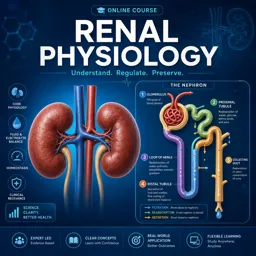
Develop a clearer understanding of renal anatomy and physiology, from nephron structure to urine formation. The courses address glomerular filtration, tubular reabsorption, tubular secretion, renal blood flow, and the regulation of water and electrolytes. Educational content also explores the kidney’s role in acid-base balance, blood pressure control, osmolality, and endocrine function.
These free courses are valuable for learners in medicine, nursing, pharmacy, biology, biomedical science, nutrition, and other health sciences. They can support university study, exam preparation, professional development, or independent learning. Beginners can build a foundation in kidney function, while advanced learners can review mechanisms relevant to clinical physiology, laboratory interpretation, and pathophysiology.
To access the Renal Physiology courses, complete the exercises, and obtain free certification, you must install the Cursa application. Android users can select Download for Android through Google Play. Apple users can select Download for iOS / iPhone through the App Store.
Study at your own pace and review complex physiological processes whenever needed. With free access, free certification, and exercises included, these online Renal Physiology courses provide a convenient educational pathway for mastering kidney function, renal regulation, and the scientific principles that support human health.
What is renal physiology?
Renal physiology is the study of how the kidneys filter blood, regulate body fluids, and maintain electrolyte and acid-base balance.
What are the main functions of the kidneys?
Kidneys remove waste, regulate water and electrolytes, control blood pressure, maintain pH, and produce hormones such as erythropoietin.
How does glomerular filtration work?
Blood pressure pushes water and small solutes across the glomerular filtration barrier into Bowman’s capsule, forming filtrate.
What is the difference between filtration, reabsorption, and secretion?
Filtration moves substances from blood into the nephron, reabsorption returns needed substances to blood, and secretion moves selected substances into tubular fluid.
What is GFR in renal physiology?
Glomerular filtration rate, or GFR, measures the volume of filtrate formed by the kidneys each minute and reflects renal filtration function.
How do the kidneys regulate water balance?
The kidneys adjust water reabsorption in the collecting ducts, mainly in response to antidiuretic hormone (ADH).
How do kidneys regulate acid-base balance?
Kidneys regulate pH by reabsorbing bicarbonate and excreting hydrogen ions and ammonium in urine.

Complete any course and issue your certificate via the app — at no cost.

Download the app! to have access to more than 4,000 Online Courses + Certificate, all free!
Download the app! 100% free courses.


Carry knowledge in your pocket.
Download the Cursa app.
There are hundreds of free courses available, with a free certificate of completion that is saved in your mobile image gallery.
Download the app to access the Course Completion Certificate for Free.


+ 10 million
students

Free and Valid
Certificate

60 thousand free
exercises

4.8/5 rating in
app stores

Free courses in
video and ebooks