Basic electronics is the study of electrical components, circuits, voltage, current, and how simple electronic systems work.

7

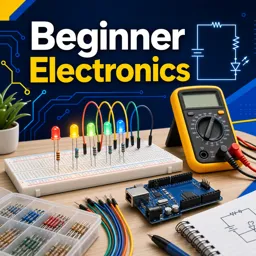
Free CourseBeginner Electronics
4.79

(84)

5h27m

24 exercises
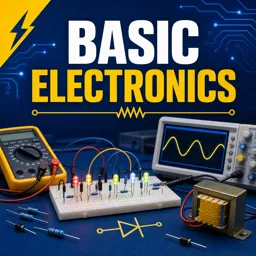
Free CourseBasic electronics
4.82
(22)
6h04m
30 exercises
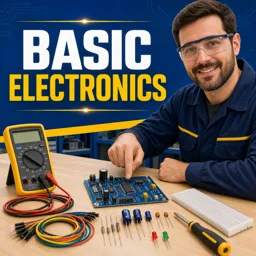
Free CourseBasic electronics
4.38

(8)
10h48m
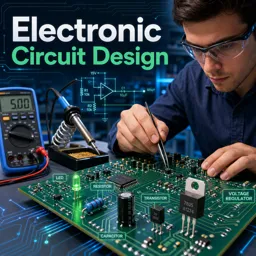
Free CourseElectronic Circuit Design
4.5
(2)
2h43m
16 exercises
Free CourseElectronic Circuit Design Course
3.75
(4)
9h31m
51 exercises
Free CourseElectronic Circuits Course
5
(6)
43h25m
49 exercises
Free CoursePLC Training Series Step
4.17
(6)
3h22m
20 exercises

Exploring Analog and Digital Circuits: A Guide for Intermediate Electronics Learners
Learn intermediate electronics with analog and digital circuits, including op-amps, logic gates, microcontrollers, and practical project-based tips for learners.

Understanding Ohm’s Law: The Foundation of Electrical Circuits
Ohm’s Law explains voltage, current, and resistance relationships, forming the essential foundation for electricians in circuit design and troubleshooting.

Introduction to Basic Electronics: Key Concepts Every Aspiring Electrician Should Know
Fundamentos da eletrônica básica essenciais para eletricistas iniciantes, preparando para carreira e estudos avançados no setor elétrico.

How to Safely Use a Multimeter: Essential Skills for Aspiring Electricians
Aprenda a usar o multímetro com segurança e confiança—uma ferramenta essencial para quem está começando na área elétrica ou em eletrônica básica.

Exploring Electronic Components: A Beginner’s Guide for Electricians
Descubra os principais componentes eletrônicos — resistores, capacitores, diodos e mais — essenciais para o aprendizado prático de futuros eletricistas.
Learn the foundations of electronics with our selection of free online Basic Electronics courses. Designed for beginners, students, hobbyists, and aspiring technicians, these educational courses explain essential concepts through accessible lessons and practical examples. Study at your own pace, complete exercises to reinforce your knowledge, and earn free certification after finishing eligible courses.
Basic Electronics courses introduce the principles required to understand electrical circuits and electronic devices. Lessons may explore voltage, current, resistance, power, conductors, semiconductors, and circuit analysis. You can also learn how common components function, including resistors, capacitors, diodes, transistors, switches, batteries, and integrated circuits.
These free courses can help you interpret circuit diagrams, apply Ohm’s law, understand series and parallel circuits, and use measurement tools safely. Educational exercises are included so that you can review theories, solve problems, and evaluate your learning progress.
Every course listed on this page is available for free, making electronics education more accessible. The courses include exercises that support active learning and help consolidate important technical concepts. You can also receive free certification, which is useful for documenting your studies, enriching your résumé, and demonstrating continued professional development.
This learning path is suitable for complete beginners, vocational students, engineering learners, repair enthusiasts, makers, and professionals seeking a refresher. No advanced background is required to begin. Whether you want to prepare for further study, understand everyday electronic equipment, or develop practical technical skills, these Basic Electronics classes offer a convenient starting point.
To access the courses, lessons, educational exercises, and free certification, you must install the Cursa application. Android users can obtain it from Google Play through Download for Android. iPhone users can install it from the App Store through Download for iOS / iPhone.
Start learning today with free online Basic Electronics courses and develop valuable knowledge for academic, personal, and professional projects.
What is basic electronics?
Basic electronics is the study of electrical components, circuits, voltage, current, and how simple electronic systems work.
What will I learn in a beginner electronics course?
You can learn circuit fundamentals, resistor and capacitor use, diodes, transistors, circuit diagrams, and safe testing methods.
Do I need prior knowledge to learn basic electronics?
No. Beginner courses usually start with essential concepts such as voltage, current, resistance, and simple circuits.
What are the most important basic electronic components?
Common components include resistors, capacitors, inductors, diodes, transistors, switches, LEDs, and integrated circuits.
What is the difference between voltage, current, and resistance?
Voltage is electrical potential, current is the flow of electric charge, and resistance limits that flow.
What is Ohm’s law in electronics?
Ohm’s law states that voltage equals current multiplied by resistance: V = I × R.
Can I learn electronic circuit design as a beginner?
Yes. Start with simple DC circuits and schematics, then progress to component selection, circuit analysis, and practical designs.

Complete any course and issue your certificate via the app — at no cost.

Download the app! to have access to more than 4,000 Online Courses + Certificate, all free!
Download the app! 100% free courses.


Carry knowledge in your pocket.
Download the Cursa app.
There are hundreds of free courses available, with a free certificate of completion that is saved in your mobile image gallery.
Download the app to access the Course Completion Certificate for Free.


+ 10 million
students

Free and Valid
Certificate

60 thousand free
exercises

4.8/5 rating in
app stores

Free courses in
video and ebooks









What are people saying about free online courses of Basic Electronics
Bright
I highly appreciate your teaching methods. From theory to practical. I really enjoyed it.
CourseBeginner Electronics
CIRRO
thanks my only teacher
CourseBasic electronics
Shawn God two
please make a lab for real simulation on people like us god23two please subscribe
CourseBeginner Electronics
Ivan Snider
great courses, awesome way to sharpen skills
CourseBeginner Electronics
Paul Ray
very good teachers and easy interesting exercise and explanations
CourseBeginner Electronics
Martin Márk Herr
This was very interesting. I thoroughly enjoyed the videos and exercises.
CourseBeginner Electronics