It covers the Scrum framework, empiricism, Scrum values, accountabilities, artifacts, commitments, and Scrum events to support PSM I preparation.

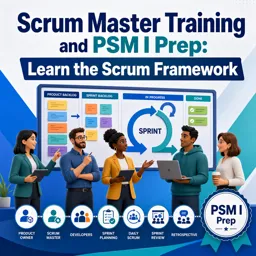
Duration of the online course: 1 hours and 54 minutes
New
Build real Scrum Master skills with a free online course and PSM I prep—master roles, events, artifacts, and Sprint goals to lead Agile delivery confidently.
Want to lead projects with more clarity, faster feedback, and better teamwork? This free online training helps you understand Scrum as a practical framework for tackling complex work in modern organizations. Built for professionals in project management, product delivery, business, and marketing teams, it connects the core ideas of Scrum with what you need to perform confidently in real environments and strengthen your readiness for PSM I-style assessments.
You will learn why Scrum is intentionally designed around empiricism and what that means day to day: making work transparent, inspecting outcomes frequently, and adapting plans based on evidence rather than assumptions. That foundation is reinforced through the Scrum values, so you do not just memorize terms—you understand the mindset that makes the framework effective and sustainable.
As you progress, the course clarifies the accountabilities within the Scrum Team so you can support healthier collaboration and reduce role confusion. You will distinguish what the Product Owner is accountable for, how Developers create value every Sprint, and how the Scrum Master serves the team and the organization by improving the way Scrum is understood and applied.
The training also focuses on the artifacts and commitments that create alignment and measurable progress. You will explore how goals guide decision-making, why the Definition of Done protects quality, and how an Increment represents valuable, usable outcomes. Events are covered in a way that emphasizes purpose and outcomes, helping you run them with intention—so time-boxes, planning, daily coordination, review, and reflection all translate into better delivery and continuous improvement.
If you are preparing for a certification exam or aiming to step into a Scrum Master role, this course helps you build a clean, standards-aligned understanding of the Scrum framework while staying grounded in practical application. By the end, you should be able to explain Scrum clearly, spot common misunderstandings, and contribute to higher-performing, goal-focused teams.

1 hours and 54 minutes of online video course

Digital certificate of course completion (Free)

Exercises to train your knowledge

100% free, from content to certificate
What does Scrum Master Training and PSM I Prep cover?
It covers the Scrum framework, empiricism, Scrum values, accountabilities, artifacts, commitments, and Scrum events to support PSM I preparation.
What is the Scrum Master accountable for in Scrum?
The Scrum Master establishes Scrum as defined in the Scrum Guide and helps the Scrum Team and organization improve their Scrum practice.
What is the difference between a Product Goal and a Sprint Goal?
The Product Goal is the long-term objective for the product, while the Sprint Goal is the single objective that gives a specific Sprint its purpose.
Ready to get started?Download the app and get started today.
Install the app now
to access the course
Over 5,000 free courses
Programming, English, Digital Marketing and much more! Learn whatever you want, for free.

Study plan with AI
Our app's Artificial Intelligence can create a study schedule for the course you choose.

From zero to professional success
Improve your resume with our free Certificate and then use our Artificial Intelligence to find your dream job.
You can also use the QR Code or the links below.



Free CourseProject Management Second Edition
5

(4)

18h17m

41 exercises
Free CourseAgile and Scrum
5
(14)
2h50m
4 exercises
Free CourseProject Management for managers
4.8
(6)
31h38m
32 exercises
Free CourseTime Management
4.8

(12)
2h16m
3 exercises
Free CourseProject Management Course
4.7
(24)
4h14m
20 exercises
Free CourseScrum Master course
4.7
(6)
3h28m
9 exercises
Free CourseProject Management course
4.6
(7)
10h06m
47 exercises
Free CourseProject management tutorial
4.5
(50)
15h48m
22 exercises
Free CourseProject Management training
4.5
(15)
8h06m
5 exercises
Free CourseProject Management Body of Knowledge
4.3
(3)
1h01m
6 exercises
Carry knowledge in your pocket.
Download the Cursa app.
There are hundreds of free courses available, with a free certificate of completion that is saved in your mobile image gallery.
Download the app to access the Course Completion Certificate for Free.


+ 10 million
students

Free and Valid
Certificate

60 thousand free
exercises

4.8/5 rating in
app stores

Free courses in
video and ebooks