

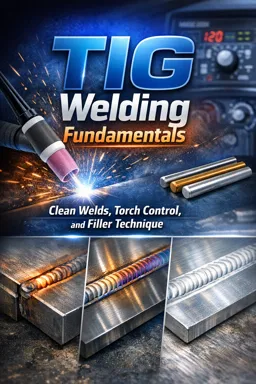
TIG welding is a precise arc-welding process that uses a non-consumable tungsten electrode and shielding gas, usually argon.

1

1



An Introduction to TIG Welding: Techniques and Applications
Learn TIG welding basics, tools, and uses—from precise techniques to applications in aerospace, art, and high-grade manufacturing.

Understanding TIG Weld Joints: Types and Best Applications
Learn the types of TIG weld joints, their applications, and how to ensure strong, clean welds through proper techniques and joint preparation.

Welding Stainless Steel with TIG: Best Practices
Achieve clean, durable stainless steel welds with TIG by following best practices: clean surfaces, control heat, avoid overlap, and use back purging and passivation.

Choosing the Right Tungsten Electrode for TIG Welding
Select the right tungsten electrode for TIG welding by considering metal type, amperage, and electrode properties. Each type affects arc stability and weld quality.
Build practical metalworking knowledge with our selection of free online TIG welding courses. Designed for beginners, students, apprentices, technicians, and professionals, these educational courses explain essential Gas Tungsten Arc Welding concepts through accessible lessons. Study at your own pace, complete exercises, and strengthen the technical skills needed to produce clean, accurate, and reliable welds.
TIG welding is widely used when precision, control, and high-quality finishes are required. The free courses introduce important topics such as welding equipment, torch setup, tungsten electrodes, filler metals, shielding gases, polarity, amperage control, and workpiece preparation. Learners can also explore techniques for creating stable arcs, controlling the weld pool, selecting suitable travel speeds, and reducing common welding defects.
Course content supports the study of TIG welding for stainless steel, carbon steel, aluminum, and other metals. Educational lessons may also address joints, welding positions, material thickness, heat control, distortion prevention, and visual inspection. Exercises are included to help you review terminology, assess your understanding, and reinforce the procedures presented in each course.
All courses listed on this page are free and include free certification. After completing an eligible course, you can earn a certificate at no cost. This learning record can support your professional development, demonstrate continuing education, and complement a resume or training portfolio. The included exercises provide valuable opportunities to test your knowledge before completing the program.
These free educational resources are suitable for anyone starting TIG welding training, reviewing fabrication fundamentals, or expanding existing welding knowledge. They can benefit vocational students, maintenance workers, metal fabricators, hobbyists, and professionals seeking flexible online learning. Practical welding must always be performed with appropriate supervision, ventilation, protective equipment, and workplace safety procedures.
To access the free TIG welding courses, exercises, and free certificates, you must install the Cursa application. Use Download for Android through Google Play or Download for iOS / iPhone through the App Store. Install the app, choose a course, and begin developing your TIG welding skills today.
What is TIG welding?
TIG welding is a precise arc-welding process that uses a non-consumable tungsten electrode and shielding gas, usually argon.
Is TIG welding difficult to learn?
TIG welding takes practice because it requires coordinated torch, filler rod, and foot-pedal control, but beginners can learn the fundamentals step by step.
What will I learn in a How To TIG Weld course?
You will learn machine setup, safety, torch angles, arc control, filler-metal use, and basic weld techniques.
How do I make clean TIG welds?
Clean TIG welds require properly cleaned metal, adequate shielding gas, the right tungsten preparation, and steady torch movement.
Why is torch control important in TIG welding?
Good torch control maintains a consistent arc length and travel speed, helping create even, strong, and attractive weld beads.
When should I use filler rod in TIG welding?
Use filler rod when the joint needs added material for strength, gap filling, or bead reinforcement; some thin joints can be fusion welded without it.
What materials can I TIG weld?
TIG welding is commonly used for stainless steel, mild steel, aluminum, chrome-moly, copper alloys, and other thin or precision metalwork.

Complete any course and issue your certificate via the app — at no cost.

Download the app! to have access to more than 4,000 Online Courses + Certificate, all free!
Download the app! 100% free courses.


Carry knowledge in your pocket.
Download the Cursa app.
There are hundreds of free courses available, with a free certificate of completion that is saved in your mobile image gallery.
Download the app to access the Course Completion Certificate for Free.


+ 10 million
students

Free and Valid
Certificate

60 thousand free
exercises

4.8/5 rating in
app stores

Free courses in
video and ebooks