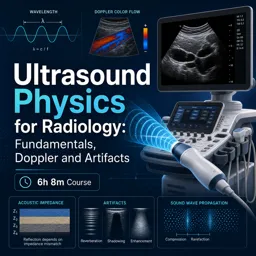


It covers sound-wave principles, image formation, transducer function, Doppler techniques, and common ultrasound artifacts.

1


Explore our selection of free online Radiology courses designed for learners who want to develop essential knowledge of diagnostic imaging, medical terminology, radiographic techniques, anatomy, and patient care. These educational courses provide flexible online learning opportunities for students, healthcare professionals, radiologic technology candidates, and anyone interested in understanding how imaging supports clinical diagnosis and treatment.
Study important Radiology concepts through accessible lessons that can be completed according to your schedule. Course topics may cover X-ray imaging, computed tomography, magnetic resonance imaging, ultrasound, radiation safety, image interpretation, contrast media, positioning, and quality control. Content availability varies by course, allowing learners to select training that matches their educational goals and current knowledge level.
Radiology education can support the development of professional vocabulary, technical awareness, and a clearer understanding of imaging procedures. By completing lessons and exercises, learners can review fundamental concepts and expand their familiarity with safe, effective diagnostic practices. The free certificate can also document continuing education and demonstrate personal commitment to learning, although it does not replace an academic degree, professional license, or regulated clinical qualification.
To access these free Radiology courses, complete the exercises, and obtain free certification, you must install the Cursa application. Android users can install it through Google Play: Download for Android. Apple users can install it through the App Store: Download for iOS / iPhone.
Choose a course, organize your study routine, and begin learning about Radiology without tuition costs. Whether you are exploring a healthcare career, reviewing diagnostic imaging subjects, or seeking additional professional education, these free online courses offer a practical way to gain knowledge, practice with exercises, and earn free certification.
What is covered in an ultrasound physics course for radiology?
It covers sound-wave principles, image formation, transducer function, Doppler techniques, and common ultrasound artifacts.
Why is ultrasound physics important for radiologists?
It helps radiologists optimize image quality, recognize artifacts, and interpret ultrasound examinations accurately.
What is Doppler ultrasound used for in radiology?
Doppler ultrasound evaluates blood-flow direction, velocity, and patterns in vessels and organs.
What are common ultrasound artifacts?
Common artifacts include acoustic shadowing, posterior enhancement, reverberation, mirror image, and aliasing.
What is the difference between color Doppler and spectral Doppler?
Color Doppler displays flow direction and relative velocity, while spectral Doppler graphs velocity over time.
Who should take an ultrasound physics and Doppler course?
Radiology residents, radiologists, sonographers, and other imaging professionals can benefit from the course.
Can an ultrasound physics course help improve image quality?
Yes. Understanding frequency, gain, depth, focus, and Doppler settings supports better image acquisition and interpretation.

Complete any course and issue your certificate via the app — at no cost.

Download the app! to have access to more than 4,000 Online Courses + Certificate, all free!
Download the app! 100% free courses.


Carry knowledge in your pocket.
Download the Cursa app.
There are hundreds of free courses available, with a free certificate of completion that is saved in your mobile image gallery.
Download the app to access the Course Completion Certificate for Free.


+ 10 million
students

Free and Valid
Certificate

60 thousand free
exercises

4.8/5 rating in
app stores

Free courses in
video and ebooks