MongoDB is a NoSQL database that stores data in flexible, JSON-like documents instead of rows and tables.

8

1


Free CourseMongoDB Tutorial For Beginners
4

(4)

3h06m

28 exercises

Free CourseComplete MongoDB Tutorial
4
(1)
2h53m
25 exercises
Free CourseMongoDB
5
(2)
36m
5 exercises
Free CourseMongoDB full course
3.2
(6)
7h50m
1 exercises
Free CourseMongoDB Tutorial for Beginners
5
(1)
1h39m
14 exercises
Free CourseMongoDB Database
5
(4)
1h27m
10 exercises
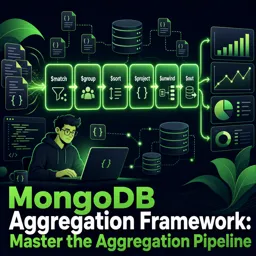
Free CourseMongoDB Aggregation Framework: Master the Aggregation Pipeline
New
1h54m
27 exercises
Free CourseMongoDB fundamentals for absolute beginners
New
1h34m
23 exercises

Advanced MongoDB Aggregation: Harnessing the Power of Data Transformation
Master advanced MongoDB aggregation techniques to transform, analyze, and gain insights from complex datasets using powerful aggregation pipelines.

Implementing Real-Time Applications with MongoDB Change Streams
Learn how to use MongoDB Change Streams to build real-time, event-driven applications with notifications, synchronization, and workflow automation.

Understanding MongoDB: A Beginner’s Guide to NoSQL Databases
Learn what MongoDB is, how it works, and why it’s a leading NoSQL database for scalable, high-performance modern applications.
Develop valuable database skills with this selection of free online MongoDB courses. Designed for students, developers, technology professionals, and anyone interested in modern data management, these educational courses explain how MongoDB works and how it can be used to build scalable applications. Study online at your own pace, complete practical exercises, and strengthen your professional profile with free certification.
MongoDB is a popular NoSQL database that stores information in flexible, document-based structures. Through structured lessons, you can learn essential concepts such as databases, collections, documents, fields, data types, and CRUD operations. More advanced educational content may cover indexing, aggregation pipelines, schema design, data modeling, replication, sharding, performance optimization, security, and cloud database deployment.
These free online courses include exercises that help you review lessons and apply MongoDB concepts in realistic situations. Practice is an important part of database education because it develops confidence in writing queries, organizing information, and solving technical problems. The courses also offer free certification, allowing you to document your learning achievement and add relevant database training to your resume or professional portfolio.
This course collection is suitable for beginners starting a database education as well as programmers, backend developers, full-stack developers, data analysts, software engineering students, and IT professionals who want to update their technical knowledge. Since the courses are free and online, learners can choose suitable subjects and follow an accessible study schedule from anywhere.
To access the MongoDB courses, lessons, exercises, and free certification, you must install the Cursa application. Android users can get it from Google Play at Download for Android. Apple users can install it from the App Store at Download for iOS / iPhone. Start learning MongoDB today and build practical database skills through flexible, career-focused online education.
What is MongoDB?
MongoDB is a NoSQL database that stores data in flexible, JSON-like documents instead of rows and tables.
Is MongoDB good for beginners?
Yes. MongoDB is beginner-friendly because its document model is easy to understand and it has extensive learning resources.
What will I learn in a MongoDB beginner course?
You will typically learn databases, collections, documents, CRUD operations, queries, indexes, and basic data modeling.
How do I create a database in MongoDB?
You can create or switch to a database with the use command, then add data to a collection.
What are CRUD operations in MongoDB?
CRUD means Create, Read, Update, and Delete—the core operations used to manage MongoDB documents.
What is the MongoDB Aggregation Framework?
The Aggregation Framework processes and transforms documents through pipeline stages to calculate, group, filter, and analyze data.
What is the difference between MongoDB and a relational database?
MongoDB uses flexible documents and collections, while relational databases use structured tables, rows, and predefined schemas.

Complete any course and issue your certificate via the app — at no cost.

Download the app! to have access to more than 4,000 Online Courses + Certificate, all free!
Download the app! 100% free courses.


Carry knowledge in your pocket.
Download the Cursa app.
There are hundreds of free courses available, with a free certificate of completion that is saved in your mobile image gallery.
Download the app to access the Course Completion Certificate for Free.


+ 10 million
students

Free and Valid
Certificate

60 thousand free
exercises

4.8/5 rating in
app stores

Free courses in
video and ebooks




What are people saying about free online courses of MongoDB
Manasa Kuruba
very amazing and that you!
CourseMongoDB Tutorial For Beginners