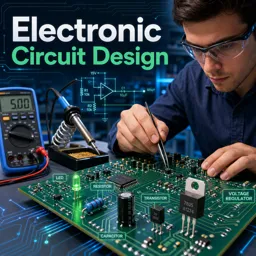


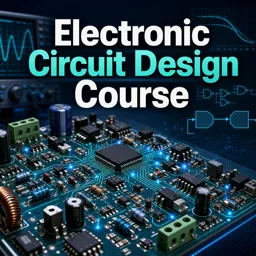
You will learn to analyze, design, simulate, and troubleshoot electronic circuits using components such as resistors, capacitors, diodes, transistors, and operational amplifiers.

4


Develop practical engineering knowledge with our selection of free online Electronic Circuit Design courses. These educational courses are ideal for students, technicians, electronics enthusiasts, makers, and professionals who want to understand how electronic circuits are planned, analyzed, simulated, assembled, and tested. Study at your own pace through accessible lessons designed to support both introductory learning and continued professional development.
The courses cover important topics used in electronics and electrical engineering, including voltage, current, resistance, capacitance, inductance, Ohm’s law, Kirchhoff’s laws, series and parallel circuits, semiconductor devices, diodes, transistors, operational amplifiers, filters, power supplies, digital logic, and printed circuit board design. Depending on the selected course, you may also study circuit simulation, schematic reading, component selection, signal analysis, troubleshooting, and laboratory measurement techniques.
Every course listed on this page is free and includes educational content that can be accessed conveniently from a mobile device. The courses also include exercises that help reinforce theoretical concepts, evaluate understanding, and encourage practical problem-solving. After completing an eligible course, learners can obtain free certification, providing a useful way to document studies and strengthen an academic profile, professional portfolio, résumé, or curriculum vitae.
Electronic Circuit Design education supports the development of analytical reasoning, mathematical interpretation, technical drawing, simulation, prototyping, testing, and fault-finding skills. By combining lessons with exercises, learners can better understand how components interact and how theoretical circuit models relate to real electronic applications.
To access these free Electronic Circuit Design courses, complete the exercises, and request free certification, it is necessary to install the Cursa application. Android users can install it through Google Play: Download for Android. iPhone users can install it through the App Store: Download for iOS / iPhone.
Choose a course that matches your learning goals and begin expanding your electronics knowledge for free. With flexible online study, practical exercises, and free certification, these courses offer an accessible educational path for mastering the principles and applications of Electronic Circuit Design.
What will I learn in an Electronic Circuit Design course?
You will learn to analyze, design, simulate, and troubleshoot electronic circuits using components such as resistors, capacitors, diodes, transistors, and operational amplifiers.
Is Electronic Circuit Design suitable for beginners?
Yes. Beginner-friendly courses typically start with voltage, current, Ohm’s law, basic components, and simple circuit analysis before moving to more advanced designs.
What software is used for electronic circuit design?
Common tools include LTspice, Multisim, Proteus, KiCad, Altium Designer, and Autodesk Eagle for circuit simulation and schematic or PCB design.
Do I need to know mathematics for electronic circuit design?
Basic algebra is essential, and an understanding of trigonometry and simple calculus can help with AC circuits, filters, signals, and advanced analysis.
What is the difference between electronic circuit design and electrical design?
Electronic circuit design focuses on low-voltage circuits that process signals or control devices, while electrical design often covers power distribution, wiring, protection, and larger electrical systems.
Can I learn PCB design in an electronic circuits course?
Many electronic circuit design courses include PCB fundamentals, such as schematic capture, component placement, routing, grounding, and preparing manufacturing files.
What projects can I build after learning electronic circuit design?
You can design projects such as LED controllers, regulated power supplies, audio amplifiers, sensor interfaces, timers, battery chargers, and microcontroller-based circuits.

Complete any course and issue your certificate via the app — at no cost.

Download the app! to have access to more than 4,000 Online Courses + Certificate, all free!
Download the app! 100% free courses.


Carry knowledge in your pocket.
Download the Cursa app.
There are hundreds of free courses available, with a free certificate of completion that is saved in your mobile image gallery.
Download the app to access the Course Completion Certificate for Free.


+ 10 million
students

Free and Valid
Certificate

60 thousand free
exercises

4.8/5 rating in
app stores

Free courses in
video and ebooks