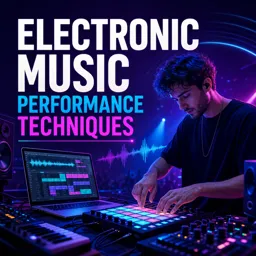
Free Course Image Electronic Music Performance Techniques

Free online course Electronic Music Performance Techniques

Duration of the online course: 1 hours and 21 minutes

New

Perform electronic music live with confidence: master Ableton Live, Push workflow, looping, drumming and sound control in a free course for producers and DJs.

In this free course, learn about

  • Key misconceptions about electronic digital instruments (EDIs) and how to approach them
  • How to configure an EDI for performance in Ableton Live (routing, MIDI mapping, setup)
  • Session View workflow: clip launching, launch quantization, and timing control
  • Drum performance basics on EDIs: fingerings, linear vs poly-rhythmic patterns
  • Building and leveling an Ableton Drum Rack; fixing sample volume inconsistencies
  • Sampling and slicing techniques; approaches to working with samples in performance
  • Live looping in Ableton: starting/stopping recording and setting loop lengths
  • Performing chord progressions on Ableton Push using chord/scale assistance features
  • Constructing and playing triads, 7th chords, and 9th chords with practical voicings
  • Creating basic compositions: combining drums, chords, bass parts, and melodies
  • Developing basslines and melodies; in-scale vs chromatic improvisation and blues ideas
  • Arranging a live set: sections, transitions, and performance-ready structure
  • Live sound design and real-time manipulation using controllers (e.g., filter sweeps/FX)

About the free online course

Turn your laptop and controller into a real performance instrument. This free online course in Music and Singing focuses on modern electronic music performance, helping you move beyond pressing play and into an expressive, hands-on workflow built for producers, DJs, and live acts. You will learn to think like a performer: making musical decisions in the moment, staying tight with timing, and shaping energy so your sets feel alive rather than pre-rendered.

Starting from a practical setup inside Ableton Live, you will develop a reliable performance environment using Session View, clip launching, and timing choices that let you play precisely or deliberately loosen the grid when the moment calls for it. From there, you will build rhythmic control through electronic drumming concepts, refining coordination and dynamics so patterns sound intentional and consistent. You will also explore ways to bring samples into performance, from slicing and triggering to capturing ideas on the fly.

Harmony and musical storytelling are treated as performance skills too. You will practice chord progressions and learn how a controller workflow can make complex voicings feel playable, then expand into richer colors such as seventh and ninth chords. By combining live looping with chords, bass parts, and melodies, you will learn how to construct sections in real time, improvise with scales that fit the key, and keep your musical parts coherent while still sounding spontaneous.

To make performances translate on stage, the course emphasizes sound design choices for live contexts and hands-on manipulation. You will map controls to key parameters, shape tone as you play, and create transitions that keep momentum between sections. By the end, you will have a clearer performance mindset, a stronger grasp of expressive techniques, and a practical approach to arranging an engaging electronic set that looks and feels performed.

Course content

  • Video class: Electronic Music Performance Techniques: Welcome to the Course 01m
  • Exercise: What is one of the key misconceptions about electronic digital instruments (EDIs) that the course aims to address?
  • Video class: Configuring Your EDI with Ableton Live | Electronic Music Performance Techniques 1/23 01m
  • Video class: Launch Quantization and Session View | Electronic Music Performance Techniques 2/23 03m
  • Exercise: What is the result of setting individual clip launch quantization to 'none' in Ableton Live?
  • Video class: Introduction to Rhythm and Drum Performance | Electronic Music Performance Techniques 3/23 00m
  • Exercise: When learning about drum performance on an EDI, which aspect is NOT covered in the initial lesson?
  • Video class: Ableton Drum Rack Setup | Electronic Music Performance Techniques 4/23 02m
  • Exercise: In Ableton Live, what do you need to adjust in the drum rack if you notice inconsistencies in terms of the volume level of your drum samples?
  • Video class: Performing Basic Drum Patterns | Electronic Music Performance Techniques 5/23 05m
  • Exercise: Which finger does the instructor suggest using for the hi-hat when playing with the left hand during electronic music drumming patterns?
  • Video class: Performing Poly-Drum Patterns | Electronic Music Performance Techniques 6/23 02m
  • Exercise: What characteristic distinguishes poly drum patterns from linear drum patterns in electronic music performance?
  • Video class: Sampling and Slicing Sounds | Electronic Music Performance Techniques 7/23 02m
  • Exercise: What are the two approaches to working with samples in electronic music as described in the given text?
  • Video class: Live Looping Drum Patterns | Electronic Music Performance Techniques 8/23 04m
  • Exercise: In Ableton Live, what is the correct way to initiate a live loop using the Session Record button?
  • Video class: Introduction to Performing Chord Progressions | Electronic Music Performance Techniques 9/23 00m
  • Exercise: What type of chords will you learn to perform in this lesson?
  • Video class: Setting up the Ableton Push | Electronic Music Performance Techniques 10/23 04m
  • Exercise: What feature does the Ableton Push offer to assist in performing chords and chord progressions?
  • Video class: Performing Basic Chord Progressions on Ableton Push | Electronic Music Performance Techniques 11/23 06m
  • Exercise: Which technique allows a musician to modify a major triad to create additional chord variations on the Push instrument?
  • Video class: Creating and Performing 7th Chords | Electronic Music Performance Techniques 12/23 03m
  • Exercise: When converting a major triad to a major seventh chord in the key of C, what additional note needs to be played?
  • Video class: Creating and Performing 9th Chords | Electronic Music Performance Techniques 13/23 04m
  • Exercise: When constructing a C minor ninth chord, which note is removed and what is its interval relationship to the root?
  • Video class: Live Looping Chord Progressions | Electronic Music Performance Techniques 14/23 02m
  • Exercise: In the given text about live looping with the Ableton Push, what feature is used to set a specific recording length?
  • Video class: Creating Basic Compositions | Electronic Music Performance Techniques 15/23 00m
  • Exercise: What fundamental element of electronic music performance will be explored in this lesson for creating a basic composition?
  • Video class: Developing Bass Parts | Electronic Music Performance Techniques 16/23 05m
  • Exercise: Which of the following is a basic technique for creating a bass part for a chord progression?
  • Video class: Developing Melodies | Electronic Music Performance Techniques 17/23 03m
  • Exercise: Which feature on the LED instrument allows you to access both in-scale and chromatic notes for improvisation?
  • Video class: Minor Blues Improv | Live Looping Melodies and Bass | Electronic Music Performance Techniques 18/23 03m
  • Exercise: Which scale is suggested for improvising a melodic idea on top of a bass part in the provided text?
  • Video class: Creating Arrangements, Improving Sound Design Intro | Electronic Music Performance Techniques 19/23 00m
  • Exercise: What is the primary focus of the lesson described in the text?
  • Video class: Sound Design for Live Performance | Electronic Music Performance Techniques 20/23 05m
  • Exercise: Which of the following modifications was NOT part of the sound design process described in the text for improving the sound of the chords track in Ableton Live?
  • Video class: Manipulating Sound in Real Time | Electronic Music Performance Techniques 21/23 06m
  • Exercise: In electronic music performance, what is the purpose of assigning a Midi Fighter Twister dial to control a parameter such as the filter one frequency in Ableton Live?
  • Video class: Arranging a Performance | Electronic Music Performance Techniques 22/23 04m
  • Exercise: In electronic music performance, what is a common technique for creating transitions between sections of a composition?
  • Video class: Rishabh Rajan Performance | Final Lesson | Electronic Music Performance Techniques 23/23 03m
  • Exercise: What common technology is typically used by artists to enhance electronic music performances?

This free course includes:

Icon for learning via the audio course

1 hours and 21 minutes of online video course

Icon for the digital course completion certificate

Digital certificate of course completion (Free)

Icon for exercises to practice what you've learned

Exercises to train your knowledge

Icon for courses that are 100% free from start to finish

100% free, from content to certificate

How do I configure an electronic digital instrument (EDI) with Ableton Live for live performance?

Connect the instrument via MIDI, enable it in Ableton Live’s MIDI preferences, and map pads, knobs, or keys to the tracks and parameters you want to control.

What does clip launch quantization set to “None” do in Ableton Live?

It launches the clip immediately when triggered, without waiting for the next beat, bar, or other quantization interval.

How can Ableton Push help with playing chord progressions live?

Ableton Push uses an in-scale pad layout that makes chord shapes easier to play and transpose, while also providing access to chromatic notes for variations and improvisation.

Ready to get started?Download the app and get started today.

Install the app now

to access the course
Icon representing technology and business courses

Over 5,000 free courses

Programming, English, Digital Marketing and much more! Learn whatever you want, for free.

Calendar icon with target representing study planning

Study plan with AI

Our app's Artificial Intelligence can create a study schedule for the course you choose.

Professional icon representing career and business

From zero to professional success

Improve your resume with our free Certificate and then use our Artificial Intelligence to find your dream job.

You can also use the QR Code or the links below.

QR Code - Download Cursa - Online Courses

More free courses at Music production and DJ

Free Ebook + Audiobooks! Learn by listening or reading!