
It covers aerodynamics, aircraft systems, airspace, navigation, weather, flight planning, regulations, weight and balance, and human factors.

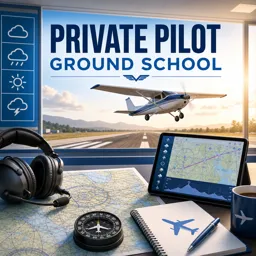
Duration of the online course: 16 hours and 21 minutes
5

(5)
Build real flight knowledge with this free online course: aerodynamics, weather, navigation, airspace and planning—study smarter and prepare for a certificate.
Step into aviation with a practical ground-school experience designed to help you think and plan like a pilot. This free online course strengthens the fundamentals behind safe, confident decision-making in the cockpit, whether your goal is to start training, refresh your knowledge, or explore aviation as a professional skill. You will connect the why behind procedures with the real-world scenarios pilots face, so concepts stick and become usable—not just memorized.
From the basics of how an airplane flies to the systems that keep it running, you will build a clear mental model of aerodynamics, performance, and the tradeoffs that matter when conditions change. You will also develop weather awareness by learning how atmosphere and pressure drive the patterns that shape visibility, winds, and altimeter settings—critical knowledge for everyday go/no-go decisions. Human factors are treated as a core safety topic, helping you recognize how perception, workload, and common error chains can influence outcomes long before an incident occurs.
Navigation, airspace, and communication are covered in a way that supports practical flight planning. You will work with charts and flight information sources, interpret key frequencies, and gain confidence in the structure of airspace so you can anticipate requirements rather than react to surprises. The course also broadens your aviation perspective with insights into helicopters, seaplanes, night operations, multi-engine and jet considerations, and even small UAS rules—useful context if you are comparing pathways or building a wider aviation foundation.
Throughout the course, short knowledge checks reinforce key takeaways and help you identify gaps early. By the end, you will be better prepared to study efficiently, communicate more clearly in aviation environments, and approach flight planning with the disciplined mindset that safe operations demand.

16 hours and 21 minutes of online video course

Digital certificate of course completion (Free)

Exercises to train your knowledge

100% free, from content to certificate
What does the Private Pilot Ground School cover for FAA knowledge test preparation?
It covers aerodynamics, aircraft systems, airspace, navigation, weather, flight planning, regulations, weight and balance, and human factors.
What does a transponder squawk code of 7500 mean?
Squawk 7500 is the emergency code indicating an aircraft is being hijacked or is subject to unlawful interference.
Why are weight and balance calculations required before a flight?
They confirm the aircraft is within approved loading and center-of-gravity limits for safe control and performance.
Ready to get started?Download the app and get started today.
Install the app now
to access the course
Over 5,000 free courses
Programming, English, Digital Marketing and much more! Learn whatever you want, for free.

Study plan with AI
Our app's Artificial Intelligence can create a study schedule for the course you choose.

From zero to professional success
Improve your resume with our free Certificate and then use our Artificial Intelligence to find your dream job.
You can also use the QR Code or the links below.



Carry knowledge in your pocket.
Download the Cursa app.
There are hundreds of free courses available, with a free certificate of completion that is saved in your mobile image gallery.
Download the app to access the Course Completion Certificate for Free.


+ 10 million
students

Free and Valid
Certificate

60 thousand free
exercises

4.8/5 rating in
app stores

Free courses in
video and ebooks







Course comments: Private Pilot Ground School
Ali Masters
This was great to add to my aviation endevours , even though im prioritizing business and medical im happy to say this really helped me get back
Jamie Visser
it's like a dream come true. thankyou and God bless ya'll.
Reyaan
thanks alot much appreciated and it's been my dream to have this achievement