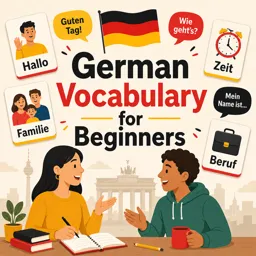
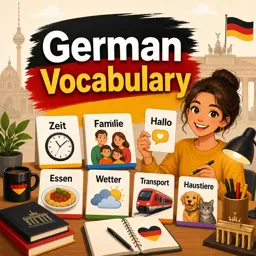
The course covers greetings, personal details, family, countries, jobs, daily activities, shopping, time, weather, health, and numbers.

Duration of the online course: 2 hours and 18 minutes
New
Build confident German fast with a free beginner course: essential vocabulary, everyday dialogues, grammar basics and practice exercises for A1–A2 learners.
Start speaking and understanding German from day one with a beginner-friendly learning path focused on the words and phrases you actually need. This free online course is designed for A1–A2 learners who want to build a practical vocabulary foundation and feel comfortable in common everyday conversations. Instead of memorizing random lists, you will connect new words to real situations so they are easier to remember and use.
Across short lessons and guided practice, you will strengthen core topics such as introductions and greetings, personal information, family and relationships, countries and languages, jobs, daily routines, shopping, time, numbers, and health situations. You will also train conversational skills like asking simple questions, responding naturally, and expressing what you do and do not understand. This makes the course a solid choice for travel plans, relocation, study goals, or a first step toward working with German-speaking clients or teams.
To support accuracy as you gain confidence, the course gently introduces key grammar that beginners often struggle with, including personal and possessive pronouns, grammatical gender, plurals, regular and irregular verbs, and clear patterns for negation. You will also get hands-on exposure to the accusative case in context, helping you form sentences that sound more natural when you talk about people, objects, and everyday needs.
Interactive exercises help you check comprehension as you go, turning passive viewing into active learning. By the end, you should be able to recognize and use essential vocabulary, follow simple spoken German, and handle common situations with greater ease, whether you are saying hello, describing your day, shopping for clothes, or making sense of prices and appointments.

Explore free online German vocabulary courses designed to help beginners and advanced learners build practical language skills for travel, study, work, and everyday conversation. Learn common German words, useful phrases, pronunciation, spelling, and real-world usage at your own pace, then earn a certificate to showcase your achievement.

Explore free online German for Beginners courses designed to help you build essential vocabulary, master basic grammar, improve pronunciation, and gain confidence in everyday conversations. Learn at your own pace with beginner-friendly lessons, practical exercises, and a free certificate to showcase your new German language skills.

2 hours and 18 minutes of online video course

Digital certificate of course completion (Free)

Exercises to train your knowledge

100% free, from content to certificate
What German vocabulary topics are covered in this beginner course?
The course covers greetings, personal details, family, countries, jobs, daily activities, shopping, time, weather, health, and numbers.
How do you say “half past four” in German?
“Half past four” is “halb fünf” in German, meaning half an hour before five.
What is the difference between nicht and kein in German?
Use “nicht” to negate verbs, adjectives, or specific information; use “kein” to negate nouns without a definite article.
Ready to get started?Download the app and get started today.
Install the app now
to access the course
Over 5,000 free courses
Programming, English, Digital Marketing and much more! Learn whatever you want, for free.

Study plan with AI
Our app's Artificial Intelligence can create a study schedule for the course you choose.

From zero to professional success
Improve your resume with our free Certificate and then use our Artificial Intelligence to find your dream job.
You can also use the QR Code or the links below.



Free CourseGerman Vocabulary
5

(5)

15h53m

15 exercises

Free CourseGerman language A2
5
(2)
9h25m
27 exercises

Free CourseGerman B2
5
(2)
9h26m
3 exercises

Free CourseA2 | Learn German for beginners
4.9
(13)
8h58m
3 exercises

Free CourseGerman A1
4.9
(9)
10h34m
18 exercises
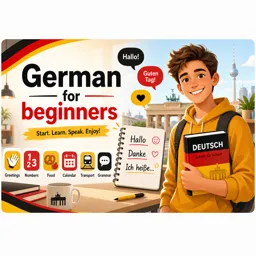
Free CourseGerman for beginners
4.8
(335)
4h10m
19 exercises
Free CourseB2 | Learn German Intermediate
4.8

(8)
2h12m
1 exercises
Free CourseGerman Grammar for Beginners
4.7
(11)
20h06m
41 exercises

Free CourseA1 | Learn German for beginners
4.7
(54)
11h07m
30 exercises

Free CourseGerman
4.7
(118)
2h03m
6 exercises
Carry knowledge in your pocket.
Download the Cursa app.
There are hundreds of free courses available, with a free certificate of completion that is saved in your mobile image gallery.
Download the app to access the Course Completion Certificate for Free.


+ 10 million
students

Free and Valid
Certificate

60 thousand free
exercises

4.8/5 rating in
app stores

Free courses in
video and ebooks