For du, er/sie/es, and ihr, an extra -e- is usually added: du arbeitest, er arbeitet, ihr arbeitet.

Duration of the online course: 9 hours and 35 minutes
New
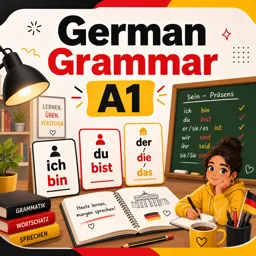
Build confident A1 German grammar skills fast with this free online course—clear explanations, quick practice, and sentence-building you can use right away.
If you want to understand German instead of guessing, this A1 grammar course helps you build a solid foundation from the very beginning. You will learn how German sentences really work and start forming your own phrases with confidence, even if grammar has felt intimidating in the past. Step by step, you develop the habits that make German feel logical: spotting the subject and verb, choosing the right article, and placing words in an order that sounds natural.
The lessons focus on the grammar you need most at A1 level to communicate in everyday situations. You will get comfortable with personal pronouns, present-tense verb forms, separable verbs, and the essential irregular verbs that appear constantly in basic conversation. You will also practice asking questions correctly, using negation in a way Germans actually say it, and handling plural forms without relying on memorization alone.
As you progress, you will strengthen key case basics through practical patterns, especially accusative and dative, so you can talk about people, objects, and simple interactions with fewer mistakes. You will also understand common prepositions, modal verbs, and the structure of main clauses, giving you the tools to express ability, permission, necessity, and preferences. By connecting grammar with high-frequency vocabulary themes like people, health, home, clothing, and shopping, you will be able to create useful sentences for real-life contexts, not just isolated exercises.
This is a free online learning experience designed to keep you moving: short explanations, frequent practice questions, and repetition in the right places so the rules stick. By the end, you will have a clearer mental map of German A1 grammar, better accuracy when you speak or write, and a stronger base for future levels and certificates that require reliable fundamentals.

Learn German A1 online with our selection of free beginner courses designed to build essential vocabulary, grammar, pronunciation, listening, and speaking skills. Study at your own pace, gain confidence for everyday conversations, and earn a certificate upon completion. Explore free German A1 courses and start your language journey today.

Explore free online German grammar courses designed to help beginners and advanced learners master sentence structure, cases, verb conjugation, articles, word order, and more. Learn at your own pace, strengthen your language skills with practical lessons, and earn a certificate upon completion to showcase your German proficiency.

9 hours and 35 minutes of online video course

Digital certificate of course completion (Free)

Exercises to train your knowledge

100% free, from content to certificate
How do you conjugate German verbs ending in -d or -t in the present tense?
For du, er/sie/es, and ihr, an extra -e- is usually added: du arbeitest, er arbeitet, ihr arbeitet.
When do I use kein instead of nicht in German?
Use kein to negate nouns with ein/eine or no article; use nicht to negate verbs, adjectives, and other sentence elements.
Where does the infinitive go in a German sentence with a modal verb?
In a main clause, the conjugated modal verb is second and the infinitive goes at the end: Ich muss Deutsch lernen.
Ready to get started?Download the app and get started today.
Install the app now
to access the course
Over 5,000 free courses
Programming, English, Digital Marketing and much more! Learn whatever you want, for free.

Study plan with AI
Our app's Artificial Intelligence can create a study schedule for the course you choose.

From zero to professional success
Improve your resume with our free Certificate and then use our Artificial Intelligence to find your dream job.
You can also use the QR Code or the links below.



Free CourseGerman Vocabulary
5

(5)

15h53m

15 exercises

Free CourseGerman language A2
5
(2)
9h25m
27 exercises

Free CourseGerman B2
5
(2)
9h26m
3 exercises

Free CourseA2 | Learn German for beginners
4.9
(13)
8h58m
3 exercises

Free CourseGerman A1
4.9
(9)
10h34m
18 exercises
Free CourseGerman for beginners
4.8
(335)
4h10m
19 exercises
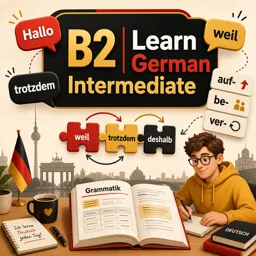
Free CourseB2 | Learn German Intermediate
4.8

(8)
2h12m
1 exercises
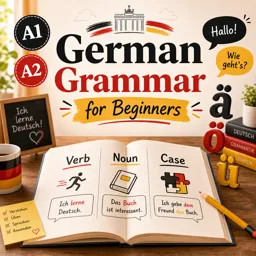
Free CourseGerman Grammar for Beginners
4.7
(11)
20h06m
41 exercises

Free CourseA1 | Learn German for beginners
4.7
(54)
11h07m
30 exercises

Free CourseGerman
4.7
(118)
2h03m
6 exercises
Carry knowledge in your pocket.
Download the Cursa app.
There are hundreds of free courses available, with a free certificate of completion that is saved in your mobile image gallery.
Download the app to access the Course Completion Certificate for Free.


+ 10 million
students

Free and Valid
Certificate

60 thousand free
exercises

4.8/5 rating in
app stores

Free courses in
video and ebooks