The course explores arpeggios, right-hand fingering, slurs, rhythm, chord balance, voicing, melodic phrasing, and harmonic playing through all 25 studies.

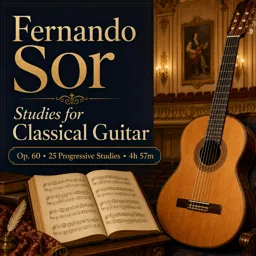
Duration of the online course: 4 hours and 57 minutes
New
Refine your classical guitar technique with a free online course on Sor studies—tone, arpeggios, slurs and musicality, plus certificate-ready practice.
Build a more confident, musical classical guitar technique through Fernando Sor’s 25 Progressive Studies, Op. 60. This free online course guides you step by step through a landmark set of etudes designed to turn fundamental skills into reliable habits: clear tone, balanced voices, coordinated hands, and an expressive sense of line. Instead of rushing for speed, you’ll learn how to make simple notation sound full and elegant, avoiding the dry, one note at a time effect by shaping harmony and sustaining important voices.
Across the studies, you’ll strengthen right-hand control through arpeggio textures, accent placement, and efficient fingering choices that keep patterns flowing even when they seem to run out of fingers. The lessons emphasize practical solutions for consistency and sound quality, helping you maintain a steady beat while highlighting melody within accompaniment. You’ll also refine left-hand accuracy with chord shifts, intervals, and position awareness, improving clarity while reducing tension.
Musicianship remains central throughout. You’ll work on voicing, phrasing, and tone color so each study sounds like music rather than an exercise. As the material advances, the course supports you in handling new challenges such as varied textures, rhythmic intricacies near cadences, and interpretive decisions when markings are inconsistent. You’ll be encouraged to develop a thoughtful editing mindset and a focused practice approach that brings out the musical line.
Whether you are returning to classical guitar or looking to strengthen core technique with repertoire that has trained generations of players, this course provides a structured path through Op. 60, ending with a complete performance overview of the full set. By the end, you should feel more secure in your fundamentals and more able to project balance, harmony, and expressive direction in your playing.

4 hours and 57 minutes of online video course

Digital certificate of course completion (Free)

Exercises to train your knowledge

100% free, from content to certificate
What classical-guitar techniques are covered in Fernando Sor’s 25 Progressive Studies, Op. 60?
The course explores arpeggios, right-hand fingering, slurs, rhythm, chord balance, voicing, melodic phrasing, and harmonic playing through all 25 studies.
How can I make Sor’s Op. 60 studies sound musical rather than like separate notes?
The lessons emphasize sustaining notes, shaping phrases, balancing melody and accompaniment, and connecting arpeggios into a clear harmonic texture.
Does the course include lessons for every study in Fernando Sor’s Op. 60?
Yes. It provides focused lessons for Studies No. 1–25, plus a complete performance of the full Op. 60 collection.
Ready to get started?Download the app and get started today.
Install the app now
to access the course
Over 5,000 free courses
Programming, English, Digital Marketing and much more! Learn whatever you want, for free.

Study plan with AI
Our app's Artificial Intelligence can create a study schedule for the course you choose.

From zero to professional success
Improve your resume with our free Certificate and then use our Artificial Intelligence to find your dream job.
You can also use the QR Code or the links below.




Free CoursePopular Guitar Lessons For Beginners
5

(28)

3h23m

17 exercises

Free CourseGuitar for beginners
4.9
(81)
1h23m
7 exercises
Free CourseGuitar course for Beginners
4.9
(20)
4h10m
25 exercises
Free CourseGuitar lessons from Beginner to Advanced
4.8

(4)
1h17m
10 exercises

Free Course30 Day Ukelele course
4
(1)
3h31m
23 exercises
Free CourseBeginner Acoustic Guitar Lessons
New
3h41m
32 exercises

Free CourseBeginner Acoustic Guitar
New
2h22m
13 exercises
Free CourseClassical Guitar Repertoire Lessons
New
6h19m
15 exercises
Free CourseSongwriting Course
New
1h16m
8 exercises
Free CourseIntermediate Guitar Course
New
6h30m
43 exercises
Carry knowledge in your pocket.
Download the Cursa app.
There are hundreds of free courses available, with a free certificate of completion that is saved in your mobile image gallery.
Download the app to access the Course Completion Certificate for Free.


+ 10 million
students

Free and Valid
Certificate

60 thousand free
exercises

4.8/5 rating in
app stores

Free courses in
video and ebooks