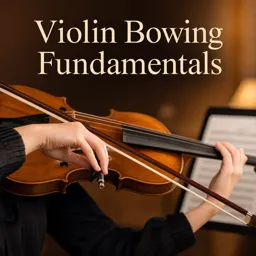


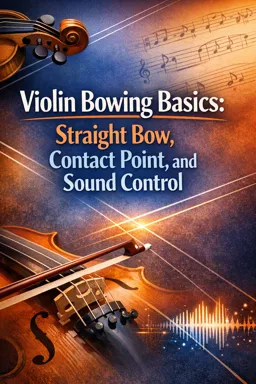
You will learn bow hold, bow direction, straight bowing, basic strokes, contact points, and tone control.

3

1


Essential Violin Bowing Patterns: Building a Strong Foundation
Master bowing patterns like detache, legato, and martelé to build a strong violin foundation and enhance your tone, rhythm, and expression.

Exploring Unique Violin Bowing Techniques: Spiccato, Col Legno, and More
Discover unique violin bowing techniques like spiccato, col legno, sul ponticello, and ricochet to expand your musical expression and tone palette.

Mastering Violin Bowing: Techniques for Expressive Playing
Explore violin bowing techniques like detache, legato, and spiccato to enhance expressiveness and control in your performance.

Understanding the Fundamentals of Violin Bowing: Tips for Beginners
Master the basics of violin bowing with clear tips on grip, placement, and exercises to build control, tone, and confidence.
Develop confident technique and expressive musicianship with our selection of free online Violin Bowing courses. These educational courses are designed for beginners, intermediate violinists, music students, teachers, and performers who want to improve bow control through structured lessons and practical exercises. Study at your own pace while building the technical foundation required for clear articulation, balanced tone, accurate rhythm, and musical expression.
Explore important concepts such as correct bow grip, posture, bow distribution, contact point, pressure, speed, and coordination between the right and left hands. Course lessons may introduce détaché, legato, martelé, staccato, spiccato, sautillé, tremolo, and other valuable bow strokes. Clear educational instruction helps you understand how each movement influences tone quality, phrasing, dynamics, and performance.
Every learning path includes exercises that support technical development and consistent practice. Work on open strings, smooth bow changes, straight bow movement, string crossings, articulation patterns, dynamic control, and rhythmic precision. These activities help learners identify tension, improve flexibility, strengthen coordination, and establish productive violin practice habits.
All courses listed on this page are free and also provide free certification. A certificate can document your educational progress and complement a music learning portfolio, professional profile, or personal development record. Whether you are preparing for lessons, ensemble rehearsals, auditions, or independent performance, these free Violin Bowing courses offer accessible training without tuition fees.
The content supports self-taught players, conservatory students, private pupils, music educators, orchestral musicians, and anyone seeking a better violin sound. Beginners can learn fundamental bow mechanics, while experienced players can review advanced articulation and refine expressive control. Online learning makes it easier to repeat demonstrations, revisit theory, and organize practice around individual goals.
To access these free online courses, complete the exercises, and obtain free certification, you must install the Cursa application. Android users can install it through Google Play at Download for Android. iPhone users can install it through the App Store at Download for iOS / iPhone.
Choose a free Violin Bowing course, follow the educational lessons, practice each exercise carefully, and progress toward a controlled, flexible, and expressive bowing technique.
What will I learn in a violin bowing fundamentals course?
You will learn bow hold, bow direction, straight bowing, basic strokes, contact points, and tone control.
How do beginners learn to bow straight on the violin?
Practice moving the bow parallel to the bridge while using a mirror or video feedback to check your bow path.
Why is the violin bow contact point important?
The contact point affects tone, volume, and clarity. Different positions between the bridge and fingerboard create different sounds.
What is the correct beginner violin bow hold?
Use a relaxed curved hand, place the thumb bent near the frog, and let the fingers rest naturally on the bow stick.
How can I improve violin bow control?
Practice slow open-string bows, keep your arm relaxed, and coordinate bow speed, weight, and contact point.
Which violin bowing exercises are best for beginners?
Open-string long bows, bow division exercises, straight-bow practice, and simple rhythm patterns build essential control.
What causes a scratchy sound when bowing a violin?
A scratchy tone can result from too much pressure, insufficient bow speed, a poor contact point, or not enough rosin on the bow hair.

Complete any course and issue your certificate via the app — at no cost.

Download the app! to have access to more than 4,000 Online Courses + Certificate, all free!
Download the app! 100% free courses.


Carry knowledge in your pocket.
Download the Cursa app.
There are hundreds of free courses available, with a free certificate of completion that is saved in your mobile image gallery.
Download the app to access the Course Completion Certificate for Free.


+ 10 million
students

Free and Valid
Certificate

60 thousand free
exercises

4.8/5 rating in
app stores

Free courses in
video and ebooks