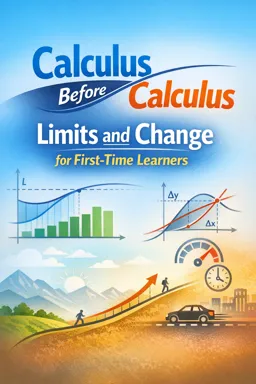
What a Limit Is Really About: “Getting Close” Without Necessarily Arriving
A limit describes what value a quantity is approaching as the input gets close to some target. The key idea is “nearby behavior,” not “exactly at the point.” You can think of it as asking: if we steer the input closer and closer to a number, what number do the outputs settle around?
Limits are useful because many important ideas in calculus depend on understanding behavior at or near places where direct substitution is inconvenient, undefined, or misleading. But you can build strong limit intuition without heavy algebra by focusing on three habits: (1) approach from both sides, (2) compare “closer inputs” and watch outputs stabilize, and (3) separate the idea of a limit from the value of the function at that point.
Limit vs. Function Value
It is common to confuse these two questions:
- What is the function’s value at x = a?
- What value does the function approach as x gets close to a?
They can be the same, but they do not have to be. A function might be undefined at x = a, or it might be defined in a way that does not match the nearby trend. Limits focus on the trend.
Approaching From the Left and From the Right
When we say “x approaches a,” we mean x can come from values less than a (left side) or greater than a (right side). A limit exists only if both sides approach the same output value.
- Listen to the audio with the screen off.
- Earn a certificate upon completion.
- Over 5000 courses for you to explore!

Download the app
Everyday Analogy: Walking Toward a Doorway
Imagine walking toward a doorway marked at position a on a hallway floor. You can approach that doorway from the left or from the right. If the temperature sensor above the doorway shows nearly the same reading as you get close from either side, then the “limit temperature at the doorway” exists. If the sensor reads near 20°C from the left but near 25°C from the right, then there is no single “approached” value.
One-Sided Limits (Intuition First)
Sometimes we only care about approaching from one side. For example, if a quantity is only defined for x > 0 (like the length of something), then “approach 0 from the right” is meaningful even if approaching from the left is not.
- Left-hand limit: what happens as x gets close to a using x < a.
- Right-hand limit: what happens as x gets close to a using x > a.
For a two-sided limit to exist, the left-hand and right-hand limits must match.
Building Limit Intuition With Tables: Watching Outputs Stabilize
A simple way to understand limits is to make a small table of values. You choose x-values that get closer and closer to the target a, and compute the corresponding outputs. If the outputs settle near a single number, that number is the limit.
Step-by-Step: A Table Approach
Suppose you want to understand the behavior of a function near x = 2. You do not need to start with algebraic manipulation. Instead:
- Step 1: Pick several x-values close to 2 from the left (like 1.9, 1.99, 1.999).
- Step 2: Pick several x-values close to 2 from the right (like 2.1, 2.01, 2.001).
- Step 3: Compute the function’s output for each x.
- Step 4: Look for a pattern: do the outputs from both sides move toward the same number?
This method is especially helpful when the function is complicated, or when plugging in x = 2 directly gives something undefined.
Example 1: A “Hole” Behavior Without Algebra Tricks
Consider the function defined by f(x) = (x^2 − 4)/(x − 2) for x ≠ 2. At x = 2, the expression is undefined because it becomes 0/0. But the limit asks what happens near 2, not at 2.
Make a table near x = 2:
x        f(x) = (x^2-4)/(x-2)  (approx.)
1.9      3.9
1.99     3.99
1.999    3.999
2.1      4.1
2.01     4.01
2.001    4.001
The outputs are getting closer to 4 from both sides. That strongly suggests the limit as x approaches 2 is 4, even though the function is not defined at x = 2 in this form.
Notice what you learned without heavy algebra: the function behaves like it wants to be 4 at x = 2, even though the formula refuses to give a value there.
What “Stabilize” Means
Outputs do not need to become exactly the limit value in your table. They only need to get closer as your x-values get closer. In practice, you look for increasing agreement in decimal places. In the table above, the outputs match 4 to more and more decimal places as x gets closer to 2.
Separating “Approach” From “Equal”: The Function Can Disagree at the Point
A function can be designed to “misbehave” at a single point while still having a perfectly clear limit. This is one of the most important conceptual separations for first-time learners.
Example 2: Same Nearby Trend, Different Value at the Point
Define a function g(x) as follows:
- For x ≠ 2, g(x) = (x^2 − 4)/(x − 2).
- At x = 2, define g(2) = 100.
Near x = 2, the values of g(x) for x ≠ 2 are the same as in the previous table and still approach 4. The limit as x approaches 2 is still 4. But the function value at x = 2 is 100.
This shows: the limit is about the nearby behavior, not the “assigned” value at the exact point.
When Limits Do Not Exist: Two Common Patterns
Sometimes the outputs do not settle on a single number. Two very common reasons are (1) the left and right sides approach different values, or (2) the outputs grow without bound.
Pattern A: Jump Behavior (Left and Right Don’t Match)
Imagine a function that behaves like 1 for inputs less than 0 and behaves like 3 for inputs greater than 0. If you approach 0 from the left, outputs are near 1. If you approach 0 from the right, outputs are near 3. Because these do not match, there is no single two-sided limit at 0.
You can detect this with a table:
x        output (example)
-0.1     1
-0.01    1
-0.001   1
0.1      3
0.01     3
0.001    3
The table does not “stabilize” to one number; it stabilizes to two different numbers depending on direction.
Pattern B: Unbounded Growth (Approaches Infinity)
Consider h(x) = 1/(x − 1). As x gets close to 1, the denominator gets close to 0, and the fraction can become very large in magnitude. From the right side (x > 1), the outputs are large positive numbers. From the left side (x < 1), the outputs are large negative numbers.
x        1/(x-1)
0.9      -10
0.99     -100
0.999    -1000
1.1      10
1.01     100
1.001    1000
This does not approach a finite number. In many courses you will describe this as “diverges” or “tends to infinity” (with attention to sign and side). The important intuition is: the outputs do not settle; they explode in size.
Closeness Is About Distance, Not Direction
When you say x is “close” to a, you mean the distance between x and a is small. Distance is always nonnegative, and it ignores whether x is less than or greater than a. This is why limits often talk about “within 0.1” or “within 0.001” of a target.
Practical Way to Think: “Within a Tolerance”
Suppose you want x to be close to 2. You might require x to be within 0.01 of 2. That means x is in the interval (1.99, 2.01). If you tighten the tolerance to 0.001, then x must be in (1.999, 2.001). As you tighten the tolerance, you force x closer and closer to 2.
Limits use this idea: as you force x to be closer to a, the outputs are forced to be closer to some number L (if the limit exists).
Estimating Limits From Realistic Measurement Situations
Limits are not only about symbolic expressions. They also describe what happens in measurement and modeling when you cannot (or should not) evaluate exactly at a point.
Example 3: Average Speed Approaching Instantaneous Speed
Suppose you track a moving object and record its position s(t) at times near t = 5 seconds. You want the speed at exactly 5 seconds, but your device only gives positions at nearby times. A practical approach is to compute average speeds over smaller and smaller time windows around 5.
Average speed from 5 to 5 + Δt is:
(s(5+Δt) - s(5)) / ΔtIf you compute this for Δt = 0.1, 0.01, 0.001 and the results settle near a number, that “settling value” is the limit of the average speeds as Δt approaches 0. This is the intuition behind instantaneous rate of change: you do not jump straight to Δt = 0; you approach it.
Step-by-Step: How You Would Do It With Data
- Step 1: Collect position measurements near t = 5 (for example at 5.1, 5.01, 5.001 seconds).
- Step 2: Compute average speed over each interval using the formula above.
- Step 3: Compare the results as the time window shrinks.
- Step 4: If the average speeds stabilize, interpret that stabilized value as the speed at t = 5 (a limit-based estimate).
This is limit intuition in action: you learn about an “instant” by looking at behavior over smaller and smaller neighborhoods around it.
Limits Without Algebra: Three Reliable “Sanity Checks”
When you are not doing heavy algebra, you still need ways to judge whether your estimate is trustworthy. Here are three checks that work well.
Check 1: Use Both Sides
Always test values from below and above the target. If you only approach from one side, you might miss a jump or a sign change.
Check 2: Tighten the Closeness Gradually
Do not jump from x = 1.9 to x = 1.999999 immediately. Use a sequence like 1.9, 1.99, 1.999 and similarly on the other side. You want to see a consistent trend, not a one-off coincidence.
Check 3: Watch for Output Stability, Not Exactness
In limit thinking, you rarely get an exact output in a table. Instead, you look for increasing agreement in digits. If outputs are 3.9, 3.99, 3.999, that is strong evidence the limit is 4.
Common Misconceptions That Block Limit Intuition
Misconception 1: “If I Can’t Plug It In, There Is No Limit”
Not being able to evaluate the function at x = a does not prevent a limit from existing. The table example with (x^2 − 4)/(x − 2) shows a clear approach to 4 even though direct substitution fails.
Misconception 2: “The Limit Must Equal the Function Value”
A function can be defined to have a different value at the point than what it approaches nearby. Limits describe the approach, not the assigned point value.
Misconception 3: “Getting Close Means Getting There”
Approaching is not the same as arriving. You can get arbitrarily close without ever being equal. This matters when the function is undefined at the point or when the point represents a boundary you cannot cross.
Practice: Guided Limit Estimation Without Algebra
Use the following exercises to train your intuition. The goal is not to simplify expressions; it is to observe approach behavior carefully.
Exercise 1: A Table That Suggests a Simple Limit
Estimate the limit as x approaches 3 for the function p(x) = (x^2 − 9)/(x − 3), using a table. Use x-values 2.9, 2.99, 2.999 and 3.1, 3.01, 3.001. Compute p(x) with a calculator and look for stabilization.
Exercise 2: Detecting a Jump With One-Sided Tables
Define q(x) by: q(x) = 2 when x < 1, and q(x) = 5 when x > 1. Make a small table approaching 1 from the left and from the right. Decide whether the two-sided limit exists, and record the left-hand and right-hand limits separately.
Exercise 3: Unbounded Behavior Near a Point
Estimate what happens to r(x) = 1/(x − 4)^2 as x approaches 4. Use x-values 3.9, 3.99, 3.999 and 4.1, 4.01, 4.001. Notice that outputs are positive on both sides and grow rapidly. Describe the behavior in words (for example: “grows without bound”).
Turning Intuition Into Precise Language (Lightly)
Even without heavy algebra, it helps to use careful language. When you say “the limit is L,” you mean: by choosing x sufficiently close to a (but not necessarily equal to a), you can make f(x) as close as you want to L.
You do not need to memorize formal symbols to benefit from this idea. The practical meaning is: closeness in input forces closeness in output, and the output closeness can be made as tight as you like by choosing inputs close enough to the target.
A Practical Rephrasing You Can Use
- “When x is near a, f(x) is near L.”
- “The closer x gets to a, the closer f(x) gets to L.”
- “From both sides of a, the outputs settle around L.”
These statements capture the heart of limits: predictable approach behavior.