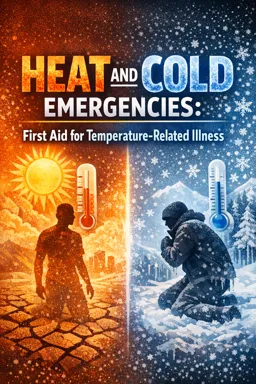
What “Severe Hypothermia” Means
Severe hypothermia is a life-threatening drop in core body temperature where the brain, heart, and breathing slow down so much that the person may appear close to death. In first aid, the key idea is that the person’s core (chest, back, neck, head) is too cold to support normal thinking, breathing, and circulation. Because the heart becomes very irritable in the cold, rough handling or sudden movements can trigger dangerous rhythms. Your priorities are to recognize danger signs early, call for help, prevent further heat loss, and rewarm the core gently while monitoring breathing and responsiveness.
Recognition: Danger Signs That Suggest Life-Threatening Hypothermia
Do not rely on a thermometer in the field. Use the person’s behavior and vital signs. Severe hypothermia is likely when you see one or more of the following:
- Confusion or altered mental status: disorientation, irrational behavior, slurred speech, poor coordination, inability to follow simple commands.
- Minimal or absent shivering: shivering may stop as the body runs out of energy; this is a major red flag.
- Very slow, shallow breathing: breaths may be hard to see; pauses can be long.
- Drowsiness, stupor, or unresponsiveness: difficulty staying awake, drifting off, not responding normally.
- Collapse or inability to stand/walk: sudden weakness, falls, or “can’t get up.”
- Cold, pale, or bluish skin: especially lips and fingertips; skin may feel stiff.
Field example: “Looks intoxicated”
A person found outdoors may seem drunk: stumbling, mumbling, acting confused. In cold conditions, treat this as possible severe hypothermia until proven otherwise, especially if shivering is weak or absent.
Emergency Response Sequence (First Aid)
1) Call emergency services immediately
Severe hypothermia requires professional care. Call your local emergency number as soon as you suspect it. If you are not alone, send someone to call while you begin care. Provide: location, weather exposure, the person’s responsiveness, and whether they are breathing normally.
2) Prevent further heat loss (stop the cooling)
- Move to shelter from wind, rain, snow, or cold ground if it can be done safely and gently.
- Insulate from the ground: place pads, blankets, coats, sleeping pads, cardboard, or dry clothing underneath.
- Remove wet clothing if you can do so without excessive movement; replace with dry layers.
- Cover the head and neck (leave the face clear for breathing).
- Create a vapor/wind barrier (tarp, emergency blanket, plastic sheet) over insulating layers to reduce heat loss.
3) Handle gently and keep the person horizontal when possible
In severe hypothermia, sudden movement can worsen the condition. Aim to:
- Listen to the audio with the screen off.
- Earn a certificate upon completion.
- Over 5000 courses for you to explore!

Download the app
- Keep them lying flat (supine) if possible, especially if they are drowsy or collapsed.
- Avoid unnecessary walking; do not “march them around” to warm up.
- Lift and move carefully with support; avoid jarring, rough rubbing, or rapid position changes.
4) Prioritize core rewarming (chest, back, neck) over limbs
Warm the core gently. Warming arms and legs aggressively can push cold blood back toward the heart and may worsen instability. Use these methods:
- Warm packs to the core: apply warm (not hot) packs to the chest, upper back, and neck. Wrap packs in cloth to prevent burns. Check skin frequently.
- Skin-to-skin warming (if appropriate and safe): place the person in dry insulation and share body heat against the torso (core-to-core), keeping privacy and safety in mind.
- Warm, dry blankets/layers: build insulation around the torso first, then the rest of the body.
Avoid:
- Direct heat sources that can burn (heating pads on high, hot water bottles directly on skin, open flames close to blankets).
- Hot baths/showers in a first-aid setting (risk of collapse, arrhythmias, and difficult handling).
- Vigorous rubbing/massage of limbs.
5) Monitor continuously until help arrives
Severe hypothermia can deteriorate suddenly. Recheck:
- Responsiveness: do they respond to voice or gentle touch?
- Breathing: look for chest rise, listen/feel for airflow. Breathing may be very slow.
- Skin color and temperature: note changes, but prioritize breathing and responsiveness.
CPR and AED Considerations (First Aid Context)
Assess for signs of life carefully
Because breathing can be extremely slow and shallow, take a careful look for normal breathing. If you are trained to check a pulse, remember it may be weak and slow; do not delay action if you are unsure.
If no signs of life: start CPR per local guidelines
- If the person is unresponsive and not breathing normally, begin CPR following your local protocol (compression rate/depth and compression-to-breath ratio per current guidance in your region).
- Use an AED if available: turn it on, follow prompts, and keep the person as insulated as possible while applying pads. If the chest is wet, dry it quickly so pads stick.
- Continue CPR until the person shows signs of life, you are too exhausted to continue, an AED instructs you to stop, or professionals take over.
If breathing is present but very slow
If the person is breathing (even slowly) and has a pulse, focus on preventing heat loss and gentle core warming. Keep them horizontal and monitor closely. Be ready to start CPR if breathing stops or becomes abnormal.
Practical Step-by-Step: A Simple On-Scene Checklist
1) Suspect severe hypothermia if confusion + weak/absent shivering + very slow breathing/drowsiness/collapse. 2) Call emergency services. 3) Gentle handling; keep horizontal; avoid walking. 4) Stop heat loss: shelter + insulation under body + remove wet clothing (gently) + dry layers + cover head/neck. 5) Core rewarm: warm packs to chest/back/neck (wrapped; not hot). Avoid heating limbs first. 6) Monitor breathing and responsiveness continuously. 7) If unresponsive and not breathing normally: start CPR + use AED if available. 8) Continue care until professionals take over.Common Mistakes to Avoid
| Mistake | Why it’s risky | Better approach |
|---|---|---|
| Forcing the person to walk or exercise | Can trigger collapse or dangerous heart rhythms | Keep them still and horizontal; carry/assist gently |
| Warming arms/legs aggressively first | May send cold blood back to the core and worsen instability | Warm the core (chest/back/neck) first |
| Hot water, direct high heat, or burns from heat packs | Cold skin burns easily; burns add complications | Use warm (not hot) packs wrapped in cloth; check skin often |
| Rough handling, shaking, vigorous rubbing | Heart is irritable in severe hypothermia | Handle gently; minimize movement |
| Assuming “sleeping it off” is safe | Drowsiness can progress to respiratory arrest | Call emergency services; monitor continuously |