What Seizures Are (and What They Are Not)
A seizure is a sudden burst of abnormal electrical activity in the brain that can temporarily change a child’s movement, awareness, behavior, or sensations. Seizures can look dramatic, but many are brief and stop on their own. The main first aid goals are to keep the child safe during the event, time what is happening, and support recovery afterward.
Not every unusual episode is a seizure. Some events that can mimic seizures include fainting, breath-holding spells, shivering from fever, tics, night terrors, or a child briefly “staring off” due to daydreaming. Because look-alikes exist, careful observation and timing are valuable. If you are unsure, treat the episode as a seizure for safety and seek medical guidance afterward.
Common seizure patterns you might see
- Generalized tonic-clonic (convulsive) seizure: stiffening, rhythmic jerking, possible drooling or foaming, eyes may roll upward, breathing may sound noisy, skin color may look pale or slightly bluish around lips during the event.
- Focal seizure: twitching or jerking in one part of the body, unusual movements (lip smacking, picking at clothes), confusion, or a child who seems “not there” but may still be partly responsive.
- Absence seizure: brief staring with subtle eyelid fluttering; the child quickly returns to normal and may not remember it.
- Atonic seizure: sudden loss of muscle tone leading to a head drop or collapse.
Regardless of type, your priorities are consistent: prevent injury, avoid putting anything in the mouth, and document what you see.
Febrile Seizures: What Makes Them Different
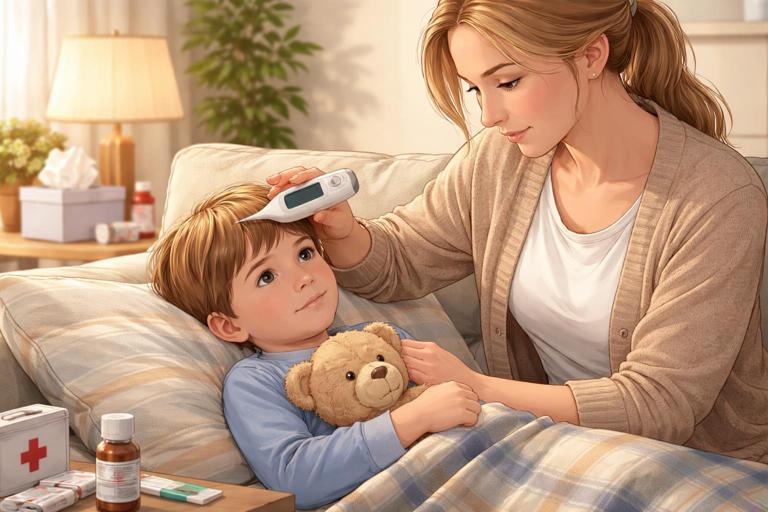
Febrile seizures are seizures triggered by fever in young children, typically between about 6 months and 5 years. They often happen early in an illness, sometimes as the temperature is rising quickly. Febrile seizures can be frightening, but most are short and do not cause brain damage.
Simple vs. complex febrile seizures (why it matters)
- Simple febrile seizure: generalized shaking, lasts less than about 15 minutes, and does not recur within 24 hours.
- Complex febrile seizure: lasts longer than about 15 minutes, happens more than once in 24 hours, or has focal features (only one side or one limb involved).
This distinction helps clinicians decide what evaluation is needed. For first aid at home or school, the immediate care is the same: safety, timing, and recovery support.
- Listen to the audio with the screen off.
- Earn a certificate upon completion.
- Over 5000 courses for you to explore!

Download the app
Important clarifications about fever and seizures
- Febrile seizures can occur with relatively modest fevers; it is not only “very high” temperatures.
- Giving fever medicine does not guarantee prevention of febrile seizures.
- The seizure itself is usually the most urgent event to manage; fever care can resume after the child is safe and recovering.
Safety During a Seizure: What to Do Step-by-Step
Use these steps for any suspected seizure, including febrile seizures. If you are in a school setting, follow your site’s medical protocols and notify designated staff while you begin safety actions.
Step 1: Start timing immediately
Look at a clock or start a timer on your phone. If you cannot access a timer, note the time as precisely as possible. Duration is one of the most important pieces of information for medical decision-making.
Step 2: Protect from injury
- Lower the child to the floor if they are standing or in a chair, guiding them gently to prevent a fall.
- Clear nearby hazards (furniture edges, toys, sharp objects, hot drinks, cords).
- Place something soft under the head (folded jacket, towel) if available.
- Loosen tight clothing around the neck.
Step 3: Position for safer breathing (when possible)
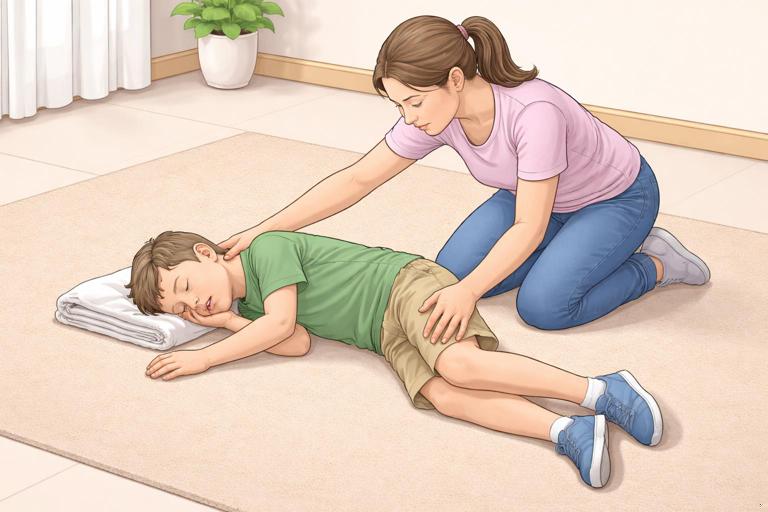
If the child is actively convulsing, do not forcefully restrain them. When you can safely do so, gently turn them onto their side (recovery position) to help saliva or vomit drain and to keep the airway more open. If you cannot roll them fully during strong jerking, wait until the movements lessen and then roll them.
Step 4: Do not put anything in the mouth
- Do not place fingers, a spoon, a wallet, a cloth, or any object in the child’s mouth.
- Do not try to hold the tongue down. The child will not “swallow their tongue.”
Objects in the mouth can break teeth, block the airway, or cause choking. Your job is to keep the area safe and the airway clear by positioning, not by inserting anything.
Step 5: Do not restrain the movements
Trying to hold arms or legs still can cause injuries to you or the child. Instead, guide away from hazards and cushion the head. If the child is in a wheelchair, stroller, or high chair, follow your environment’s safety plan: generally, stop movement, secure the device if safe, and protect the head while preparing to move the child to a safer position as soon as feasible.
Step 6: Observe and record key details
While keeping the child safe, note what you see. These observations help clinicians distinguish seizure types and causes.
- How the seizure started (sudden collapse, staring, one arm jerking first).
- Body movements (stiffening, rhythmic jerking, one-sided vs. whole body).
- Eye position (deviation to one side, eyelid flutter).
- Breathing changes (noisy breathing, brief pauses, color changes).
- Any triggers (fever, recent illness, flashing lights, head injury).
- Any injuries during the event.
Step 7: Keep the environment calm and private
In a classroom or public area, ask bystanders to step back. Reduce noise and bright stimulation. Assign one person to meet responders at the door if emergency services are being activated per your local protocol.
Timing and “When It’s Not Stopping”: Practical Thresholds
Timing is not just documentation; it guides escalation. A seizure that continues can become harder to stop and may require emergency medication. Even if you have already called for help, continue timing and observing.
Use the 5-minute rule as a practical anchor
Many seizures stop within 1–2 minutes. A convulsive seizure lasting around 5 minutes or longer is a key threshold for urgent emergency response in many protocols. If you are alone, prioritize safety positioning and timing first, then activate help according to your setting’s plan.
Other situations that increase urgency
- Repeated seizures without the child returning to their usual level of awareness between episodes.
- Breathing that does not improve after the jerking stops, or persistent bluish color.
- Significant injury (head strike, heavy bleeding) during the seizure.
- Seizure in water (bath, pool) or after a possible poisoning.
- First known seizure, or a child with no seizure history (especially outside the typical febrile age range).
Even when a seizure ends quickly, a first seizure or an atypical pattern may still require same-day medical evaluation. In school or childcare, follow your policy for notifying guardians and documenting the event.
Recovery Care: What to Do After the Seizure Stops
The period after a seizure is called the postictal phase. Children may be sleepy, confused, tearful, nauseated, or briefly agitated. Some may have a headache or muscle soreness. This phase can last minutes to hours depending on the seizure type and the child.
Step-by-step recovery support
Step 1: Re-check safety and breathing
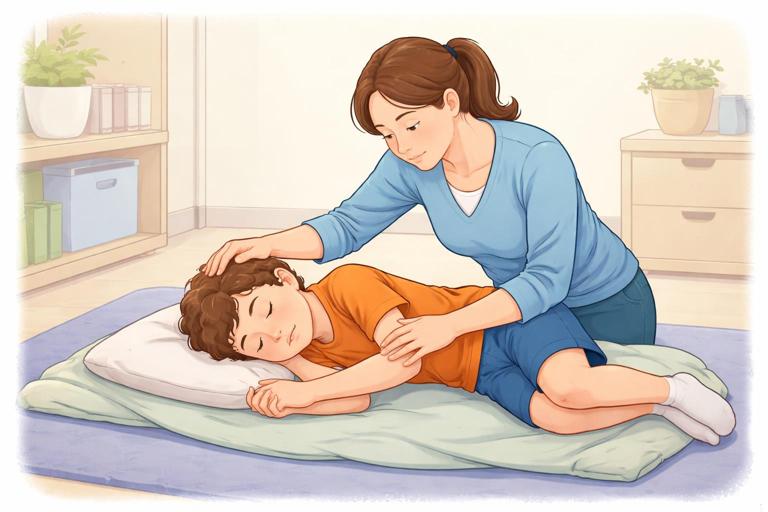
- Keep the child on their side if they are drowsy, drooling, or nauseated.
- Check that the airway is clear of visible vomit or saliva (wipe the mouth gently; do not sweep inside).
- Watch the chest and listen for normal breathing sounds.
Step 2: Provide a calm, low-stimulation space
- Dim lights if possible and reduce noise.
- Speak softly and use simple reassurance: “You’re safe. The shaking stopped. I’m here.”
- Limit the number of people around the child.
Step 3: Look for injuries
Do a quick head-to-toe check for bumps, tongue bites, bleeding, or joint pain. If the child fell, pay special attention to the head and face. Treat bleeding or suspected fractures according to your local first aid procedures, but avoid moving the child unnecessarily if there is concern for neck or spine injury.
Step 4: Do not give food or drink right away
Wait until the child is fully awake, can sit with good head control, and can swallow normally. After a seizure, gag reflex and coordination can be temporarily impaired. If the child asks for water, offer small sips only when fully alert.
Step 5: Re-orient and assess return to baseline
As the child wakes up, ask simple questions appropriate for their age: their name, where they are, or to squeeze your hand. Expect confusion. Document how long it takes for them to return to their usual behavior and speech.
Step 6: Communicate with caregivers and document clearly
Provide a factual description rather than interpretations. Include start time, end time, what you observed, and what the child was doing right before the seizure (playing, napping, running, complaining of headache). In a school setting, note any fever, recent illness reports, or medication administration per policy.
Febrile Seizure Recovery: Practical Home and School Considerations
After a febrile seizure, the child may recover quickly or may sleep. Sleepiness alone can be normal, but the child should be breathing comfortably and gradually becoming more responsive.
Managing the fever after the child is safe
- Focus first on seizure recovery positioning and observation.
- Once fully awake and able to swallow, fever-reducing medicine may be given if it is part of the child’s care plan and dosing is known. Avoid guessing doses.
- Use light clothing and a comfortable room temperature. Avoid cold baths or aggressive cooling methods that cause shivering, as shivering can raise body temperature and distress the child.
What caregivers often ask: “Will it happen again tonight?”
Recurrence can happen, especially during the same illness. The best preparation is not constant waking or forcing fluids, but having a clear plan: safe positioning, timing, and knowing when to seek urgent care. If a clinician has provided rescue medication for prolonged seizures, ensure it is accessible and that trained caregivers know how and when to use it.
Rescue Medications and Seizure Action Plans (When Provided)
Some children with known seizure disorders have a prescribed Seizure Action Plan and rescue medication (often a benzodiazepine) to stop prolonged seizures. In schools and childcare settings, administration rules vary by region and policy, but the principles are consistent: give only what is prescribed for that child, in the prescribed way, and document the time given.
Key points for caregivers and staff
- Know where the child’s plan and medication are stored and who is authorized to administer them.
- Know the trigger for giving rescue medication (commonly based on seizure duration, such as at 3–5 minutes, or specific seizure patterns).
- After giving rescue medication, monitor breathing closely and follow the plan for emergency activation and observation.
If you do not have training or authorization, focus on safety, timing, and activating the appropriate medical response per your setting’s rules.
Special Situations: Practical Safety Adaptations
Seizure in bed or on a couch
- Remove pillows or heavy blankets near the face.
- Turn the child onto their side if possible.
- Do not try to carry the child while they are convulsing unless there is immediate danger (fire, water, traffic).
Seizure in a chair, stroller, or wheelchair
- Prevent falls: lock wheels if present, secure the chair if safe.
- Support the head to prevent repeated impact.
- As soon as feasible and safe, move the child to the floor and side position for recovery.
Seizure in the bathroom or near water
- Move the child away from water sources if you can do so safely.
- Protect the head from hard surfaces (tub edge, tile).
- After the seizure, keep them on their side and watch breathing closely.
Seizure during sports or playground activity
- Clear the area and protect the head.
- Do not remove a helmet during active convulsions unless it is obstructing breathing; if removal is needed, do it carefully when the movements lessen and with attention to neck alignment.
- Check for injuries after the seizure ends, especially if there was a fall from height.
What to Record: A Simple Seizure Log Template
Accurate notes reduce guesswork later. Use a phone note or paper form.
Seizure event record (example template) Date: ____ Location: ____ Observer: ____ Start time: ____ End time: ____ Total duration: ____ What child was doing before: ____ Fever/illness symptoms noticed: ____ Description of movements: (stiffening? jerking? one-sided?) ____ Awareness: (responsive? staring? confused?) ____ Breathing/color changes: ____ Injuries: ____ Recovery: (sleepy? confused? time to baseline) ____ Medications given (if any): name/dose/time ____ Who was notified: ____Common Mistakes to Avoid
- Putting something in the mouth: increases choking and injury risk.
- Holding the child down: can cause musculoskeletal injury.
- Trying to give liquids or medicine during or immediately after: aspiration risk.
- Assuming it is “just a fever” and not timing: duration is critical information.
- Overheating or overcooling: heavy blankets or ice baths can worsen distress; aim for comfort.
- Skipping documentation: details fade quickly, especially after a stressful event.
Practical Examples
Example 1: Febrile seizure at home (toddler)
A 20-month-old with a runny nose feels hot and suddenly stiffens and begins rhythmic jerking. The caregiver starts a phone timer, gently lowers the child to the floor, moves a coffee table away, and places a folded sweatshirt under the head. They turn the child onto their side when the jerking allows. They do not put anything in the mouth. The seizure stops at 2 minutes. The child is sleepy and drooling, so the caregiver keeps them on their side, wipes saliva, and watches breathing. Once the child is fully awake and swallowing normally, the caregiver follows their clinician’s guidance for fever comfort care and contacts the child’s healthcare provider for next steps, documenting the event details.
Example 2: Known epilepsy at school (elementary age)
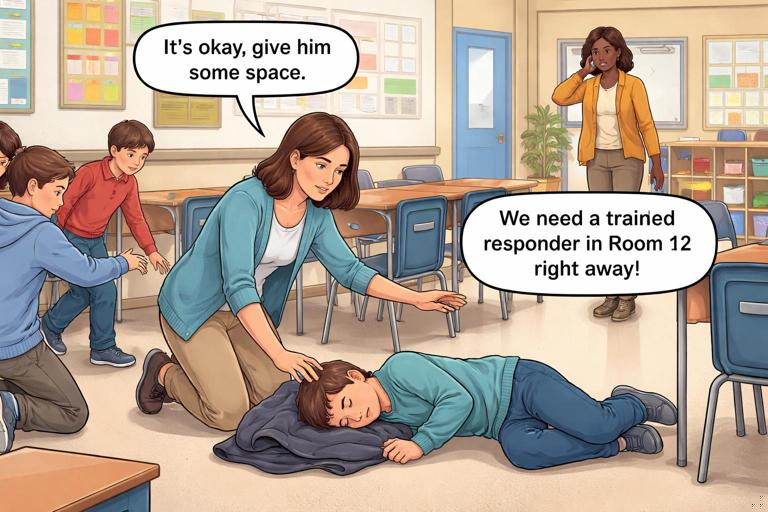
A student with a documented Seizure Action Plan collapses during reading time and begins convulsing. The teacher signals the office for the trained responder, starts timing, clears desks away, and cushions the head with a jacket. When the trained responder arrives, they follow the plan’s timing threshold for rescue medication and document the administration time. After the seizure ends, the student is placed on their side and monitored in a quiet area. Staff record the duration, observed features, and recovery time, and notify the parent/guardian per policy.
Example 3: Focal seizure with confusion (pre-teen)
A 12-year-old suddenly stops talking, stares, and repeatedly smacks their lips while picking at their shirt. They do not fall, but they are not responding normally. The caregiver starts timing, guides the child away from stairs, and keeps them seated safely. The episode lasts about 90 seconds. Afterward, the child is confused and embarrassed. The caregiver stays calm, offers reassurance, checks for injuries, and documents the behavior and duration. Because this is a first-time event, they seek same-day medical evaluation and bring the written description.