Why “running the conversation” matters
In many workplace negotiations, the outcome is shaped less by a single brilliant argument and more by who guides the flow of the discussion. “Running the conversation” means you deliberately manage the sequence: you open with a purpose, ask questions that surface decision criteria, listen for what is not being said, and frame options so the other side can say “yes” without feeling cornered. This is especially important in non-sales roles where you often negotiate sideways (with peers), upward (with leaders), or cross-functionally (with teams that have different metrics and pressures).
Running the conversation is not about dominating airtime. It is about creating a structure that makes it easier to exchange information, reduce misunderstandings, and make decisions. The core tools are: (1) questions that reveal priorities and constraints, (2) listening that captures meaning and emotion, and (3) framing that shapes how choices are perceived.
Conversation architecture: a simple map you can reuse
Use a repeatable structure so you do not improvise under pressure. A practical map is: Open → Diagnose → Confirm → Explore → Decide.
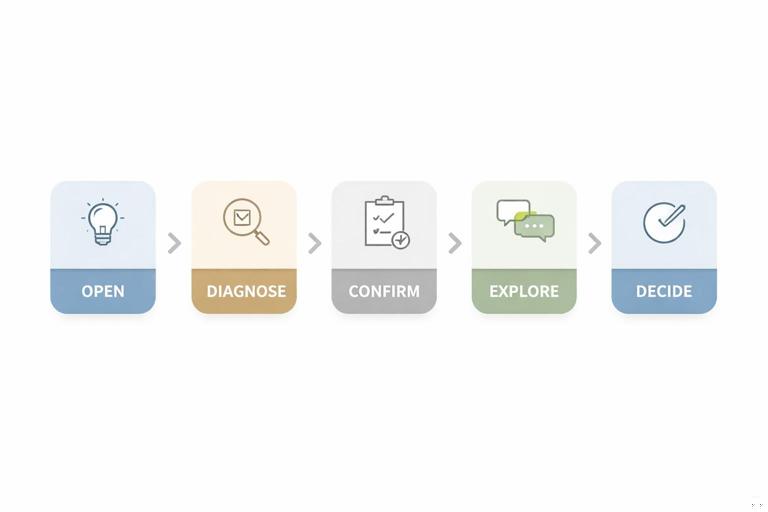
- Open: Set purpose, time, and desired output of the meeting.
- Diagnose: Ask questions to understand needs, constraints, and decision process.
- Confirm: Summarize what you heard and test for accuracy.
- Explore: Generate and evaluate options using clear criteria.
- Decide: Agree on next steps, owners, and timelines (even if the decision is “we need more data”).
This structure keeps you from jumping too early into solutions or defending your position before you understand theirs.
Opening moves: set the frame before content
The first 60 seconds often determine whether the conversation becomes collaborative or combative. Your opening should do three things: clarify the goal, define the agenda, and invite correction.
- Listen to the audio with the screen off.
- Earn a certificate upon completion.
- Over 5000 courses for you to explore!

Download the app
Step-by-step opening script
- State the purpose: “I’d like to align on how we’ll handle X so we can hit Y deadline without surprises.”
- Propose a process: “I suggest we spend 10 minutes on constraints, 10 on options, and 5 on next steps.”
- Invite adjustment: “Is there anything you want to add or change before we start?”
This creates psychological safety and signals you are not trying to trap them. It also gives you permission to steer later: if the discussion drifts, you can reference the agreed process.
Micro-frames that reduce defensiveness
- Joint problem frame: “Let’s solve for both reliability and speed.”
- Learning frame: “I may be missing context—help me understand how you’re seeing it.”
- Constraint frame: “We both have limits; let’s surface them early so we don’t waste time.”
Questions: the steering wheel of negotiation
Questions do more than gather information. They shape attention. A well-placed question can move the conversation from positions to criteria, from blame to problem-solving, and from vague objections to specific conditions for agreement.
Principles for effective negotiation questions
- Ask to learn, not to corner: If your question sounds like a cross-examination, you will get guarded answers.
- One question at a time: Multi-part questions invite selective responses and confusion.
- Prefer “what/how” over “why”: “Why” can sound accusatory; “what led to…” or “how did you decide…” is softer.
- Use silence: After asking, pause. People often fill silence with useful detail.
A question toolkit (with examples)
1) Diagnostic questions (surface constraints and drivers)
- “What does success look like for you on this?”
- “What constraints are you working under—time, budget, policy, risk?”
- “What’s the biggest concern you have about moving forward?”
- “What would make this easy to approve on your side?”
2) Criteria questions (reveal how decisions are made)
- “What criteria will you use to choose between options?”
- “How are you weighing cost vs. speed vs. quality?”
- “What’s non-negotiable, and what’s flexible?”
3) Process questions (clarify steps, stakeholders, and timing)
- “Who else needs to be comfortable with this?”
- “What’s the approval path and typical timeline?”
- “If we agree today, what happens next?”
4) Calibration questions (invite collaboration and reduce resistance)
- “How can we make this work given the deadline?”
- “What would you need from me to feel confident about this?”
- “What’s the best way to handle the risk you’re pointing out?”
5) Testing questions (check assumptions and prevent surprises)
- “If we did X, what would break?”
- “What’s the downside from your perspective?”
- “What am I not seeing that you are?”
Step-by-step: turning an objection into a useful conversation
When you hear “No, that won’t work,” avoid responding with a counterargument. Instead, run a short sequence:
- Label: “It sounds like this creates risk for your team.”
- Clarify: “What part is the biggest issue—timing, resources, or compliance?”
- Quantify: “How big is the impact if we proceed as-is?”
- Condition: “What would need to change for it to work?”
- Confirm: “So if we can address A and B, you’d be comfortable moving forward?”
This sequence converts a vague “no” into specific conditions, which you can then evaluate and work with.
Listening: extracting meaning, not just words
Listening in negotiation is an active skill: you are tracking content, emotion, and intent. Many workplace negotiations stall because people listen only for openings to rebut. When you listen to understand, you gain leverage: you learn what they truly care about, you reduce defensiveness, and you can propose solutions that fit their reality.
Three layers of listening
- Level 1: Facts (what happened, what is needed, what is constrained)
- Level 2: Interpretation (what they believe the facts mean, what they fear, what they assume)
- Level 3: Emotion and identity (what would make them look competent, safe, fair, respected)
In non-sales roles, Level 3 is often the hidden driver: a manager may resist a plan not because it is flawed, but because it threatens their team’s credibility or increases perceived accountability.
Active listening behaviors you can practice
- Minimal encouragers: “Go on.” “Say more.” “I’m following.”
- Mirroring: Repeat the last 1–3 key words as a question: “Not feasible?” This invites elaboration.
- Paraphrasing: “So your main concern is the support load after launch.”
- Labeling emotion: “It sounds frustrating.” “It seems like you’re under a lot of pressure to deliver.”
- Summarizing with structure: “Let me recap: your priorities are A and B; your constraints are C; and the risk is D. Did I get that right?”
These behaviors slow the conversation down just enough to prevent misalignment and to signal respect.
Step-by-step: the “listen–validate–redirect” loop
Use this loop when the conversation becomes tense or repetitive.
- Listen: Let them finish. Do not interrupt to correct details.
- Validate: Acknowledge the logic or feeling without conceding the point: “That makes sense given the audit requirements.”
- Redirect: Move to a productive question: “Given that requirement, what options do we have that still meet the timeline?”
Validation is not agreement. It is recognition. Recognition reduces the need for them to repeat themselves louder.
Framing: shaping how choices are understood
Framing is the way you present an issue so that certain aspects become salient: risk vs. opportunity, short-term vs. long-term, fairness vs. efficiency, certainty vs. flexibility. In negotiation, framing influences what feels reasonable and what feels extreme.
Good framing is not manipulation; it is clarity. You are helping the other side see the decision in a way that matches the real trade-offs and avoids false dilemmas.
Common workplace frames (and when to use them)
1) The “shared goal” frame: Use when teams are siloed.
- Example: “We both want a stable launch; the question is which approach gets us there with the least rework.”
2) The “constraints are real” frame: Use when someone assumes you can simply “try harder.”
- Example: “We can absolutely improve turnaround time; within current staffing, the realistic range is X to Y days.”
3) The “risk management” frame: Use when the other side is cautious or accountable.
- Example: “Let’s define what ‘safe enough’ means and what monitoring we’ll put in place.”
4) The “options, not ultimatums” frame: Use when the conversation becomes positional.
- Example: “I see at least three workable paths; can we evaluate them against your criteria?”
5) The “fair process” frame: Use when fairness concerns block progress.
- Example: “Let’s agree on the criteria first, then apply them consistently.”
Reframing: moving from stuck to solvable
Reframing is a specific technique: you take a statement that creates conflict and translate it into a neutral, solvable problem. The key is to preserve the underlying concern while removing blame or absolutes.
- From blame: “Your team always changes requirements.” To process: “We need a clearer change-control process so late changes don’t derail delivery.”
- From absolute: “We can’t do that.” To conditions: “Under what conditions could it be possible?”
- From personal: “You’re not being reasonable.” To criteria: “What criteria would make this feel reasonable to you?”
Step-by-step: framing an ask without triggering resistance
- Context: “Given the new compliance requirement…”
- Impact: “…we’re seeing a 20% increase in review time.”
- Shared objective: “We both want to keep releases predictable.”
- Choice set: “We have two viable approaches: A (faster, higher coordination) or B (slower, lower risk).”
- Invite criteria: “Which criteria matter most to you in choosing between them?”
This approach reduces the sense that you are demanding a concession; you are inviting a decision.
Managing airtime and turn-taking
Running the conversation includes managing how long each person speaks and ensuring key topics are covered. If you talk too much, you lose information. If you talk too little, you lose direction.
Practical techniques
- Use signposting: “I’ll make two points, then I want your reaction.”
- Time-box deep dives: “Let’s spend five minutes on root cause, then decide next steps.”
- Park issues: “That’s important; can we park it and return after we settle the timeline?”
- Invite quieter stakeholders: “We’ve heard from A and B; C, what’s your view?”
These techniques are especially useful in cross-functional meetings where the loudest voice can unintentionally set the agenda.
Handling rapid-fire questions and pressure tactics (without escalating)
Sometimes the other side uses speed, volume, or repeated questioning to gain control. Your goal is to slow the pace and restore structure.
Step-by-step: regain control when you feel rushed
- Name the pace: “There are a few important questions coming at once.”
- Propose an order: “Can we take them one by one? I suggest we start with scope, then timing, then risk.”
- Answer briefly: Provide a concise response, then ask a question back to keep it two-way.
- Confirm: “Does that address your question on timing?”
This prevents you from being pulled into a defensive monologue and re-establishes a collaborative rhythm.
Using summaries to lock in alignment
Summaries are a powerful way to run the conversation because they convert talk into shared understanding. They also surface disagreements early, when they are cheaper to fix.
Two types of summaries
- Alignment summary (during the meeting): “So we agree the priority is reducing incidents, and the constraint is on-call capacity.”
- Decision summary (end of a segment): “We’re choosing option B, with a checkpoint in two weeks and A as the fallback if metrics slip.”
Step-by-step: the “checkpoint summary” every 10–15 minutes
- What we heard: “Here’s what I’m hearing…”
- What we agree: “We seem aligned on…”
- Open items: “We still need to resolve…”
- Next question: “Is it okay if we move to…”
This keeps the discussion from looping and helps prevent the classic problem of leaving a meeting with different interpretations.
Practical examples in non-sales contexts
Example 1: Negotiating project scope with a peer team
Situation: A partner team wants additional features added late in the cycle.
Run the conversation:
- Open: “Let’s align on what’s needed for launch and what can follow after, so we protect stability.”
- Diagnose questions: “What user problem does the added feature solve?” “What happens if it ships one sprint later?” “Who is asking for it and why now?”
- Listen for emotion: The partner may fear stakeholder backlash. Label it: “It sounds like you’re worried about disappointing leadership.”
- Frame choices: “We can either (A) include it now with higher risk and more testing, or (B) ship core now and commit to a dated follow-up. Let’s pick based on risk tolerance and stakeholder expectations.”
- Confirm: “If we commit to a follow-up date and a communication plan, does that address the concern?”
Example 2: Negotiating priorities with your manager
Situation: You have too many tasks and need a decision on what to deprioritize.
Run the conversation:
- Open: “I want to confirm priorities for the next two weeks so I can deliver reliably.”
- Criteria questions: “Which outcomes matter most right now—speed, quality, stakeholder visibility, or risk reduction?”
- Listen: Your manager may be balancing political pressure. Paraphrase: “So the executive update is driving urgency.”
- Frame: “Given capacity, we’re choosing what to delay. Let’s decide explicitly rather than implicitly.”
- Summary: “To recap: I’ll deliver A by Friday, B next week, and we’ll pause C unless D changes.”
Example 3: Negotiating with a vendor or external partner on delivery timing
Situation: A vendor misses milestones and asks for more time.
Run the conversation:
- Open: “Let’s understand what’s driving the slip and agree on a plan that restores predictability.”
- Diagnostic questions: “What specifically caused the delay?” “What dependencies are still uncertain?” “What can you commit to with high confidence?”
- Listening: Watch for vague language (“should,” “probably”). Ask follow-ups: “What would make it ‘definite’?”
- Frame: “We need a plan that reduces uncertainty: smaller milestones, clearer acceptance criteria, and earlier risk flags.”
- Confirm: “If we agree on weekly checkpoints and a revised milestone plan, can you commit to the new dates?”
Common pitfalls and how to correct them in real time
Pitfall 1: Asking leading questions that trigger defensiveness
Risk: “Don’t you agree this is the only reasonable option?” invites resistance.
Correction: Replace with a criteria question: “What would make an option reasonable to you?”
Pitfall 2: Listening only for facts and missing identity concerns
Risk: You solve the technical issue but the person still resists.
Correction: Add a label: “It sounds like you’re concerned about accountability if this goes wrong.” Then ask: “What would make you feel protected?”
Pitfall 3: Framing as a binary choice
Risk: “Either we do X or we fail” creates fear and stubbornness.
Correction: Reframe into options and criteria: “Let’s list two or three approaches and evaluate them against timeline, risk, and effort.”
Pitfall 4: Over-explaining
Risk: Long explanations sound like persuasion attempts and reduce dialogue.
Correction: Use a short statement then a question: “The main constraint is test capacity. How does that land with you?”
Practice drills you can use before your next negotiation
Drill 1: Write five diagnostic questions in advance
Before the meeting, draft five questions you genuinely do not know the answer to. If you already know the answer, it is not diagnostic. Example categories: constraints, criteria, stakeholders, timing, and risk.
Drill 2: Paraphrase in one sentence
After the other person speaks, practice summarizing their point in one sentence starting with “So you’re saying…” Then ask, “Did I get that right?” This builds the habit of confirming meaning before responding.
Drill 3: Reframe three common “stuck” statements
Take phrases you hear often and pre-write reframes.
Stuck: “We can’t do that.”  Reframe: “What would need to be true for it to be possible?”
Stuck: “That’s not my problem.”  Reframe: “What part is in your scope, and what part isn’t?”
Stuck: “This is unfair.”  Reframe: “What would a fair process or outcome look like to you?”
Drill 4: Build a “checkpoint summary” template
Create a reusable sentence you can say naturally: “Let me pause and recap what we’ve aligned on and what’s still open.” Practicing this line makes it easier to use under stress.