Why pushback happens (and why it’s useful)
Pushback, objections, and difficult behaviors are not signs that a negotiation is failing. In non-sales roles, they often signal that the other party is protecting constraints (budget, time, risk, reputation), managing internal politics, or testing whether you can hold a line without becoming rigid. Treat pushback as information: it reveals what the other side fears, what they need to justify a decision internally, and where the real decision power sits.
It helps to separate three things that often get mixed together:
- Objections: substantive concerns about the proposal (cost, feasibility, compliance, timeline, quality).
- Pushback: resistance to movement or to your process ("Why do we need this?", "We’ve never done it that way", "Just send the final number").
- Difficult behaviors: interpersonal tactics or emotional conduct (interrupting, stonewalling, sarcasm, threats, personal attacks).
Each requires a different response. Objections need problem-solving. Pushback needs reframing and structure. Difficult behaviors need boundary-setting and process control.
A practical diagnostic: content, process, or relationship?
When you feel tension rising, quickly diagnose what’s happening by labeling it internally as one of three categories:
- Content issue: disagreement about facts, options, constraints, or criteria.
- Process issue: disagreement about how the decision will be made, who is involved, what steps come next, or the pace.
- Relationship issue: trust, respect, tone, or perceived fairness.
This diagnostic prevents you from answering the wrong question. For example, if someone says, “This is too expensive,” that might be content. But if they say it repeatedly without engaging with alternatives, it may be process (they want you to bid against yourself) or relationship (they don’t trust your numbers). Your response should match the category.
- Listen to the audio with the screen off.
- Earn a certificate upon completion.
- Over 5000 courses for you to explore!

Download the app


Step-by-step method for handling objections: A.C.K. (Acknowledge, Clarify, Keep moving)
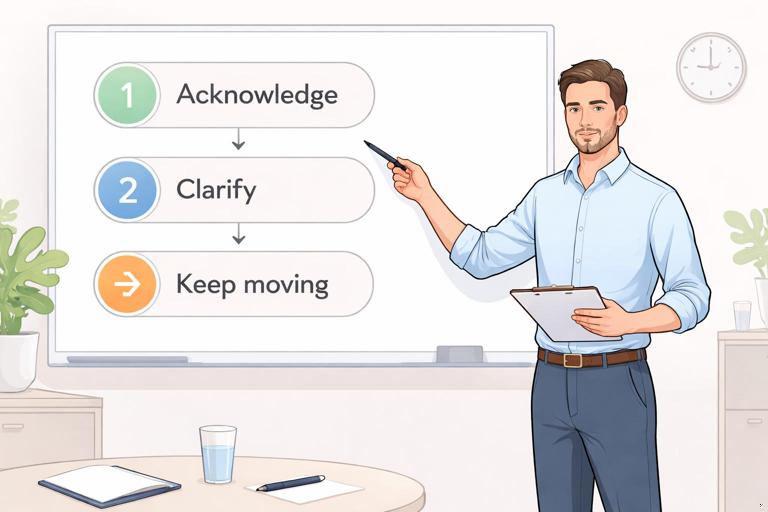
Use a simple, repeatable sequence to stay calm and effective. The goal is not to “win” the moment; it’s to keep the conversation productive while protecting your boundaries.
Step 1: Acknowledge (without conceding)
Acknowledgment is not agreement. It signals you heard them and reduces defensiveness. Use neutral language that reflects their concern.
- “I hear that timeline is your biggest concern.”
- “That makes sense to raise—risk is a real factor here.”
- “Thanks for flagging that; let’s unpack it.”
Avoid phrases that imply you accept their premise when you don’t (e.g., “You’re right,” “That is too expensive”).
Step 2: Clarify (turn the objection into a specific problem)
Most objections are vague. Your job is to make them concrete and testable. Ask targeted questions to identify the real constraint, the decision criteria, and what “good” looks like.
- Scope clarity: “Which part feels most expensive—the implementation work, the ongoing support, or the tooling?”
- Thresholds: “What budget range did you have approval for?”
- Comparisons: “Expensive compared to what alternative?”
- Impact: “If we don’t solve this, what breaks operationally?”
- Decision path: “Who needs to sign off, and what do they need to see?”
Clarifying questions also reveal whether the objection is real or tactical. If they can’t specify, it may be a reflexive “no” or a request for you to discount without justification.
Step 3: Keep moving (propose a next step, option, or test)
Once clarified, move forward with a concrete response: offer an option, suggest a test, or propose a process step. The key is to avoid getting stuck in debate.
- “If budget is capped, we can reduce scope A or extend timeline B—what’s more workable?”
- “Let’s validate the risk: we can run a two-week pilot with success criteria X and Y.”
- “If legal is the blocker, let’s schedule 30 minutes with them and walk through the redlines together.”
Common objection types and effective responses
1) “It’s too expensive” (budget objection)
In non-sales roles, “too expensive” often means “I can’t justify this internally” or “I’m protecting my budget.” Respond by shifting from price to justification and structure.
- Clarify: “Is the issue the total amount, the timing of spend, or the budget owner?”
- Reframe: “If we can show this prevents X hours of rework per month, would that change how finance views it?”
- Structure: “We can split delivery into phases so the spend aligns with milestones.”
Example (IT project with a business unit):
Business partner: “This is too expensive.”
You: “Understood. When you say expensive, is it that the total exceeds your approved budget, or that the ROI isn’t clear yet?”
Business partner: “Both.”
You: “Let’s tackle them separately. For budget: we can phase it into Q2 and Q3. For ROI: we’ll quantify the manual work eliminated and the risk reduction. If we can document that in a one-pager for finance, would you be able to sponsor it?”
2) “We don’t have time” (timeline objection)
This can mean they are overloaded, they fear disruption, or they want to delay a decision. Convert “no time” into prioritization and sequencing.
- “What’s driving the deadline—an external date, internal dependency, or resource availability?”
- “If we reduce scope, what’s the minimum viable outcome you still need?”
- “Could we do a short discovery now and commit to build after your peak period?”
Example (HR policy rollout):
Stakeholder: “We can’t do this this quarter.”
You: “Got it. Is the constraint your team’s capacity, or is there a business event we need to avoid disrupting?”
Stakeholder: “Capacity.”
You: “Then let’s separate decision from execution. Can we agree on the policy direction now, and schedule implementation for next quarter with a light-touch comms plan in the meantime?”
3) “This won’t work here” (feasibility/culture objection)
This is often a protective statement based on past failures. Don’t argue. Ask for specifics and propose a low-risk test.
- “What part won’t work—tools, process steps, or adoption?”
- “What happened last time we tried something similar?”
- “What would we need to see in a pilot to feel confident?”
Then propose a controlled experiment with clear success metrics and exit criteria.
4) “We’ve always done it this way” (status quo objection)
Status quo objections are about uncertainty and loss. The response is to make the cost of staying the same visible and to reduce perceived risk of change.
- “What does the current approach do well that we must preserve?”
- “Where is the current approach failing or creating rework?”
- “If we keep the current approach, what’s the risk over the next 6–12 months?”
Offer continuity: keep what works, change what doesn’t, and stage the transition.
5) “Your team caused this problem” (blame objection)
Blame can derail negotiations by triggering defensiveness. Your goal is to acknowledge impact, separate intent from outcome, and redirect to repair.
- “I hear the impact was serious.”
- “Let’s focus on what needs to be true going forward.”
- “What would repair look like from your perspective—service levels, credits, process changes?”
If there is real fault, you can acknowledge responsibility without over-admitting or speculating. Keep statements factual and tied to corrective actions.
Handling difficult behaviors: keep the relationship, control the process
Difficult behaviors are often attempts to gain advantage through emotion, speed, or intimidation. Your leverage is composure and structure. The goal is not to diagnose their personality; it’s to keep the interaction safe and productive.
Behavior 1: Interrupting and talking over you
What it signals: dominance play, impatience, or anxiety.
Response pattern: name the process, then propose a structure.
- “I want to make sure we cover your points and mine. Can we do two minutes each without interruptions?”
- “Let me finish this thought, then I’ll come back to your question.”
If it continues, escalate gently: “If we can’t take turns, we’ll need to pause and reschedule when we can have a productive discussion.”
Behavior 2: Stonewalling (“Send it in an email”; silence; no decisions)
What it signals: lack of authority, fear of commitment, competing priorities, or a tactic to wear you down.
Response pattern: make the decision path explicit and time-bound.
- “What decision are you able to make today, and what needs someone else?”
- “What information would make this easy to approve?”
- “Can we agree that if we don’t hear back by Thursday, we’ll assume option B and proceed?”
Be careful with “assume and proceed” if it could damage trust; use it when you have a clear mandate or when delay creates real cost that they accept.
Behavior 3: Aggressive tone, sarcasm, or personal jabs
What it signals: stress, insecurity, or an attempt to destabilize you.
Response pattern: set a boundary on tone, then return to substance.
- “I’m open to direct feedback. I’m not comfortable with personal comments. Let’s focus on the proposal.”
- “I want to solve this with you, and I need us to keep the conversation respectful.”
If it persists, pause: “I’m going to suggest we take a break and come back when we can continue constructively.”
Behavior 4: Threats and ultimatums (“Take it or leave it”)
What it signals: they want to force a quick concession, or they believe they have power.
Response pattern: don’t mirror the threat; slow down and test it.
- “Help me understand what’s driving that constraint.”
- “If those are the only terms available, we may not be able to proceed. Are there any alternatives you’d consider?”
- “What would need to change for you to have flexibility?”
Sometimes the right move is to accept the ultimatum as information and shift to internal escalation or alternative options. The key is to avoid negotiating against yourself under pressure.
Behavior 5: “Good cop / bad cop” or inconsistent messages
What it signals: internal misalignment on their side or a deliberate tactic.
Response pattern: unify the conversation around shared criteria and a single decision owner.
- “I’m hearing two different priorities: speed and risk control. Which one is the decision driver?”
- “Who is the final approver, and can we include them in the next meeting?”
De-escalation tools you can use in the moment
Use “labels” for emotion and constraint
Labeling is a short statement that names what you observe without judging it. It reduces intensity and invites correction.
- “It sounds like you’re under pressure to cut costs.”
- “It seems like the risk of downtime is the main fear.”
- “It looks like this decision has a lot of visibility.”
Then pause. Silence gives them space to confirm or correct, which often reveals the real issue.
Use “micro-summaries” to stop spirals
When a discussion loops, summarize in 20–30 seconds:
- “Let me check I’ve got it: you need A by date B, you’re worried about risk C, and you can’t exceed budget D. Did I miss anything?”
This resets the conversation and creates a shared map of the problem.
Use “two-track” statements: empathy + structure
Combine acknowledgment with a process move:
- “I see why this is frustrating. To move forward, can we agree on the criteria we’ll use to choose between options?”
- “That’s a fair concern. Let’s list the risks and decide which ones we can mitigate versus accept.”
Turning objections into joint problem-solving (without repeating earlier frameworks)
Once an objection is clarified, shift the interaction from “me vs. you” to “us vs. the problem.” Practical ways to do that:
- Externalize the constraint: “The constraint is the audit requirement, not either of our preferences.”
- Use shared criteria: “Let’s evaluate options by impact on customers, compliance, and workload.”
- Offer controlled choices: “Would you rather adjust scope or adjust timeline?”
- Propose a test: “Let’s run a pilot to reduce uncertainty before committing.”
Example (Finance vs. Engineering on tooling):
Finance: “We’re not approving another tool.”
You: “Understood. Is the concern tool sprawl, cost, or security review overhead?”
Finance: “All three.”
You: “Let’s treat that as the problem to solve. If we can consolidate two existing tools and keep net cost flat, and security signs off via the standard review, would that meet your criteria?”
When pushback is actually a request for reassurance
Some objections are not about the proposal; they’re about fear of being blamed if something goes wrong. In non-sales roles, stakeholders may resist because they carry operational risk. Provide reassurance through clarity and accountability.
- Define ownership: “My team will own the rollout plan and weekly status updates.”
- Define escalation: “If we hit a blocker, we escalate within 24 hours to X and Y.”
- Define safeguards: “We’ll include a rollback plan and a change freeze window.”
This kind of reassurance often reduces “no” responses that are really “I’m scared to say yes.”
Scripts for common high-friction moments
When they demand an immediate answer
- “I can give you an initial view now, and I want to confirm one detail before I commit. Can I come back to you by 3pm today?”
When they try to re-open settled points
- “We can revisit it if new information has emerged. What changed since we agreed on it?”
When they accuse you of being inflexible
- “I’m flexible on how we get there, but I’m not flexible on the requirement that we meet compliance and protect uptime. Let’s look for options within those constraints.”
When they say “Just do it for free” (or “It should be included”)
- “I can’t commit to that as-is. If we include it, we’ll need to adjust either scope, timeline, or resourcing. Which trade-off would you prefer?”
When they use vague rejection (“This isn’t acceptable”)
- “What would make it acceptable? Is it the deliverable, the timeline, the risk controls, or something else?”
Protecting yourself and your team: boundaries and escalation
Non-sales negotiators often represent a function (Legal, HR, IT, Ops) and must protect their team from scope creep, unrealistic deadlines, and abusive conduct. Boundary-setting is not hostility; it is role clarity.
Set boundaries on scope and workload
Use explicit language about capacity and prioritization:
- “We can take this on, but it means deprioritizing X. Which should we pause?”
- “We can deliver by that date if we remove these two items. Otherwise the earliest is…”
Set boundaries on behavior
Have a prepared line for disrespectful behavior, and use it early:
- “I’m here to solve the problem. If the conversation stays personal, I’ll end the meeting and we can continue with a mediator present.”
Know when to escalate
Escalation is appropriate when:
- There is repeated disrespect or harassment.
- They demand commitments outside your authority.
- Risk, compliance, or safety is being ignored.
- Deadlines are imposed without agreement on trade-offs.
Escalate with facts and options, not complaints. A useful format is: situation, impact, decision needed, options.
Situation: Stakeholder requests launch in 2 weeks with full scope and no additional resources. Team capacity is fixed. Impact: High risk of defects and missed compliance checks. Decision needed: Choose timeline or scope adjustment. Options: (1) Keep scope, launch in 6 weeks. (2) Launch in 2 weeks with reduced scope A/B. (3) Add 2 contractors for 4 weeks to meet 2-week date.Handling multi-party pushback in meetings
Pushback is harder when it happens in front of others because people perform for status. Your job is to keep the group aligned on the question being solved.
Technique: park, label, and sequence
- Park: “Let’s park the vendor comparison for a moment.”
- Label: “Right now we’re deciding the rollout approach.”
- Sequence: “First we agree criteria, then we compare options, then we assign owners.”
This prevents derailment without dismissing concerns.
Technique: invite the quiet constraint-holder
Often the real blocker is silent (security, legal, finance). Bring them in:
- “Before we decide, I’d like to hear from Security: what would make this acceptable from your standpoint?”
This reduces later “surprise objections” that appear after the meeting.
Practice drill: prepare for pushback before the meeting

Even though you can’t predict everything, you can prepare for the most likely objections and behaviors. A simple drill:
- List 5 likely objections (budget, timeline, feasibility, authority, precedent).
- For each, write: one acknowledgment line, two clarifying questions, and one forward-moving option.
- List 3 difficult behaviors you might face (interruptions, stonewalling, aggression).
- For each, write: one boundary line and one process reset line.
Example template you can reuse:
Objection: ______________________ Acknowledge: ______________________ Clarify Q1: ______________________ Clarify Q2: ______________________ Move forward: ______________________ Behavior: ______________________ Boundary line: ______________________ Process reset: ______________________This preparation reduces emotional reactivity and makes your responses consistent across stakeholders.