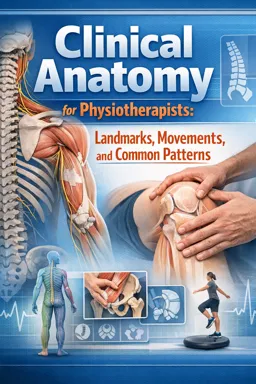
Clinical anatomy in physiotherapy decision-making
Clinical anatomy is the practical use of anatomical knowledge to explain what you can see, feel, and provoke during assessment, and to guide safe, testable hypotheses about movement problems. In physiotherapy, it links structure (bones, joints, muscles, nerves, fascia) to function (movement quality, symptom behavior, strength, range, coordination) so you can decide what to test next, what to treat, and when to refer.
Think of it as a mapping process: surface landmarks help you locate deeper structures; those structures constrain or enable joint motion; muscles and tendons generate and control motion; nerves and pain mechanisms influence motor output and symptom patterns. Your job is to translate a patient’s movement presentation into a small set of plausible anatomical and functional explanations that can be confirmed or ruled out with targeted tests.
(1) Core concepts: linking bones, joints, muscles, and nerves to observable movement
A. Bones and surface landmarks: the “map” for consistent assessment
Surface landmarks are palpable reference points that allow you to standardize where you observe, palpate, measure, and re-test. They improve reliability between sessions and between clinicians.
- Landmarks define orientation: e.g., locating the anterior superior iliac spine (ASIS) and posterior superior iliac spine (PSIS) helps you orient pelvic tilt and hip joint line estimates.
- Landmarks define lever arms: e.g., the lateral epicondyle approximates the elbow axis for observing flexion/extension and for positioning resisted tests.
- Landmarks define tissue targets: e.g., the greater tubercle region helps you approximate rotator cuff tendon insertions for palpation and symptom reproduction.
Practical rule: if you cannot name and palpate the landmark, you cannot reliably interpret the movement or the test that depends on it.
B. Joints: arthrokinematics and the “expected movement story”
Joints create predictable patterns of motion based on articular shape, capsuloligamentous restraints, and available accessory motion. In clinic, you rarely need to recite detailed arthrokinematics; you need to recognize when the movement story is inconsistent with what the joint should do.
- Listen to the audio with the screen off.
- Earn a certificate upon completion.
- Over 5000 courses for you to explore!

Download the app
- Range: Is the limitation global (many directions) or specific (one direction)?
- End-feel: Does it feel capsular, muscular, empty (pain-limited), or springy?
- Symptom behavior: Does pain appear early (high irritability) or only at end range (lower irritability)?
Example (pattern thinking): A shoulder that is limited in multiple directions with a firm capsular end-feel suggests a joint/capsule-dominant limitation; a shoulder limited mainly in one direction with a stretch end-feel suggests muscle length or neural mechanosensitivity may be more relevant.
C. Muscles and tendons: force production, control, and load response
Muscles contribute to movement in three clinically useful ways:
- Prime mover capacity: can the muscle generate force when asked?
- Synergy and timing: does the movement look coordinated, smooth, and efficient?
- Load tolerance: do symptoms increase with resistance, repetition, or sustained contraction?
Tendons and entheses (insertions) often present with load-related pain and localized tenderness. Clinical anatomy helps you choose the right loading direction and joint position to bias a specific tendon or muscle.
Example (biasing tissue): To bias a muscle in testing, position the joint to place it near mid-length for strength testing; to bias length, position it toward end-range stretch; to bias a tendon, apply load in the line of pull and observe symptom response over repetitions.
D. Nerves: symptom distribution, mechanosensitivity, and motor output
Nerves influence movement through sensation, pain, reflexes, and motor drive. Clinically, you map nerve involvement by combining:
- Distribution: symptoms following a dermatomal or peripheral nerve territory.
- Neurodynamic behavior: symptoms change with positions that tension or slacken neural tissue.
- Motor pattern changes: weakness, altered recruitment, protective guarding, or coordination loss.
Key link to movement: A patient may “move differently” not because a joint cannot move, but because the nervous system is protecting a sensitive structure. This is why observation and symptom behavior must be interpreted together.
E. From structure to movement: a simple mapping framework
Use this mapping sequence to connect what you see to what you test:
| What you observe | Likely contributors (examples) | What to test next |
|---|---|---|
| Limited range with firm end-feel | Capsule, joint stiffness, osteoarthritic change | Passive range, accessory motion, compare sides, symptom irritability |
| Pain with resisted contraction | Muscle/tendon load sensitivity | Resisted isometrics, repeated loading, palpate tendon/enthesis |
| Pain with stretch, minimal weakness | Muscle length sensitivity, neural mechanosensitivity | Length tests, neurodynamic differentiation, symptom mapping |
| Uncoordinated movement, guarding | Protective motor strategy, pain inhibition, fear, instability | Quality-focused active movement, graded exposure, stability/control tests |
| Symptoms distal to joint, variable with posture | Neural involvement, referred pain | Neuro screen, repeated movements/postural changes, red flag screen |
(2) Safety and scope: red flags, contraindications, and informed consent during palpation
A. Recognizing red flags for referral (screen before you stress tissues)
Clinical anatomy supports safety by helping you recognize when symptoms do not match a typical musculoskeletal pattern. Refer or seek urgent medical input when red flags suggest serious pathology.
- Possible fracture: significant trauma, inability to weight-bear/use limb, deformity, severe localized bony tenderness.
- Possible infection: fever, chills, unexplained systemic illness, hot swollen joint with severe pain, recent infection or immunosuppression.
- Possible cauda equina or severe neurological compromise: new urinary retention/incontinence, saddle anesthesia, rapidly progressive bilateral weakness.
- Possible vascular emergency: sudden severe limb pain with pallor/coldness, loss of pulses; calf swelling with risk factors for DVT; chest pain/shortness of breath with exertion-related symptoms.
- Possible malignancy: unexplained weight loss, night pain not eased by position, history of cancer with new unexplained symptoms.
Clinical action: stop provocative testing, document clearly, and follow local escalation/referral pathways.
B. Contraindications and precautions to testing
Before palpation and movement testing, decide what is safe to stress today based on irritability, tissue healing stage, and medical context.
- Absolute contraindications (examples): suspected fracture/dislocation not cleared; suspected infection in/around a joint; acute vascular compromise; unstable neurological signs; open wounds where contact is unsafe.
- Relative precautions (examples): high irritability (pain easily provoked and slow to settle); anticoagulation or bleeding disorders (bruising risk with deep palpation); osteoporosis (avoid high-force end-range); recent surgery (respect protocols); severe allodynia/hypersensitivity (modify touch and load).
Practical rule: if a test is likely to flare symptoms for hours or days, it is not a “good test” for that session—choose a lower-load alternative that still informs your hypothesis.
C. Informed consent and professional touch during palpation
Palpation is a clinical procedure. It requires explicit consent, clear explanation, and ongoing permission.
- Explain: what you will palpate, why it matters, and what the patient might feel (pressure, tenderness).
- Ask permission: “Is it okay if I palpate around your shoulder blade and collarbone?”
- Offer control: patient can stop at any time; agree on a stop signal.
- Maintain dignity: appropriate draping, minimal exposure, and professional hand placement.
- Communicate findings carefully: avoid alarming language; describe in functional terms (e.g., “sensitive today” rather than “damaged”).
(3) A consistent clinical method: observe → palpate → move → test → interpret patterns
This course uses a repeatable sequence that keeps assessment efficient and reduces missed information. Each step should generate a short list of hypotheses and a plan for the next step.
Step 1: Observe (static posture and dynamic movement)
Goal: identify the movement task that matters, the quality of movement, and the symptom behavior.
- Choose a meaningful task: sit-to-stand, overhead reach, gait, step-down, grip, squat, turning in bed—whatever reproduces the complaint.
- Watch for quality: speed, smoothness, asymmetry, compensations, tremor, breath holding, guarding.
- Track symptoms: location, intensity, onset (early/late), and what eases it.
Practical tip: observe once without cues, then repeat with a simple cue (slower, smaller range, different foot position) to see if the pattern is modifiable.
Step 2: Palpate (landmarks first, then tissues)
Goal: confirm orientation, locate key structures, and identify localized tenderness or swelling that matches the story.
Sequence:
- 2A. Landmark palpation: find 2–4 bony points that define the region (e.g., spine of scapula, acromion, greater trochanter, tibial tuberosity). Mark mentally (or with skin-safe marker if appropriate and consented).
- 2B. Tissue palpation: palpate along likely involved tissues (tendon, muscle belly, joint line) using graded pressure.
- 2C. Compare sides: temperature, swelling, tone, tenderness.
What counts as useful palpation: palpation that changes your hypothesis (e.g., “pain is clearly localized to the tendon insertion and matches resisted loading”). Palpation that only produces non-specific soreness is less informative.
Step 3: Move (active then passive)
Goal: separate movement control from available range and identify whether symptoms are provoked by motion, load, or position.
- 3A. Active movement: ask the patient to move through the relevant range. Note range, quality, and symptom onset.
- 3B. Passive movement: you move the segment to assess end-feel, symptom response, and whether range changes when the patient relaxes.
- 3C. Overpressure (only if appropriate): add gentle end-range pressure to clarify limitation type; avoid if high irritability or red flags.
Decision cues:
- Active limited, passive near normal: consider pain inhibition, motor control, or weakness.
- Active and passive limited similarly: consider joint/capsule, muscle length, or neural mechanosensitivity depending on end-feel and symptom behavior.
Step 4: Test (resisted and length tests)
Goal: bias specific tissues to see what reproduces symptoms and what fails under load.
- 4A. Resisted testing (often isometric first): choose a position that targets the suspected muscle/tendon while minimizing joint compression if irritable. Record pain (0–10), strength (e.g., MMT grade or dynamometer), and quality (smooth vs. shaky).
- 4B. Length testing: place the muscle on stretch gradually. Note whether symptoms are local stretch, referred, or neural-like (tingling, electric, burning).
- 4C. Repetition or sustained holds: use when load tolerance is the key complaint (e.g., symptoms that build with activity).
Practical step-by-step for a single resisted test:
- Position to isolate the target as much as feasible.
- Explain: “Build up to a moderate effort over 2 seconds; stop if sharp pain.”
- Apply resistance gradually (avoid sudden force).
- Record: pain intensity, location, strength, and after-effect at 30–60 seconds.
Step 5: Interpret patterns (cluster findings into a working hypothesis)
Goal: decide which anatomical/functional category best explains the pattern today and what to do next.
Use pattern logic rather than single-test certainty:
- Joint-dominant pattern: passive limitation, firm end-feel, pain at end range, less change with resisted tests.
- Contractile pattern: pain with resisted contraction and/or pain with stretch, localized tenderness in muscle/tendon, load-related symptom behavior.
- Neural pattern: distal symptoms, paresthesia, symptoms change with neural tension positions, inconsistent with local tissue loading alone.
- Motor control/protective pattern: variable range, guarding, improved with cueing, disproportionate fear or bracing, inconsistent strength output.
Re-test principle: after any meaningful intervention (education cue, taping, manual technique, graded loading), re-test the original movement task to confirm that your interpretation leads to change.
Starter checklist: documentation for landmarks, movement quality, symptoms, and irritability
Use this checklist to standardize notes and make re-testing meaningful. Keep it brief but specific.
1) Landmarks and palpation
- Region:
___ - Landmarks identified (2–6):
___ - Side-to-side differences:
temperature/swelling/tone - Point tenderness (location + depth):
___ - Palpation reproduction of symptoms?
Y/NIf yes:where/quality
2) Observation and movement quality
- Primary functional task observed:
___ - Movement quality:
smooth / guarded / jerky / asymmetrical / slow / breath-hold - Compensations:
___ - Modifiable with cueing?
Y/NCue used:___
3) Active and passive movement
- Active ROM:
direction(s) limited + symptom onset (early/late) - Passive ROM:
direction(s) limited + end-feel - Overpressure used?
Y/NResponse:___
4) Resisted and length tests
- Resisted tests performed:
___ - Pain with resistance:
0–10Location/quality:___ - Strength:
MMT/dynamometerNotes:___ - Length tests performed:
___ - Stretch response:
local stretch / referred / neural-like
5) Symptoms and irritability
- Baseline symptoms (rest):
0–10Location:___ - Irritability:
high / moderate / low(based on ease of provocation + time to settle) - After-effect of testing (30–60s and end of session):
better/same/worse - 24-hour behavior (if known):
___
6) Working pattern and next test
- Pattern category (provisional):
joint / contractile / neural / motor control - Top 2 hypotheses:
___ - Next step to confirm/refute:
___