Why the Term Sheet Matters (and What It Is)
A term sheet is a structured summary of the business and legal terms you intend to put into a definitive agreement. In partnerships, it acts as the bridge between “we agree in principle” and “we can execute without surprises.” It is not just a negotiation artifact; it is an execution artifact. A good term sheet reduces drafting cycles, prevents scope creep, and creates a shared operating model before lawyers turn language into enforceable clauses.
Unlike a full contract, a term sheet should be readable by operators. If the only people who can understand it are attorneys, it will fail at its main job: aligning the teams who must deliver the partnership. Your goal is to capture the minimum set of terms that, if misunderstood, would cause the partnership to break during implementation.
Term Sheet vs. Definitive Agreement vs. Statement of Work
Partnerships often involve multiple documents. Confusion about which document governs what is a common cause of execution delays. Use a simple hierarchy: the definitive agreement (or master agreement) sets the legal framework; the term sheet sets the commercial intent and key deal mechanics; and the statement of work (SOW) or order form defines deliverables, timelines, and pricing for a specific workstream.
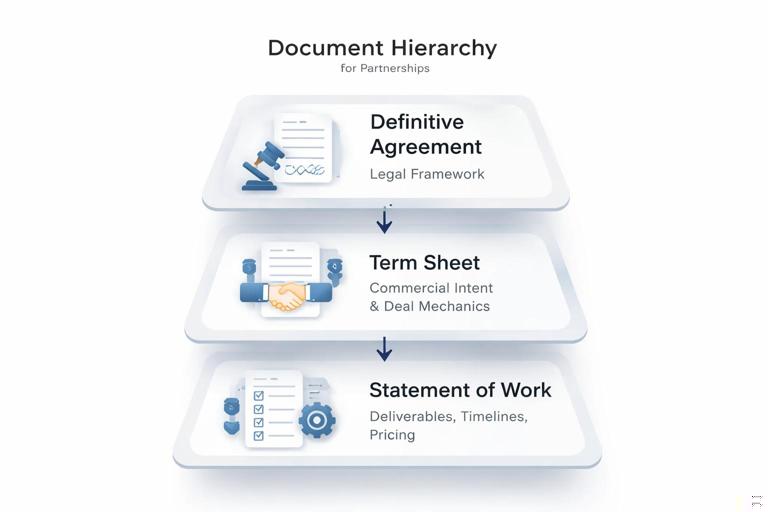
For example, a platform integration partnership might use: (1) a Master Partnership Agreement covering confidentiality, IP, liability, and dispute resolution; (2) a term sheet capturing revenue share, lead routing, co-marketing commitments, and exclusivity; and (3) an SOW for the first integration milestone with acceptance criteria and a delivery schedule. If you only have a contract without an operator-friendly term sheet, you risk “legal completeness” but “operational ambiguity.”
The Core Sections of a Partnership Term Sheet
1) Parties, Scope, and Definitions
Start with who is partnering (legal entities), what the partnership is (scope), and the few definitions that prevent downstream arguments. Definitions should be limited to terms that affect money, ownership, or obligations. Examples: “Qualified Lead,” “Net Revenue,” “Referral,” “Co-Sell Opportunity,” “Customer,” “Territory,” “Confidential Information,” and “Launch Date.”
- Listen to the audio with the screen off.
- Earn a certificate upon completion.
- Over 5000 courses for you to explore!

Download the app
Practical example: If you define “Qualified Lead” as “a company with 50+ employees that requests a demo,” you avoid disputes where one partner sends low-intent signups and expects credit. If you define “Net Revenue” as “gross receipts minus refunds and taxes, excluding pass-through fees,” you avoid revenue-share conflicts later.
2) Commercial Model and Economics
This section answers: how does value move between the parties? Common models include referral fees, revenue share, reseller margin, usage-based rev share, fixed sponsorships, or bundled offers. Specify the calculation method, payment timing, reporting cadence, and audit rights (lightweight but explicit).
- Revenue share: define percentage, base (gross vs net), and duration per customer.
- Referral fee: define flat fee vs percentage, when it is earned (contract signature vs first payment), and clawbacks for churn or non-payment.
- Reseller: define discount schedule, who invoices the customer, and who owns collections risk.
Practical example: “Partner A receives 20% of Net Revenue for 12 months from the Start Date of each Referred Customer; payments issued within 30 days after month-end; minimum payout threshold $500; reporting includes customer name, contract value, start date, and status.” This is operator-usable and lawyer-draftable.
3) Lead Flow, Deal Registration, and Rules of Engagement
If the partnership involves selling, you need explicit rules for how opportunities are created, routed, and credited. Term sheets should specify the system of record (CRM), required fields, response time SLAs, and conflict resolution for overlapping claims.
- Deal registration window: e.g., 30–90 days of protection after registration.
- Acceptance criteria: what makes a registration valid (named account, contact, use case).
- Response SLA: e.g., “acknowledge within 2 business days; first customer contact within 5 business days.”
Practical example: If both partners sell to mid-market, define “house accounts” and “named accounts” to avoid internal channel conflict. Also define what happens if the customer was already in the pipeline: no credit, split credit, or “first-touch wins” with evidence requirements.
4) Marketing and Brand Usage
Co-marketing is where partnerships often overpromise. Put commitments in measurable units: number of webinars, email sends, landing pages, event sponsorships, or content pieces. Specify who owns production, who approves copy, and the approval timeline.
Include brand usage rules: logo placement, trademark guidelines, and whether either party can issue a press release. Add a simple approval SLA (for example, “approval not unreasonably withheld; response within 5 business days”). This prevents launch delays caused by endless review loops.
5) Product/Integration Commitments (If Applicable)
If there is an integration, the term sheet should capture the “integration shape” without becoming a technical spec. Include: integration type (API, embedded, marketplace listing), dependencies, security requirements (SSO, SOC 2 expectations), and a milestone-based timeline. Save detailed acceptance criteria for the SOW, but ensure the term sheet states who builds what and who maintains it.
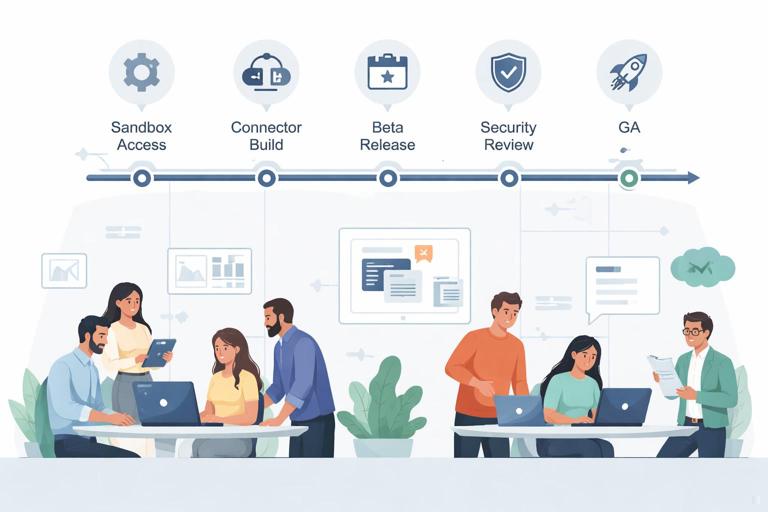
Practical example: “Partner A builds and maintains the connector to Partner B’s API; Partner B provides sandbox access and technical support up to 4 hours/week during build; both parties target a beta release by May 15; GA requires passing security review and completing joint documentation.”
6) Data Sharing, Privacy, and Customer Consent
Partnership execution often fails at the data boundary. The term sheet should specify what data is shared, for what purpose, and under what consent model. If personal data is involved, reference the need for a data processing addendum (DPA) and define which party is controller/processor in plain terms for operators.
- Data fields: e.g., name, email, company, usage metrics, billing status.
- Permitted purpose: e.g., “to deliver the integration and support joint customers.”
- Retention: e.g., “delete within 30 days of termination unless required by law.”
Practical example: If you plan to share product usage signals for co-selling, specify whether the customer must opt in, whether the signal is aggregated, and whether it can be used for marketing or only for customer success.
7) IP Ownership and Licensing
Term sheets should clearly state what each party owns before the partnership, what is created during the partnership, and what rights are granted. Keep it simple: “each party retains its pre-existing IP,” and define ownership of jointly created materials (content, integration code, templates).
Practical example: If you build an integration, decide whether the connector code is owned by the builder, jointly owned, or licensed. If you create co-branded content, define whether either party can reuse it after termination and under what brand rules.
8) Exclusivity, Territory, and Non-Compete Boundaries
Exclusivity is a high-risk term because it limits future options. If it exists, constrain it tightly: define the exact scope (product line, segment, geography), duration, and performance conditions. Add a clear “out” if minimum commitments are not met.
Practical example: “Exclusivity applies only to co-selling in the healthcare vertical in the UK for 6 months, contingent on 20 qualified opportunities created; if not met by month 4, exclusivity converts to non-exclusive.” This protects both parties and prevents indefinite lock-in.
9) Term, Termination, and Transition Assistance
Operators need to know what happens when the partnership ends. Include term length, renewal mechanics, termination for convenience vs cause, and what obligations survive (payments owed, confidentiality, IP licenses). Add transition assistance for customers: support window, data export, and communication responsibilities.
Practical example: “Upon termination, parties will support existing joint customers for 90 days; no new referrals after termination date; revenue share continues for active referred customers for the agreed attribution period.” This prevents customer harm and reduces disputes.
10) Governance: Owners, Cadence, and Escalation
Execution requires named owners. The term sheet should list the business owner, technical owner, and legal/finance contacts for each side. Define meeting cadence (weekly during launch, monthly thereafter) and an escalation path with time-bound steps.
- Working group: operators who unblock tasks.
- Steering group: executives who resolve trade-offs.
- Escalation SLA: e.g., “issues unresolved in 7 days escalate to steering.”
Practical example: If lead routing breaks, the working group has 48 hours to diagnose; if unresolved, steering decides whether to pause campaigns or adjust qualification rules.
A Step-by-Step Process to Build a Term Sheet That Drafts Cleanly
Step 1: Start from an Execution Map, Not a Legal Template
Before writing, outline the real workflow: how a lead is generated, qualified, handed off, sold, implemented, supported, and renewed. Then convert each “handoff point” into a term. This prevents missing clauses that only become visible once teams try to operate.
Step 2: Identify the “Dispute Prone” Terms
Not every detail belongs in a term sheet. Focus on terms that create disputes: money calculations, crediting rules, timelines, ownership, and exclusivity. If a misunderstanding would cost time, money, or reputation, it belongs in the term sheet.
Step 3: Write Operator-Readable Language First
Use plain language and examples. For each economic term, include a sample calculation. For each process term, include a simple SLA. Lawyers can convert it into formal language, but if operators cannot validate it, you will ship a contract that cannot be executed.
Step 4: Add a “Source of Truth” Table
Include a small table that states which system governs each data element: CRM for deal stage, billing system for revenue, marketing automation for campaign attribution, ticketing system for support SLAs. This reduces reporting fights.
Example source-of-truth table (simplified) Lead owner: CRM (Partner A) Deal stage: CRM (Partner B) Revenue: Billing system (Partner B) Referral list: Shared spreadsheet or portal Support tickets: Zendesk (Partner A)Step 5: Validate with the People Who Will Execute
Run the term sheet through a “tabletop exercise” with sales ops, marketing ops, finance, support, and product. Ask them to simulate one deal from start to finish and flag ambiguity. This is faster than discovering gaps after signature.
Step 6: Lock the Term Sheet Before Redlining the Contract
Make the term sheet the single commercial reference. Once both parties sign off on it (even if non-binding), instruct legal teams to draft to it. If new terms appear during redlines, route them back to the business owners and update the term sheet to maintain alignment.
Contract-to-Execution Handoff: Turning Signed Paper into a Working Partnership
Why Handoffs Fail
Most partnerships fail after signature because the contract is treated as the finish line. Common failure modes include: no internal owner, unclear launch date, missing enablement materials, no system configuration for lead routing, and finance not set up to pay or invoice correctly. The fix is a formal handoff process that treats signature as the start of delivery.

The Handoff Package (What Must Be Delivered at Signature)
Create a standardized handoff package that is attached to the internal deal record and shared with the partner. It should be short, actionable, and version-controlled.
- Final term sheet + definitive agreement: with a one-page operator summary.
- Operating plan: milestones, owners, and dates for launch activities.
- Enablement kit: pitch deck, one-pager, FAQs, objection handling, demo flow, integration overview.
- Process diagrams: lead routing, deal registration, support escalation.
- Reporting spec: what is reported, by whom, and when.
Step-by-Step: The First 30 Days After Signature
Step 1 (Day 0–2): Internal Deal Desk to Ops Kickoff
Hold a 30–45 minute internal kickoff with sales ops, finance, marketing ops, and the partnership owner. Review: economics, payment triggers, CRM fields required, and any restricted claims (exclusivity, territory). Assign each setup task an owner and a due date.
Step 2 (Day 2–7): Partner Joint Kickoff and Working Cadence
Run a joint kickoff focused on execution, not re-negotiation. Confirm launch date, campaign calendar, lead routing test plan, and escalation contacts. Set the recurring working meeting and define what “ready to launch” means (for example: tracking live, enablement delivered, landing page approved).
Step 3 (Week 1–2): Systems Configuration and Dry Runs
Configure the systems that operationalize the contract: CRM routing rules, deal registration form, shared partner portal access, billing tags for referred customers, and reporting dashboards. Perform dry runs: submit a test lead, register a test deal, and generate a sample payout report. Dry runs reveal missing fields and broken assumptions while stakes are low.
Step 4 (Week 2–3): Enablement and Certification
Enablement should be measurable. Require each side to complete a short certification: who the ideal customer is, how to position the joint solution, how to submit leads, and what not to promise. This reduces mis-selling and support burden.
Practical example: Create a 10-question checklist and require 80%+ to be “certified to refer.” If the partner has multiple reps, certify at least one champion per region before launch.
Step 5 (Week 3–4): Launch, Monitor, and Escalate Fast
Launch with a controlled first wave: one webinar, one email, or a limited set of accounts. Monitor lead quality, response times, and customer feedback. If SLAs are missed, escalate according to the governance terms. The goal is to correct process issues before scaling activity.
Operational Checklists You Can Reuse
Term Sheet Completeness Checklist
- Scope and definitions cover crediting, revenue base, and customer categories.
- Economics include calculation, timing, reporting, and edge cases (refunds, churn, upgrades).
- Lead/deal rules specify system of record, SLAs, and conflict resolution.
- Marketing commitments are quantified with approval timelines.
- Integration responsibilities and milestones are assigned (if applicable).
- Data sharing fields, purpose, consent, and retention are defined.
- IP ownership and reuse rights are clear for integration and content.
- Exclusivity (if any) is narrow, time-bound, and performance-conditioned.
- Termination includes customer transition and post-termination economics.
- Governance names owners, cadence, and escalation steps.
Contract-to-Execution Handoff Checklist
- Internal owner assigned; partner owner confirmed; escalation contacts exchanged.
- Launch date set; “ready to launch” criteria documented.
- CRM fields and routing rules implemented; test lead processed successfully.
- Deal registration process live; protection window configured.
- Billing and payout process set up; sample report generated.
- Enablement materials delivered; certification completed.
- Co-marketing assets approved; tracking links and landing pages validated.
- Support workflow defined; ticket routing and response SLAs tested.