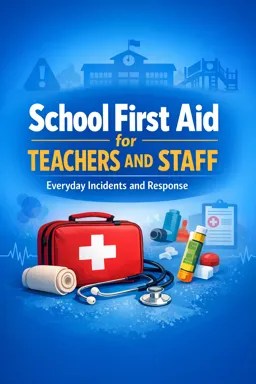
Scope of First Aid for Non-Medical School Staff: What You Can (and Cannot) Do
In a school setting, first aid by teachers and staff means providing immediate, temporary support until the student can be safely transferred to the school nurse/health office or emergency medical services (EMS). Your priorities are consistent across incidents: 1) scene safety, 2) student safety, 3) activate help. You are not expected to diagnose conditions, provide medical treatment beyond your training and school policy, or delay escalation when a situation looks serious.
Priority order of actions (a simple mental script)
- Scene safety: Is it safe for you to approach? Identify hazards (traffic, electricity, aggressive behavior, broken glass, chemicals, sports equipment in motion).
- Student safety: If safe, check responsiveness and obvious life threats; keep the student from further harm (move hazards away, stop activity, keep others back).
- Help activation: Call the nurse/health office and/or EMS per policy; delegate tasks (send a runner, call front office, retrieve kit/AED/meds).
Use this order even when you feel pressure to “do something” immediately. Unsafe rescuers create additional victims and slow care.
(1) Role Boundaries and When to Defer to the School Nurse/Health Office
What non-medical staff typically do
- Provide immediate safety measures (stop play, separate students, remove hazards).
- Basic first aid within training and policy (e.g., simple wound care, cold pack, positioning for comfort).
- Observe and report: what happened, what you see, what the student says, and what you did.
- Activate the school’s response system (nurse, office, emergency response team, parent/guardian notification per policy).
What to avoid (common boundary issues)
- Do not administer medications unless your role, training, and written school policy explicitly authorize it (including “over-the-counter” products).
- Do not pressure a student to “tough it out” or return to play/class if symptoms suggest risk.
- Do not make medical judgments (e.g., “it’s just anxiety,” “it’s definitely not a concussion”). Stick to observable facts.
- Do not delay escalation while searching for forms, calling parents first, or waiting for a supervisor if urgent signs are present.
When to defer immediately to the nurse/health office (and/or activate EMS per policy)
Defer when the student’s condition is beyond routine classroom care, when symptoms are escalating, or when you are unsure. Examples that should trigger immediate nurse involvement include: significant breathing difficulty, severe allergic reaction concerns, altered level of consciousness, serious injury mechanism (fall from height, head impact), uncontrolled bleeding, severe pain, or any situation where the student cannot be safely supervised in class.
(2) Personal Safety Precautions: Hygiene, Gloves, and Reducing Exposure
Your safety is part of student safety. Schools are high-contact environments, and bodily fluids (blood, vomit, saliva, nasal discharge) can spread infection. Use a consistent approach rather than deciding “case by case” in the moment.
Step-by-step: a quick PPE and hygiene routine
- Assess from a distance first: look for blood or fluids before touching anything.
- Put on gloves before contact with blood or bodily fluids, or when you anticipate contact (wound care, nosebleed assistance, vomiting).
- Use barriers: gauze, paper towels, disposable pads, or a clean cloth between you and fluids.
- Avoid hand-to-face contact while wearing gloves; keep your phone and personal items away from the care area.
- Remove gloves safely: peel off without snapping; avoid touching the outside surface.
- Hand hygiene immediately: wash with soap and water when available; use sanitizer if needed until washing is possible.
- Report and follow exposure procedures: if you have a splash to eyes/mouth, a bite that breaks skin, or contact with non-intact skin, follow the school’s exposure protocol promptly.
Practical tips that reduce exposure risk
- Keep a small “grab kit” accessible (gloves, gauze, barrier mask if available, sanitizer).
- Assign one staff member to provide care and another to manage the environment; fewer people near fluids means less contamination.
- If a student is vomiting, increase distance, provide a container if available, and keep others back; ventilate the area when possible.
(3) Quick Environmental Risk Scan: Classroom, Playground, Field Trips, Sports Areas
A fast hazard scan prevents secondary injuries and helps you choose the safest location for assessment. Make it a habit: scan high-risk hazards first, then control the crowd.
- Listen to the audio with the screen off.
- Earn a certificate upon completion.
- Over 5000 courses for you to explore!

Download the app
Step-by-step: 10-second risk scan
- Stop the activity: whistle/voice command; pause play or instruction.
- Look up, down, and around: falling objects, wet floors, sharp edges, traffic, moving equipment.
- Identify the “danger zone”: where could someone else get hurt in the next 30 seconds?
- Create space: move bystanders back; use cones, chairs, or staff positioning as a barrier.
- Choose a safe care spot: stable surface, away from crowds, with access for nurse/EMS.
Common hazards by setting
| Setting | High-frequency hazards | Immediate control actions |
|---|---|---|
| Classroom | Spilled liquids, broken glass, lab materials, cords, furniture edges | Block off area, remove students, isolate sharps, request custodial support |
| Playground | Falls from equipment, moving swings, uneven surfaces, heat exposure | Stop equipment use, clear landing zones, move student to shade |
| Field trips | Traffic, crowds, unfamiliar terrain, delayed access to supplies | Group accountability, designate meeting point, retrieve trip kit, call site security/EMS |
| Sports areas | High-speed collisions, balls/bats, exertional heat illness, ongoing play | Stop play, clear sideline space, assign supervision for team/peers |
(4) Basic Triage Mindset: Who Needs Urgent Attention First
Triage in schools is not about making medical diagnoses; it is about prioritizing attention when more than one student is involved or when the environment is chaotic. The goal is to identify who cannot safely wait.
A simple triage filter for staff
- Immediate: student appears in severe distress, symptoms are rapidly worsening, or there is a potential life threat.
- Next: student is stable but needs prompt evaluation by the nurse (significant pain, concerning mechanism, persistent symptoms).
- Later/monitor: minor complaints with stable appearance; can be observed while urgent needs are addressed.
Step-by-step: triage when multiple students are involved
- Call for help early: request the nurse and additional staff; do not wait until you “sort it out.”
- Quickly identify the most concerning student: look for inability to speak normally, extreme lethargy, or obvious severe injury.
- Assign supervision: direct another adult to stay with stable students; keep them in one visible location.
- Reassess frequently: a “stable” student can deteriorate; check in at short intervals until care is transferred.
When in doubt, treat uncertainty as risk: escalate to the nurse/health office and follow emergency procedures.
(5) Core Equipment Orientation: Kits, PPE, Cold Packs, Epinephrine, and Inhaler Policies
Readiness improves when staff know what is available, where it is stored, and what policies govern its use. Equipment is only helpful if it can be accessed quickly and used within role limits.
School first aid kit: what staff should recognize
- Barrier items: disposable gloves, hand sanitizer, CPR barrier mask/face shield (if included), disposable bags.
- Wound supplies: gauze pads, roller gauze, adhesive bandages, tape, antiseptic wipes (if permitted), sterile dressings.
- Tools: scissors, tweezers (policy-dependent), instant cold packs, triangular bandage.
- Documentation aids: incident report forms or QR/process instructions (if used), emergency contact list access method.
Know the kit’s location(s): classroom kits, playground kits, gym kits, field trip kits, and who is responsible for restocking.
PPE orientation: what “ready” looks like
- Gloves in multiple sizes and accessible without searching.
- Barriers for bodily fluids (absorbent pads, disposable bags).
- Clear disposal plan: where contaminated items go and who cleans the area.
Cold packs (ice packs): safe use reminders
- Use a barrier (cloth/paper towel) between cold pack and skin.
- Apply for short intervals per school guidance; monitor skin comfort.
- Do not use cold packs to “clear” a student to return to play if symptoms are concerning; refer to nurse/coach protocols.
Epinephrine auto-injector availability (stock and student-specific)
Staff should know whether the school has stock epinephrine, where it is stored, who is authorized to administer it, and the process for rapid retrieval. If a student has a prescribed auto-injector, know the policy for where it is kept (carried by student vs. stored) and how to access it quickly. In an emergency, time matters; do not send multiple people searching without coordination.
Asthma inhaler policies
Schools vary: some allow self-carry with authorization; others store inhalers in the health office. Staff readiness means knowing: who is approved to self-carry, how to contact the nurse quickly, and what to do if a student reports breathing trouble during activity. If a student requests help accessing their inhaler, follow the established policy and activate the nurse/office immediately.
(6) Communication Flow: Who to Call, What to Say, and Managing Bystanders
Clear communication prevents delays and confusion. Use a predictable flow: activate help, provide concise facts, control the scene, maintain supervision.
Who to call (typical school chain)
- School nurse/health office: first contact for medical evaluation and guidance when the situation is not clearly life-threatening.
- Main office/administrator: for additional staffing, parent/guardian notification coordination, and campus control.
- EMS (per policy): when urgent signs are present or when directed by nurse/administrator; do not wait for permission if policy allows immediate activation for emergencies.
- Campus security (if available): crowd control, directing EMS to location, managing hazards.
What to say: a structured script for calls/radio
Use a short, repeatable format so you do not forget key details under stress:
1) Location: exact place and best entry point (building, room, field gate). 2) Who: student age/grade (no names over open radio if policy restricts). 3) What happened: brief mechanism (fall, collision, allergic exposure, unknown). 4) What you see: main signs (breathing difficulty, bleeding, altered responsiveness, severe pain). 5) What you did: first aid steps taken and current status. 6) What you need: nurse/EMS, AED/kit, additional supervision, crowd control.Keeping bystanders and other students supervised
- Assign roles out loud: “You call the nurse. You bring the first aid kit. You take the class to the hallway.”
- Create a privacy and safety perimeter: move students back; use desks, cones, or staff positioning.
- Maintain adult coverage: never leave the injured student alone, and never leave the rest of the students unsupervised—delegate.
- Limit spectators and recording: follow school policy on phones; direct students to put devices away and move on.
- Preserve key information: identify witnesses; note time of incident and any changes you observe for handoff to the nurse/EMS.
Practical example: hallway incident with crowding
A student falls in a crowded hallway during passing time. You stop foot traffic with a clear command, ask a nearby staff member to reroute students, and send a reliable student or adult to the health office with the location. You put on gloves if there is blood, keep the student still and calm, and provide a concise report when the nurse arrives: mechanism (slipped on wet spot), observed signs (complains of ankle pain, cannot bear weight), actions taken (cleared area, applied cold pack barrier, kept student seated), and any changes (increasing swelling, dizziness).