What a Scenario Playbook Is (and Why It Works in Rescues)
A scenario playbook is a pre-built, situation-specific response guide that tells the rescue lead and delivery team what to do in the first hours and days after a recognizable failure pattern appears. Unlike a general recovery plan, a scenario playbook is triggered by a concrete symptom set (for example, “milestones slipping two cycles in a row” or “vendor misses two critical deliverables”), and it provides: (1) a rapid classification of what kind of problem this is, (2) immediate containment actions to stop further damage, (3) a short sequence of decisions with owners and timeboxes, and (4) a set of artifacts to produce so leadership can approve the next move quickly.
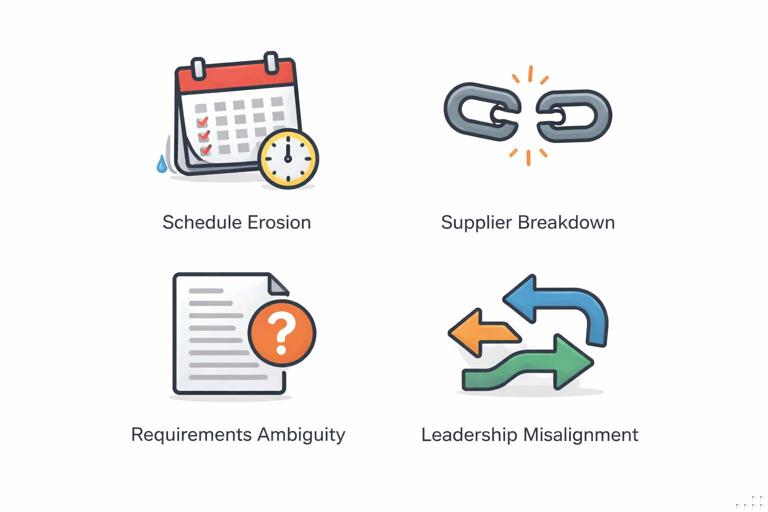
Scenario playbooks work because troubled projects rarely fail in unique ways. They fail in recurring patterns—schedule erosion, supplier breakdown, requirements ambiguity, and leadership misalignment. When you codify these patterns, you reduce decision latency, avoid “meeting your way into clarity,” and prevent the team from improvising under stress. A good playbook also protects relationships: it makes the response feel procedural rather than personal, which lowers defensiveness when you need fast changes.
How to Use Playbooks Without Creating Bureaucracy
- Trigger-based: each playbook starts with observable triggers and thresholds (e.g., “two consecutive missed sprint goals” or “vendor fails acceptance twice”).
- Timeboxed: actions are sequenced into 0–24 hours, 24–72 hours, and 1–2 weeks.
- Decision-oriented: each step ends with a decision or a produced artifact that enables a decision.
- Role-specific: every action has an owner (PM, tech lead, product, procurement, exec sponsor).
- Minimal artifacts: only the documents needed to align and execute (e.g., a one-page decision memo, a revised milestone map, a vendor remediation notice).
Playbook 1: Slipping Deadlines
Trigger Conditions
- Two or more milestones slip within one reporting cycle, or the same milestone slips twice.
- Teams report “almost done” repeatedly without closure (high carryover).
- Critical path tasks show increasing duration variance (estimates consistently wrong in one direction).
- Downstream teams (QA, release, operations) are repeatedly re-planning due to late handoffs.
Objective
Stop schedule erosion, restore predictability, and create a credible near-term delivery path that leadership can trust—without defaulting to unrealistic compression or broad overtime.
0–24 Hours: Contain and Re-establish Control
- Freeze non-essential change for 48 hours. Owner: PM + Product. Action: pause new scope intake except for true defects or compliance items. Output: a short “change freeze notice” to stakeholders.
- Define the next “must-hit” checkpoint. Owner: PM + Tech Lead. Action: pick a checkpoint within 5–10 business days (demo, integration test, or production-like deploy). Output: checkpoint definition with acceptance criteria.
- Identify the schedule’s single point of failure. Owner: Tech Lead. Action: name the one dependency or component that, if late, makes everything late (e.g., API contract, data migration, environment readiness). Output: a one-line “critical path choke point” statement.
24–72 Hours: Diagnose the Schedule Failure Mode
Slipping deadlines are not a root cause; they are a symptom. The playbook focuses on classifying the failure mode so the fix matches the problem.
- Classify the slip pattern: Owner: PM. Use one of these categories: (a) estimation bias (systematically optimistic), (b) hidden work (integration, testing, rework), (c) dependency drag (waiting on others), (d) capacity instability (context switching, attrition), (e) decision latency (waiting for approvals), (f) technical uncertainty (unknowns not reduced early).
- Run a “plan vs. actual” micro-review on the last 2–3 iterations. Owner: PM + Team Leads. Action: list planned deliverables, actual delivered, and why each miss occurred in one sentence. Output: a table that shows repeated miss reasons.
- Rebuild the next 2 weeks as a commitment plan. Owner: Delivery Leads. Action: convert work into a small set of deliverables with clear “done” definitions and named owners. Output: a two-week commitment board.
1–2 Weeks: Stabilize Predictability
- Introduce a “finish line” policy. Owner: Tech Lead. Action: cap work-in-progress; prioritize finishing and integrating over starting. Output: WIP limits and a definition of “integrated done.”
- Protect maker time and reduce context switching. Owner: PM. Action: consolidate meetings; create office hours for questions; block focus time. Output: updated team calendar norms.
- Install a schedule risk buffer explicitly. Owner: PM + Sponsor. Action: add visible contingency to key milestones rather than hiding it in tasks. Output: milestone map with buffer labeled.
Practical Example: Deadline Slip Due to Hidden Integration Work
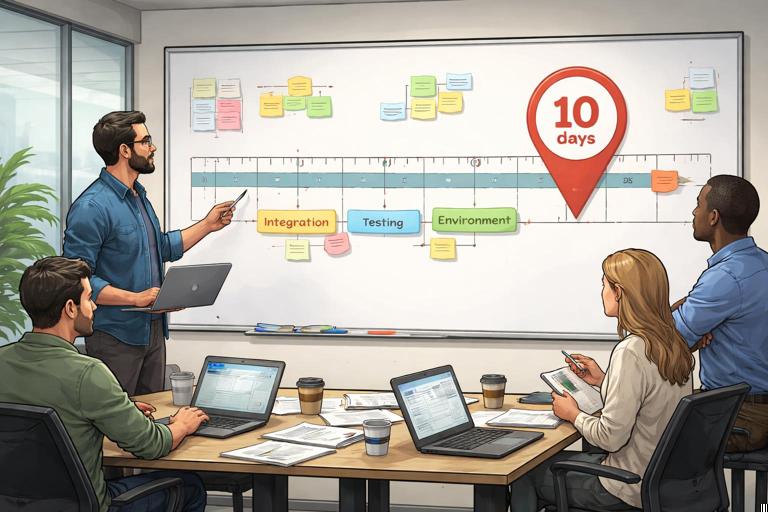
A team reports that “feature development is 90% done,” but releases keep slipping. The micro-review shows most misses are “integration issues” and “test environment instability.” The playbook response is to set the next checkpoint as an end-to-end integration demo in a production-like environment within 10 days, freeze new feature intake for 48 hours, and re-plan the next two weeks around integration hardening rather than new stories. The visible checkpoint forces the team to surface hidden work early and gives leadership a concrete signal of progress.
- Listen to the audio with the screen off.
- Earn a certificate upon completion.
- Over 5000 courses for you to explore!

Download the app
Playbook 2: Vendor Failure
Trigger Conditions
- Vendor misses two committed deliverables or fails acceptance criteria twice.
- Vendor staffing changes reduce capability (key architect leaves, team replaced).
- Vendor communication becomes inconsistent (missed status, vague updates).
- Contractual outputs are ambiguous, leading to disputes about “done.”
Objective
Restore delivery reliability from the vendor stream, reduce dependency risk to the core project, and create enforceable accountability with clear options if remediation fails.
0–24 Hours: Contain Dependency Risk
- Establish a single vendor interface. Owner: PM or Vendor Manager. Action: one accountable person for requests, escalations, and approvals. Output: named interface communicated to both sides.
- Stop accepting partial deliverables. Owner: Tech Lead + QA Lead. Action: enforce acceptance criteria; no “we’ll fix it later” handoffs. Output: acceptance checklist for vendor deliverables.
- Create a dependency firewall. Owner: Tech Lead. Action: isolate vendor work behind interfaces, feature flags, or stubs so internal teams can proceed. Output: a short plan for stubbing/mocking or parallel work.
24–72 Hours: Run a Vendor Reality Check
- Hold a remediation working session with the vendor. Owner: PM + Procurement. Agenda: (1) restate deliverables and acceptance criteria, (2) review missed commitments, (3) identify root blockers from vendor perspective, (4) agree on a 2-week recovery sprint with measurable outputs. Output: a written remediation plan.
- Demand a named delivery lead and staffing plan. Owner: Procurement + Sponsor. Action: require vendor to identify accountable lead, team composition, and availability. Output: vendor org chart and allocation statement.
- Validate technical approach quickly. Owner: Tech Lead. Action: request architecture notes, code samples, or a spike to prove feasibility. Output: a technical validation summary (pass/concerns).
1–2 Weeks: Enforce Accountability and Prepare Alternatives
- Implement weekly acceptance gates. Owner: QA Lead. Action: vendor deliverables must pass a defined gate each week (tests, performance, security checks). Output: gate results log.
- Set explicit escalation thresholds. Owner: PM + Sponsor. Action: define what triggers contract remedies or exit (e.g., “miss one more gate” or “no stable team by date X”). Output: escalation criteria memo.
- Build a contingency path. Owner: Tech Lead + PM. Action: identify what can be insourced, replaced, or deferred if vendor fails again. Output: contingency backlog and rough effort bands.
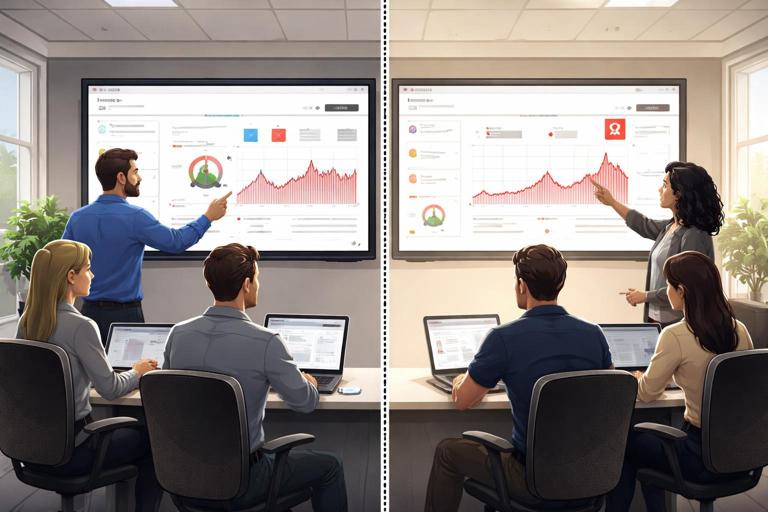
Practical Example: Vendor Delivers an API That Fails Performance Tests
The vendor delivers an API that meets functional requirements but fails load testing. The playbook response is to stop accepting partial completion, define acceptance gates (functional + performance), and create a dependency firewall by using a stubbed API for internal integration while the vendor remediates. Procurement requests a staffing plan and a named performance engineer. The escalation threshold is set: if the next weekly gate fails, the team activates the contingency path (insource performance remediation or switch to an alternate component).
Playbook 3: Unclear Requirements
Trigger Conditions
- Repeated rework due to “not what I meant” feedback from stakeholders.
- Backlog items are written as solutions rather than outcomes (e.g., “build a dashboard”) with no success criteria.
- Multiple stakeholders give conflicting direction, and the team is asked to satisfy all.
- Acceptance is subjective (“looks good”) rather than testable.
Objective
Convert ambiguity into testable outcomes, reduce rework, and create a shared understanding of what “done” means for the next increments—without restarting the entire project.
0–24 Hours: Stop the Bleed
- Pause new build on ambiguous items. Owner: Product + PM. Action: stop starting work that lacks acceptance criteria; continue only on clearly defined items or technical risk reduction. Output: list of paused items with reasons.
- Pick a single “north-star outcome” for the next increment. Owner: Product Owner. Action: define one measurable outcome (e.g., “reduce onboarding time from 30 to 10 minutes”). Output: outcome statement with baseline and target.
- Establish an acceptance authority. Owner: Sponsor. Action: name who can accept/reject deliverables to avoid endless review loops. Output: acceptance authority note.
24–72 Hours: Clarify Through Structured Conversations
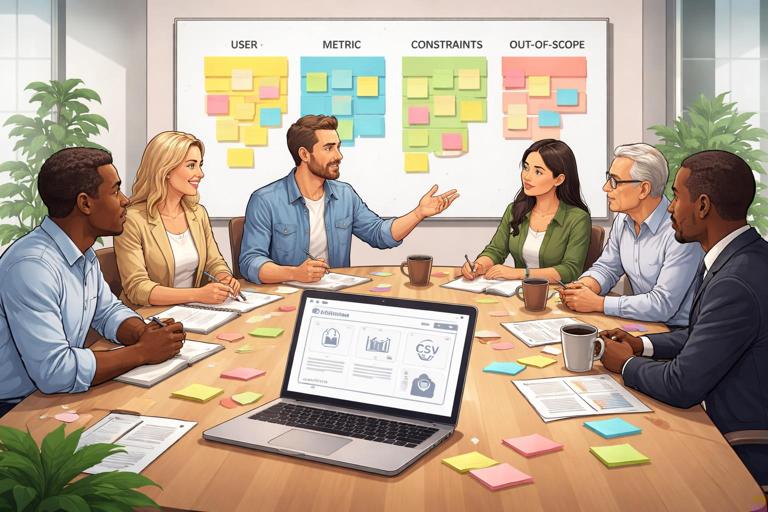
- Run a requirements alignment workshop focused on decisions. Owner: Product + Facilitator. Participants: key stakeholders, tech lead, QA. Method: for each top item, decide (a) user, (b) problem, (c) success metric, (d) constraints, (e) out-of-scope. Output: a decision log with resolved items and open questions.
- Create “example-first” acceptance criteria. Owner: QA Lead + Product. Action: write 3–5 concrete examples per item (inputs/outputs, edge cases). Output: acceptance examples attached to each item.
- Define a thin vertical slice. Owner: Tech Lead + Product. Action: choose the smallest end-to-end path that proves value and can be validated by users. Output: slice definition and demo script.
1–2 Weeks: Prevent Ambiguity From Returning
- Adopt a “definition of ready” for starting work. Owner: Team Leads. Action: require outcome, acceptance examples, data needs, and dependencies before work starts. Output: readiness checklist embedded in workflow.
- Schedule short, frequent validation demos. Owner: PM. Action: demo the vertical slice and subsequent increments to the acceptance authority and 1–2 representative users. Output: demo notes with decisions and changes.
- Use a controlled change channel. Owner: Product. Action: funnel new ideas into a queue with impact notes rather than injecting into active work. Output: change queue with impact tags.
Practical Example: Stakeholders Want “A Reporting Dashboard”
The team is asked to “build a reporting dashboard,” but each stakeholder imagines a different dashboard. The playbook pauses dashboard build, defines the north-star outcome as “reduce weekly reporting effort from 6 hours to 1 hour,” and names the finance director as acceptance authority. In the workshop, the group decides the first vertical slice is a single report with three metrics, export to CSV, and role-based access. Acceptance examples specify data freshness, rounding rules, and what happens when data is missing. The team demos the slice within two weeks, and subsequent requirements are clarified through examples rather than opinions.
Playbook 4: Executive Misalignment
Trigger Conditions
- Executives give conflicting priorities (speed vs. quality vs. cost) without a clear tradeoff decision.
- Steering meetings end with “we’ll take it offline,” and decisions don’t land.
- Different leaders communicate different narratives to their organizations.
- Project teams receive contradictory directives from multiple chains of command.
Objective
Create a single, explicit set of executive decisions and a unified narrative that the organization can execute, reducing churn caused by shifting priorities and unclear authority.
0–24 Hours: Create a Decision Forcing Function
- Draft a one-page “alignment brief.” Owner: Rescue Lead or PM. Content: current objective, key constraints, top 3 decisions needed, and the cost of indecision. Output: alignment brief sent before the meeting.
- Identify the decision owner(s). Owner: Sponsor or PMO. Action: clarify who has authority for scope, date, and funding decisions. Output: decision rights statement.
- Stop parallel directives. Owner: Sponsor. Action: request that all executive requests route through the decision owner until alignment is restored. Output: temporary governance rule.
24–72 Hours: Run an Executive Alignment Session (Decision-Driven)
This is not a status meeting. It is a decision meeting with pre-work and explicit outputs.
- Agenda structure: Owner: Facilitator. (1) confirm the goal, (2) confirm constraints, (3) decide priority order (time, scope, cost, quality), (4) decide what will not be done, (5) confirm success metrics and reporting cadence. Output: signed decision record.
- Use “forced choice” tradeoff questions. Owner: Facilitator. Examples: “If we must choose, do we protect the date or the full scope?” “If quality issues appear, do we delay release or accept known defects?” Output: explicit tradeoff decisions.
- Align on a single narrative. Owner: Sponsor + Comms. Action: agree on the message to the organization: what changed, why, and what happens next. Output: approved narrative paragraph.
1–2 Weeks: Operationalize Alignment
- Install a lightweight steering mechanism. Owner: PMO. Action: short weekly steering with a fixed decision list; no new topics without a decision request. Output: steering agenda template and decision backlog.
- Translate executive decisions into team-level priorities. Owner: PM + Product + Tech Lead. Action: map decisions to the next 2–4 weeks of work; remove conflicting items. Output: updated priority list and “not doing” list.
- Monitor for misalignment relapse. Owner: Rescue Lead. Action: track signals like conflicting requests, re-opened decisions, or narrative drift. Output: misalignment signal log with escalation path.
Practical Example: One Executive Wants Speed, Another Wants Zero Defects
A product executive pushes for a fixed launch date, while a risk executive insists on zero critical defects. The playbook creates an alignment brief that frames the tradeoff and the cost of indecision (teams thrash, testing is undermined, and dates slip anyway). In the alignment session, executives decide the priority order: protect the date, but define a quality gate that blocks release only for critical severity issues; non-critical issues are deferred with a published remediation plan. The decision record is distributed, and weekly steering focuses on whether the quality gate is trending toward pass/fail, not on re-litigating the priority order.

Building Your Own Scenario Playbooks (Reusable Structure)
Playbook Template: Sections to Include
- Name and intent: “Slipping Deadlines—restore predictability.”
- Triggers and thresholds: observable signals with numeric thresholds when possible.
- Primary objective: what success looks like in 2 weeks.
- Immediate containment actions: what to stop, what to freeze, what to protect.
- Classification questions: 5–10 questions that sort the scenario into a failure mode.
- Timeboxed action plan: 0–24h, 24–72h, 1–2w with owners and outputs.
- Decision points: what must be decided, by whom, and by when.
- Artifacts produced: decision record, acceptance gates, checkpoint definition, remediation plan.
- Escalation and exit criteria: what triggers escalation, and what “stop/change course” looks like.
Step-by-Step: Converting a Real Incident Into a Playbook
Collect 3–5 recent incidents of the same pattern. Example: three deadline slips caused by integration delays.
Extract the earliest reliable trigger. Not “we feel behind,” but “carryover exceeds 30% for two iterations” or “integration environment unavailable for 3+ days.”
Identify the first containment move that consistently helps. Example: define a near-term integration checkpoint and freeze new scope for 48 hours.
Write the classification questions that separate causes. Example: “Are we waiting on external dependencies?” “Is rework increasing?” “Are decisions pending?”
Define the minimum artifacts that enable leadership decisions. Example: a one-page decision record and a two-week commitment plan.
Test the playbook in a tabletop exercise. Simulate the scenario with the team: run through steps, check if owners and outputs are clear, and remove unnecessary steps.
Operationalize it. Store playbooks where teams work, link them to triggers in your reporting, and assign a custodian to keep them current.
Quick Reference: Classification Questions by Scenario
Slipping Deadlines: Is the slip driven by hidden work, dependencies, capacity instability, decision latency, or technical uncertainty? Vendor Failure: Is the issue capability, capacity, incentives/contract, unclear acceptance, or integration friction? Unclear Requirements: Is ambiguity in outcomes, stakeholders, data rules, edge cases, or acceptance authority? Executive Misalignment: Is conflict in priorities, decision rights, risk tolerance, or narrative ownership?