From “Great Partners” to a System: What It Means to Scale a Partner Ecosystem
Scaling a partner ecosystem means turning partnerships from a set of individually managed relationships into a coordinated system that reliably produces pipeline, revenue, retention, and product adoption with predictable effort. In early stages, a partnership manager can “hero” outcomes by personally driving launches, chasing follow-ups, and customizing everything. Ecosystem scale begins when outcomes depend less on individual heroics and more on repeatable mechanisms: standardized partner journeys, modular offers, shared operating data, and a portfolio approach to performance. The goal is not simply “more partners,” but a higher ratio of impact per unit of partner-management time, per dollar of enablement spend, and per integration or campaign shipped.
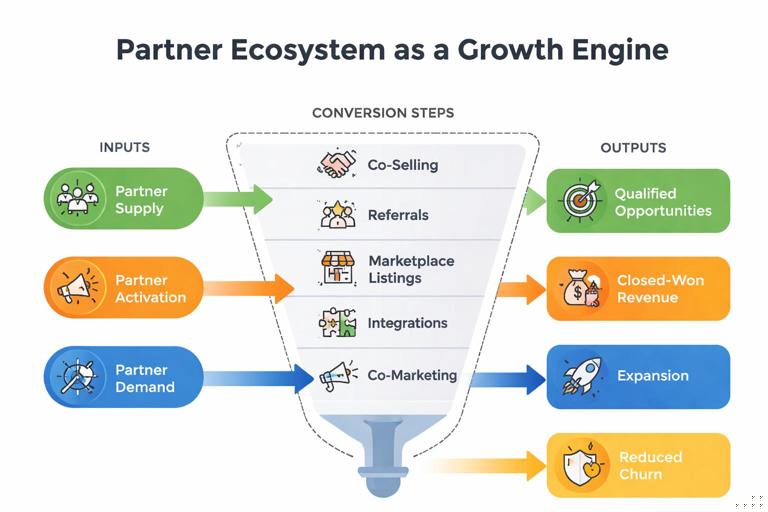
A useful mental model is to treat the ecosystem like a growth engine with inputs, conversion steps, and outputs. Inputs include partner supply (new partners entering), partner activation (partners becoming capable and motivated), and partner demand (end-customer interest). Conversion steps include co-selling motions, referrals, marketplace listings, integrations, and co-marketing programs. Outputs include qualified opportunities, closed-won revenue, expansion, and reduced churn. Scaling is the discipline of improving throughput and reducing friction at each step while keeping quality high.
Designing the Ecosystem Operating Model: Roles, Motions, and “Where Value Is Created”
Before you scale, you need an explicit operating model that answers: who does what, using which motion, for which partner segment, to produce which outcome. An ecosystem typically includes multiple partner types (for example: implementation partners, technology partners, affiliates, agencies, communities, or strategic alliances). Each type creates value in different places: some generate demand, some deliver services, some reduce time-to-value, some expand distribution, and some increase product stickiness. Scaling requires you to map partner types to the primary value-creation point and then build repeatable motions around that point.
Start by defining a small set of “standard motions” your company will support at scale. Examples include: partner-sourced referrals, partner-influenced co-selling, partner-delivered implementation, and partner-led customer success. For each motion, define the minimum viable workflow that can be executed consistently: what triggers the motion, what artifacts are required, what systems record it, and what handoffs occur. The operating model should also define internal roles (partner manager, partner operations, partner marketing, solutions engineering, legal, finance) and clarify decision rights. If decision rights are unclear, scaling creates bottlenecks because every deal or campaign becomes an exception.
Segmenting Partners for Scale: Tiers, Capacity, and Investment Levels
Scaling requires segmentation so you can invest proportionally. A common mistake is to treat all partners as strategic. Instead, define tiers based on objective indicators of potential and capacity to execute. Capacity is often more predictive than brand name: a mid-sized agency with a dedicated practice lead and a repeatable delivery package may outperform a famous firm that treats you as a side offering.
- Listen to the audio with the screen off.
- Earn a certificate upon completion.
- Over 5000 courses for you to explore!

Download the app
Build a tiering framework that includes: (1) partner capacity (number of sellers/consultants, delivery bandwidth, marketing resources), (2) commitment signals (certifications completed, joint plan participation, pipeline registration), and (3) performance signals (sourced opportunities, influenced wins, activation milestones). Tie each tier to a clear “partner experience”: access to support, co-marketing funds, lead sharing, technical resources, and executive attention. The scaling principle is simple: higher tiers get higher leverage resources, but only if they meet measurable obligations. This prevents the ecosystem from becoming a cost center driven by relationship maintenance.
Standardizing the Partner Journey: A Repeatable Path from “Signed” to “Producing”
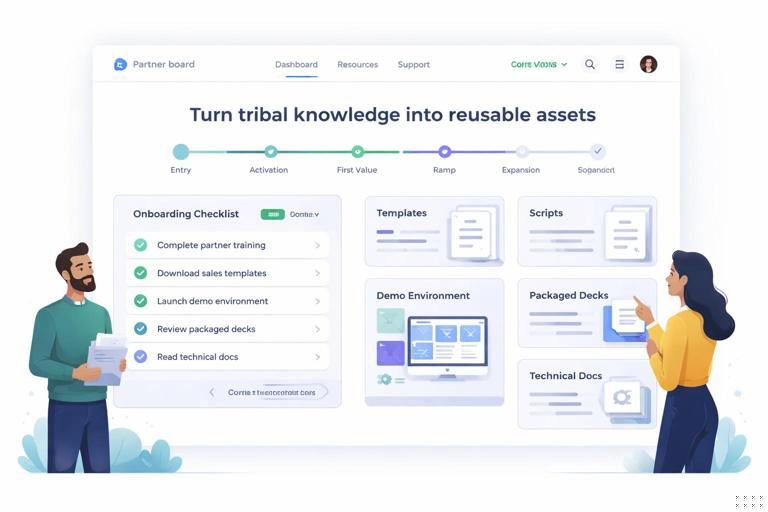
To become a growth engine, you need a standardized partner journey with clear stages and exit criteria. Think of it as a funnel for partners, not customers. A typical journey includes: entry, activation, first value, ramp, and expansion. Each stage should have a checklist of required actions and a time-bound target. For example, activation might require completing training, publishing a partner page, and identifying a first joint account list. “First value” might be defined as the first registered deal, first referral, first integration install, or first co-marketing asset shipped—depending on the partner type.
Make the journey visible to both internal teams and partners. A partner portal or shared workspace can show progress, required tasks, and available assets. The key scaling move is to convert tribal knowledge into artifacts: templates, scripts, demo environments, packaged decks, and standardized technical documentation. When the journey is explicit, you can diagnose where partners stall and fix the system rather than blaming the partner manager or the partner.
Partner Operations as the Scaling Backbone: Systems, Data, and Automation
Partner operations is the function that turns partnership intent into repeatable execution. Even if you do not have a dedicated partner ops hire yet, you need partner ops thinking: consistent data definitions, workflow automation, and a single source of truth. Scaling fails when partner data lives in slides, inboxes, and personal spreadsheets. It also fails when partner activity cannot be tied to outcomes because fields are missing, inconsistent, or optional.
Define a partner data model that includes: partner profile (type, tier, regions, industries), contacts and roles, capabilities (certifications, services offered), motions enabled, and activity logs (deals registered, referrals submitted, campaigns launched, integrations installed). Then define required fields and validation rules so the data is usable. Automate what you can: onboarding sequences, training reminders, deal registration routing, and quarterly planning prompts. The objective is to reduce time spent on coordination and increase time spent on high-leverage partner growth activities.
Building Repeatable “Partner Offers”: Packages That Partners Can Sell and Deliver
A partner ecosystem scales faster when partners can sell something concrete, not just “our product.” Create partner offers that are packaged, priced (even if indicative), and easy to explain. Offers can be implementation bundles, assessments, migration packages, industry-specific solutions, or integration-based bundles. The scaling principle is modularity: the offer should be composed of reusable components (scope, deliverables, timeline, prerequisites, success metrics) so partners can adapt it without reinventing it.
For example, a SaaS company might create a “30-Day Launch Package” with a fixed scope: setup, data import, two workflows configured, and admin training. Another offer might be an “Executive Dashboard Accelerator” that uses a prebuilt template. Partners can then market and deliver these offers repeatedly, and your internal team can support them with standardized enablement and QA. Packaged offers also reduce sales cycle friction because buyers understand what they are getting and partners know how to deliver it.
Portfolio Management: Managing the Ecosystem Like a Growth Portfolio
At scale, you are not managing individual partners; you are managing a portfolio with different risk and return profiles. Some partners are high-volume but low average deal size. Others are low-volume but strategic. Some are experimental and may never produce. Portfolio management means setting targets by segment, monitoring performance distribution, and reallocating resources based on evidence.
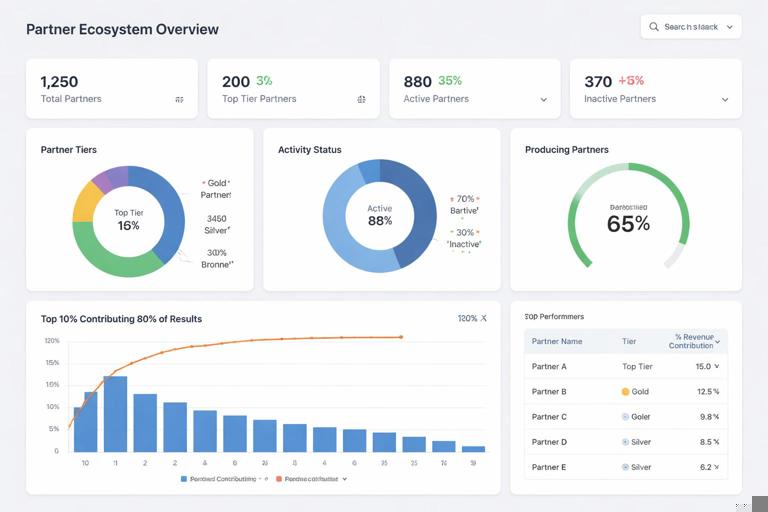
Use a simple portfolio dashboard that answers: how many partners are in each tier, how many are active, what percentage are producing, and what share of outcomes comes from the top 10%. If 80% of results come from 10% of partners, that is normal—but it should inform your operating model. You might create a “long tail” program with self-serve enablement and automated communications, while reserving high-touch planning for the top tier. This is how you scale without burning out your team.
Step-by-Step: Turning the Ecosystem into a Repeatable Growth Engine (90-Day Build)
Step 1: Define the engine metrics and constraints
Pick a small set of ecosystem-level metrics that represent throughput, not vanity. Examples: active partners (partners who completed a defined activity in the last 30 days), partner-sourced qualified opportunities, partner-influenced pipeline, and partner-delivered onboarding capacity. Also define constraints: partner manager capacity, solutions engineering bandwidth, marketing calendar space, and integration roadmap limits. Scaling is optimization under constraints; naming constraints prevents over-promising.
Step 2: Choose 2–3 standard motions to scale first
Select the motions that match your product and sales model and that you can support operationally. Avoid launching too many motions at once. For each motion, write a one-page “motion spec”: trigger, required artifacts, workflow steps, systems of record, and success thresholds. This becomes the reference document for training and for cross-functional alignment.
Step 3: Build the partner journey stages and checklists
Create stages with exit criteria and target timelines. Example: Activation completed within 14 days; First value within 45 days; Ramp within 90 days. Build checklists for each stage and convert them into tasks in your partner portal, CRM, or project tool. Include partner-facing assets (pitch deck, demo script, case study library) and internal assets (intake forms, routing rules, escalation paths).
Step 4: Create one packaged offer per motion
For each motion, create a packaged offer that partners can execute repeatedly. Document: buyer profile, problem statement, deliverables, prerequisites, timeline, pricing guidance, and how the offer maps to your product SKUs. Then create a simple enablement kit: a one-page overview, a slide deck, and a delivery checklist. The goal is speed: partners should be able to start selling within a week of activation.
Step 5: Implement partner ops workflows and minimum automation
Set up required fields, partner tiering logic, and automated sequences. Examples: when a partner reaches “Activated,” trigger an email sequence with co-selling playbooks; when a deal is registered, route it to the correct sales owner and notify the partner manager; when a partner is inactive for 30 days, trigger a reactivation workflow. Keep automation minimal but reliable; broken automation erodes trust faster than no automation.
Step 6: Launch a “production sprint” with a small cohort
Choose a cohort of partners that represent your target segments and run a 4–6 week sprint focused on producing measurable outcomes (for example, a set number of registered opportunities or a set number of joint webinars). Hold weekly office hours, track blockers, and update assets in real time. The purpose is to pressure-test the system: where do partners get stuck, what questions repeat, what approvals slow things down, and what assets are missing.
Step 7: Codify what worked into versioned playbooks
After the sprint, convert learnings into versioned playbooks: “v1 referral motion,” “v1 co-selling motion,” “v1 implementation partner package.” Versioning matters because it signals that the system will evolve and that feedback is expected. Store playbooks in a single, searchable location and link them directly in partner communications and onboarding tasks.
Scaling Enablement Without High Touch: Self-Serve, Certification, and Community Loops
High-touch enablement does not scale linearly. To scale, you need self-serve learning paths, lightweight certification, and peer-to-peer support mechanisms. Self-serve does not mean low quality; it means structured. Create role-based tracks (partner seller, partner consultant, partner marketer) with clear outcomes: what they should be able to pitch, demo, implement, or market after completion.
Add lightweight certification that is tied to ecosystem privileges: directory listing priority, access to leads, eligibility for co-marketing, or access to beta features. Certification should test practical competence (for example, delivering a demo or completing a sample implementation) rather than memorization. Finally, build community loops: office hours, partner forums, and showcases where partners share wins and templates. Community reduces support load and increases adoption of best practices.
Creating Ecosystem Feedback Loops: Learning at Scale
A growth engine improves through feedback loops. In partner ecosystems, the most valuable loops connect partner activity to customer outcomes and then back into enablement, product, and messaging. For example, if partners consistently lose deals due to a missing integration, that signal should inform product prioritization. If partners win in a specific vertical with a specific narrative, that should become a packaged vertical play.
Operationalize feedback by creating structured intake: a monthly partner insights form, a tagged support channel, and a recurring review where partner ops summarizes patterns. Then publish changes as release notes for the ecosystem: updated pitch deck, new battlecard, improved onboarding checklist, revised packaged offer. When partners see their feedback reflected in improvements, engagement increases and the ecosystem becomes more resilient.
Scaling Quality: Guardrails, Standards, and Brand Protection
As you scale, quality variance becomes a major risk. Poor implementations, misleading marketing claims, or inconsistent customer experiences can damage retention and brand trust. Scaling requires guardrails: delivery standards, messaging guidelines, and a clear escalation path for customer issues involving partners. Guardrails should be explicit and measurable: required implementation steps, minimum documentation, response time expectations, and rules for using your brand assets.
Quality control can be scaled through audits and sampling rather than constant oversight. For example, review a percentage of partner-delivered projects each month, or require submission of a delivery checklist for certain packages. For marketing, provide pre-approved copy blocks and co-branded templates. The objective is to enable speed while preventing avoidable failures that create churn and support burden.
Capacity Planning: Matching Partner Growth to Internal Bandwidth
An ecosystem can outgrow your internal capacity if you activate too many partners without support structures. Capacity planning means forecasting the support load created by partner activity and ensuring you have the right mix of self-serve resources and human support. Identify the “support multipliers” in your model: solutions engineering hours per co-sell, onboarding specialist hours per partner-delivered implementation, or partner marketing hours per campaign.
Then set activation gates. For example, you might limit the number of partners entering a high-touch tier per quarter, or require completion of certification before partners can access certain resources. This is not about being restrictive; it is about protecting customer experience and ensuring partners succeed. A smaller number of productive partners is a stronger growth engine than a large number of inactive or underperforming partners.
Scaling Across Regions and Verticals: Replication With Local Adaptation
When expanding geographically or into new verticals, the scaling challenge is balancing replication with local adaptation. Replication means the core motions, journey stages, and data model remain consistent. Local adaptation means adjusting messaging, compliance requirements, and partner types to fit the market. A practical approach is to define a “global core” and a “local layer.” The global core includes standard playbooks, packaged offers, and partner tier definitions. The local layer includes localized case studies, region-specific pricing guidance, language assets, and local partner events.
To avoid fragmentation, require that local adaptations are made through controlled templates. For example, a vertical play might have a standard structure: target buyer, pain points, proof points, demo flow, and packaged offer. Regional teams can fill in localized proof and compliance notes without changing the underlying motion. This keeps the ecosystem coherent while still relevant in each market.
Incentivizing the Right Behaviors at Scale: Outcomes, Not Activity
As the ecosystem grows, incentives can unintentionally drive low-quality behavior: spammy referrals, inflated deal registrations, or superficial co-marketing. To scale sustainably, align incentives with outcomes and quality. For example, reward partners for accepted and progressed opportunities rather than raw submissions, or for customer retention and expansion rather than only initial sales. If you offer marketing benefits, tie them to performance milestones and compliance with brand standards.
Also consider non-monetary incentives that scale well: visibility in a partner directory, speaking slots at events, access to roadmap briefings, or early access to new features. These incentives can motivate partners without creating complex financial administration. The key is to make incentives predictable, transparent, and tied to behaviors that correlate with customer success.
Common Scaling Failure Modes and How to Correct Them
One failure mode is “partner count obsession,” where teams celebrate signings but do not measure activation and production. Correct it by reporting active partners and first-value time as primary metrics. Another failure mode is “custom everything,” where every partner gets a unique process. Correct it by enforcing standard motions and packaged offers, and treating exceptions as product work that must be justified.
A third failure mode is “data blindness,” where outcomes cannot be attributed to partner activity because workflows are not recorded consistently. Correct it with required fields, automated routing, and regular data hygiene. A fourth failure mode is “over-centralization,” where every decision requires headquarters approval, slowing regional growth. Correct it by defining decision rights and providing templates that allow local execution within guardrails. Scaling is less about adding complexity and more about removing friction while protecting quality.