What “Reseller” and “Channel Partner” Mean in Practice
A reseller or channel partner is a third party that sells your product to end customers through their existing distribution, relationships, and sales motion. In a direct model, your company owns demand generation, sales, contracting, and often implementation. In a channel model, you deliberately share those responsibilities with intermediaries to reach more customers faster, especially in segments where you lack coverage, credibility, or cost-effective access.
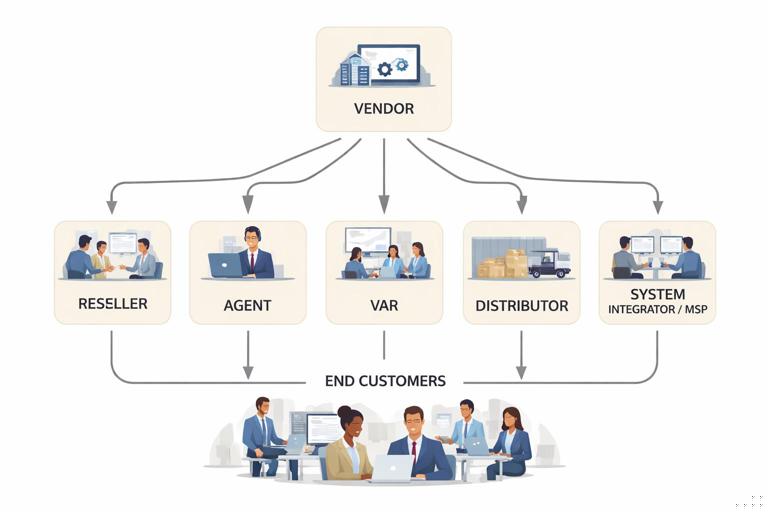
Channel partners come in several common forms: (1) resellers who buy at a discount and resell at a margin, (2) agents or brokers who sell on your behalf for a commission without taking title, (3) value-added resellers (VARs) who bundle services, implementation, or complementary products, (4) distributors who aggregate many vendors and supply resellers, and (5) system integrators or managed service providers who embed your product into a broader solution. Your strategy should specify which of these you are building, because each implies different economics, control, and operational requirements.
When a Channel Strategy Is the Right Distribution Lever
Channel is most effective when your product can be standardized enough for repeatable selling, your target customers are already served by intermediaries, and the partner can add meaningful leverage (reach, trust, services capacity, local presence, or procurement access). It is also attractive when direct sales is too expensive for smaller deal sizes, when you need geographic expansion without hiring locally, or when your product is part of a broader stack that partners already sell.
Channel is usually a poor fit when your product requires heavy founder-led selling for every deal, when onboarding is highly bespoke and cannot be delegated, when margins are too thin to share, or when your pricing and packaging are not stable. It can also fail when your company expects partners to “create demand” without giving them a reason to prioritize you over alternatives.
Choosing the Right Channel Model: Margin, Control, and Speed
Reseller (Buy-Resell)
In a buy-resell model, the partner purchases your product (or commits to a minimum) and resells to the customer. This gives the partner strong motivation and control over the customer relationship, but it reduces your visibility into the end customer unless you design for it. It works well when procurement prefers buying from an approved vendor, when partners can bundle your product with services, and when you can support deal registration to reduce channel conflict.
- Listen to the audio with the screen off.
- Earn a certificate upon completion.
- Over 5000 courses for you to explore!

Download the app
Agent / Referral-to-Resell Hybrid
In an agent model, the partner sells but you contract directly with the customer. This preserves your control over pricing, terms, and customer data, and it can be simpler early on. The tradeoff is that partners may feel less ownership and may prioritize vendors that allow them to invoice and bundle. A hybrid approach is common: start with agent deals to learn, then graduate top performers into buy-resell once processes are stable.
Distributor-Led
Distributors provide logistics, credit terms, and access to a network of resellers. They can accelerate scale in hardware, security, and IT procurement-heavy categories. The tradeoff is margin stacking: you may need to fund both distributor and reseller economics, and you must manage pricing discipline to avoid race-to-the-bottom discounting.
Designing Channel Economics That Actually Work
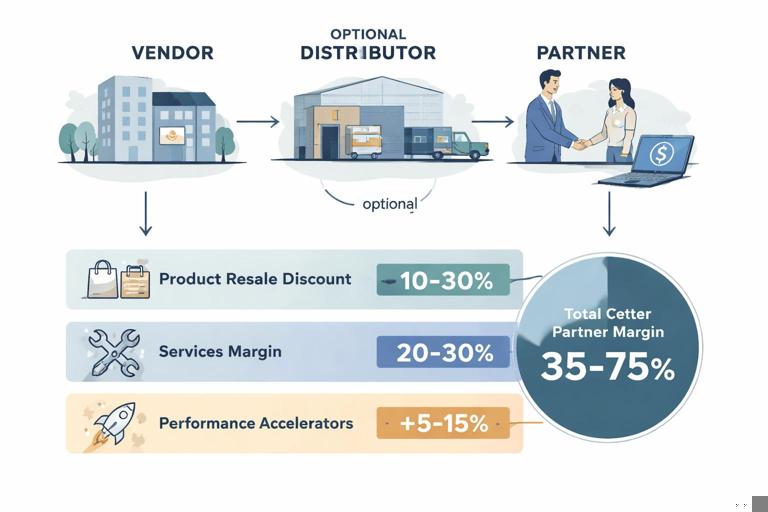
Channel economics must be viable for three parties: you, the partner, and (if applicable) a distributor. Start by modeling the “partner P&L” for a typical deal: sales effort, pre-sales time, implementation effort, customer support load, and cash flow timing. Partners will compare your program to alternatives; if your margin does not cover their cost to sell and service, they will not prioritize you.
A practical way to structure economics is to separate (1) product margin for resale, (2) services margin for implementation or managed services, and (3) performance accelerators for volume or strategic behaviors. For example, a software vendor might offer 20–30% resale discount, while enabling partners to earn 40–60% gross margin on implementation services. If your product is low-cost and self-serve, you may need higher percentage commissions to compensate for small absolute dollars per deal.
Step-by-step: Build a channel margin model
- Step 1: Define a representative deal. Choose a typical customer size, contract value, and expected renewal pattern.
- Step 2: Estimate partner cost-to-sell. Include discovery calls, demos, proposal work, procurement steps, and account management time.
- Step 3: Estimate partner cost-to-deliver. If partners implement or support, estimate hours and staffing mix.
- Step 4: Set target partner gross profit. Many partners need a minimum gross profit per deal to justify attention; translate that into required margin/commission.
- Step 5: Stress-test with discounting. Model what happens if the partner discounts to win; decide guardrails and approval thresholds.
- Step 6: Validate with 3–5 partners. Ask them to pressure-test assumptions and compare to competing programs.
Packaging and Pricing for Channel: Make It Easy to Sell
Channel partners sell what is easy to explain, easy to quote, and easy to implement. If your pricing requires custom configuration for every customer, partners will stall. Create channel-friendly packaging: clear tiers, predictable add-ons, and a quoting tool or price book that partners can use without waiting on your team.
Also design a “partner attach path”: a recommended bundle that naturally includes partner services. For example, a cybersecurity tool might have a standard package plus an optional managed monitoring service delivered by the partner. This increases partner profitability and makes them more invested in customer success.
Step-by-step: Create a channel-ready offer
- Step 1: Define 2–3 standard bundles. Each bundle should map to a clear customer profile and outcome.
- Step 2: Create a simple quoting workflow. Provide a price book, discount rules, and an approval process with clear turnaround times.
- Step 3: Build a partner services play. Document what partners can deliver, typical timelines, and what “done” looks like.
- Step 4: Provide proof assets. Case studies, ROI calculator, security documentation, and competitive positioning in partner-friendly language.
- Step 5: Pilot with one partner. Observe where they get stuck: pricing questions, objections, implementation uncertainty, or internal approvals.
Territory, Segmentation, and Channel Coverage Design
Channel scale is not only “more partners.” It is coverage: the right partners in the right segments with clear rules. Define your channel coverage map across geography, verticals, and customer size. Then decide which segments are partner-led, which are direct-led, and which are shared. Without this, you will create internal conflict and inconsistent customer experiences.
A common approach is to make partners primary for small and mid-market deals where direct sales is expensive, while keeping enterprise direct or co-sell. Another approach is vertical specialization: partners own industries where they have credibility (healthcare, manufacturing, public sector), while your direct team focuses on general commercial accounts.
Step-by-step: Build a channel coverage map
- Step 1: Segment your market. Use 2–3 dimensions (e.g., company size, industry, region).
- Step 2: Assign a default route-to-market. For each segment, specify “partner-led,” “direct-led,” or “co-sell.”
- Step 3: Define exceptions. For example, strategic logos may remain direct regardless of size.
- Step 4: Define partner types per segment. VARs for complex implementations, MSPs for ongoing management, distributors for procurement-heavy segments.
- Step 5: Publish internal rules. Sales, finance, and support must share the same understanding to avoid deal friction.
Recruiting Partners for Scale: Quality Beats Quantity
Channel programs often fail when companies recruit too many partners too early. A large roster creates enablement burden and low productivity. Instead, recruit in cohorts: a small group of partners that match your coverage map, then expand once you have repeatable partner success patterns.
Prioritize partners with (1) an existing customer base in your target segment, (2) a sales motion compatible with your deal cycle, (3) services capacity if your product needs implementation, and (4) leadership commitment. A partner with a strong brand but no dedicated sellers for your category will produce little revenue.
Step-by-step: Cohort-based partner recruitment
- Step 1: Define your “ideal partner profile” for this chapter’s channel model. Include segment focus, sales capacity, services capability, and competitive conflicts.
- Step 2: Recruit 5–10 partners as Cohort 1. Keep it small enough to support deeply.
- Step 3: Set a 90-day activation target. Examples: number of trained sellers, number of qualified opportunities created, number of proposals delivered.
- Step 4: Review performance and refine. Identify which partner traits correlate with results.
- Step 5: Recruit Cohort 2 using the refined profile. Scale only after you can predict activation outcomes.
Channel Sales Motions: Partner-Led, Co-Sell, and Deal Desk Support
To scale distribution, you must define how deals flow. In partner-led deals, the partner owns prospecting, qualification, and often implementation; your team supports with product expertise and approvals. In co-sell deals, your sales team and the partner coordinate: the partner provides access and credibility, while your team drives the sales process. In direct-to-partner influence, your direct team closes but partners deliver services; this can be useful when partners are strong implementers but not strong sellers.
Operationally, channel scale requires a “channel deal desk” function: fast quoting, clear discount approvals, and consistent rules. Partners will not wait two weeks for pricing answers. Slow response times are one of the most common silent killers of channel momentum.
Step-by-step: Define a channel deal flow
- Step 1: Choose a default motion per segment. Partner-led for SMB, co-sell for mid-market, direct-led for enterprise (example).
- Step 2: Define roles in writing. Who runs discovery, who does demos, who negotiates, who signs, who implements.
- Step 3: Create a deal registration process. Partners submit basic deal info; you confirm protection and rules within a defined SLA.
- Step 4: Build a channel deal desk. A shared inbox or portal, pricing templates, and an approval matrix.
- Step 5: Track cycle time. Measure time-to-quote, time-to-approval, and time-to-contract as operational KPIs.
Preventing Channel Conflict and Protecting Trust
Channel conflict happens when partners feel you compete with them for the same customer, undercut pricing, or ignore their effort. Conflict is not only a relationship issue; it directly reduces pipeline because partners stop bringing you deals. The solution is not “promise we won’t compete,” but clear rules and consistent enforcement.
Use deal registration to protect partner-sourced opportunities, define how inbound leads are distributed, and specify how your direct team should behave when a partner is involved. Also define what happens when two partners claim the same account, or when a partner registers a deal but does not progress it. Clear expiration rules and activity requirements keep the system fair.
Step-by-step: A simple conflict policy
- Step 1: Define what qualifies for protection. Minimum information, proof of engagement, and a time window.
- Step 2: Set an approval SLA. Example: respond to registrations within 48 hours.
- Step 3: Define inactivity expiration. Example: if no documented progress in 30 days, protection expires.
- Step 4: Define inbound routing rules. For partner-led segments, route inbound to partners; for direct-led, allow partner attachment for services.
- Step 5: Enforce consistently. One exception can damage trust across the entire channel.
Channel Enablement That Scales: From Training to “Sell Kits”
Training alone does not create revenue. Scalable enablement gives partners ready-to-use assets that reduce cognitive load: pitch decks, demo scripts, objection handling, competitive battlecards, pricing guidance, and implementation checklists. Think in terms of “sell kits” for specific customer scenarios rather than generic product training.
Build enablement around the partner’s workflow. A partner seller wants a 10-minute pitch, a one-page qualification checklist, and a simple next step. A partner engineer wants deployment patterns, troubleshooting guides, and escalation paths. If you provide only high-level marketing content, partners will improvise, which leads to inconsistent messaging and failed deals.
Step-by-step: Build a partner sell kit
- Step 1: Choose one target use case. Example: “reduce onboarding time for HR teams” or “monitor endpoints for SMB.”
- Step 2: Create a 10-slide pitch. Problem, impact, solution, proof, pricing approach, next steps.
- Step 3: Write an objection guide. Top 10 objections with short, partner-friendly responses.
- Step 4: Provide a demo path. A scripted flow with expected questions and outcomes.
- Step 5: Add a qualification checklist. Criteria that indicate a good fit and red flags that waste time.
- Step 6: Package it in a portal. One link, version-controlled, easy to find.
Inventory, Provisioning, and Billing: The Hidden Scaling Constraints
Distribution scale often breaks on operational details: provisioning delays, billing confusion, tax handling, and renewals. For software, decide whether partners can provision licenses themselves, whether you support multi-tenant management for MSPs, and how upgrades and downgrades work. For physical products, decide how inventory is held, how returns are handled, and how warranty claims flow.
Billing design affects partner motivation. If partners cannot invoice customers, they may struggle to bundle services. If you invoice directly, partners may prefer commission models. If you support both, you need clear rules to avoid double counting and to keep pricing consistent across routes-to-market.
Step-by-step: Operational checklist for channel readiness
- Step 1: Define provisioning ownership. Who creates accounts, assigns licenses, and manages access.
- Step 2: Define billing flows. Direct billing, partner billing, or mixed; include renewal handling.
- Step 3: Define support tiers. What the partner handles vs what you handle; escalation SLAs.
- Step 4: Define returns/cancellations. Credits, clawbacks, and customer satisfaction policies.
- Step 5: Test end-to-end. Run a “fake deal” from quote to renewal to find friction before scaling.
Measuring Channel Performance: Productivity, Not Vanity Metrics
Channel scale is measured by productivity per partner and per segment, not by the number of signed partners. Track activation rate (partners who create real pipeline), time-to-first-deal, pipeline coverage by partner, win rate by partner type, average discounting, and services attach rate. These metrics tell you whether your program is economically healthy and whether partners are truly engaged.
Also measure operational KPIs that partners feel: time-to-quote, time-to-approval, time-to-provision, and support response times. Improving these often increases partner revenue more than adding new partners, because it removes friction from every deal in motion.
Step-by-step: A channel performance dashboard
- Step 1: Define partner stages. Recruited, onboarded, activated, producing, scaled.
- Step 2: Choose 5–8 core metrics. Activation rate, time-to-first-deal, pipeline created, revenue, win rate, average discount, attach rate, churn/renewal rate.
- Step 3: Segment the data. By partner type, region, and customer size.
- Step 4: Set operating rhythms. Monthly partner reviews for top partners; quarterly program reviews for policy and economics.
- Step 5: Tie actions to metrics. If activation is low, improve sell kits; if win rate is low, fix qualification and positioning; if discounting is high, tighten guardrails and improve value proof.
Scaling Tactics: From “A Few Deals” to a Repeatable Channel Engine
Once you have a handful of partners producing consistently, scaling becomes a systems problem: replicating what works while maintaining quality. Expand in layers: deepen within a partner (more sellers trained, more regions covered), then add similar partners in the same segment, then expand to adjacent segments. This reduces complexity and preserves learning.
Use tiering to focus your effort. A small number of partners will drive most revenue. Create clear criteria for tiers (revenue, certifications, customer satisfaction, strategic behaviors) and align benefits accordingly (priority support, marketing funds, lead sharing, early access). Tiering is not about status; it is about allocating scarce resources to maximize distribution output.
Step-by-step: A practical scaling plan
- Step 1: Identify your “repeatable partner archetype.” The partner profile that reliably produces deals.
- Step 2: Create a partner expansion play. Train additional sellers, run joint account planning, and set quarterly targets.
- Step 3: Standardize the operating cadence. Weekly pipeline sync for active partners, monthly business review for top partners.
- Step 4: Launch tiering. Define requirements and benefits; keep it simple and measurable.
- Step 5: Add partners in batches. Recruit the next cohort only when your team can support activation without degrading response times.
- Step 6: Invest in partner operations. Portal, deal registration tooling, automated provisioning, and a dedicated channel manager function as volume grows.
Worked Example: A B2B SaaS Company Expanding Through MSPs
Imagine a B2B SaaS company selling IT compliance automation to small businesses. Direct sales struggles because deal sizes are modest and customers trust their managed service provider. The company chooses an MSP channel strategy: partners bundle the software with ongoing compliance management.
The company creates two standard bundles (Essentials and Plus), a simple price book with a resale discount, and a partner sell kit focused on one use case: “pass audits with less manual work.” They define partner-led motion for SMB, with deal registration and a 48-hour pricing SLA. They also build multi-tenant management so MSPs can manage multiple clients efficiently.
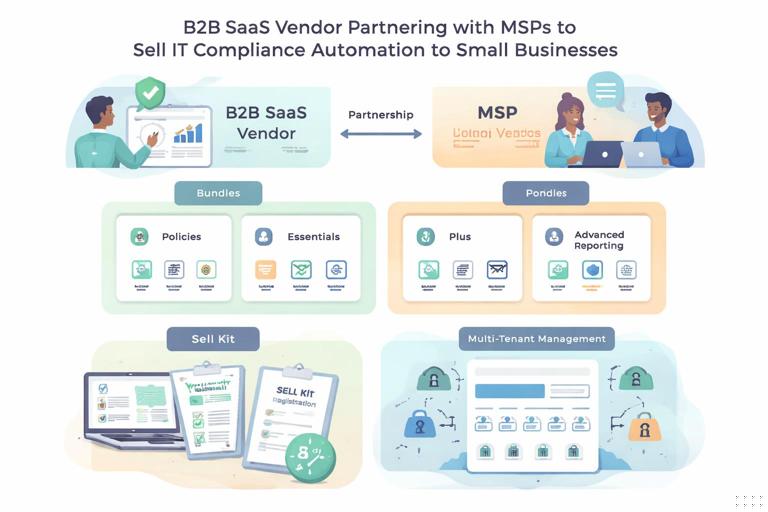
In the first cohort, they recruit eight MSPs with existing compliance practices. They set a 90-day activation target: each MSP trains two sellers and creates three qualified opportunities. After 90 days, three MSPs produce most pipeline. The company studies what those MSPs share (dedicated compliance lead, packaged service offering, and a clear outbound list). They refine the ideal partner profile and recruit the next cohort accordingly, while deepening within the top three MSPs by training more sellers and expanding to additional regions.