What a Referral Program Is (and What It Is Not)
A referral program is a structured system that motivates partners, customers, or affiliates to introduce qualified prospects to your business in exchange for a defined reward. In partnership-led entrepreneurship, referral programs are the “lightweight alliance”: they create a repeatable flow of introductions without requiring deep co-building, heavy integration, or joint delivery. The core promise is simple: a trusted party transfers attention and credibility to you, and you compensate them when that introduction produces a measurable outcome.

A referral program is not the same as “word of mouth.” Word of mouth is organic and unpredictable; a referral program is engineered. It is also not the same as an affiliate program in every case. Affiliates often drive traffic at scale using tracking links and media buying; referral partners can be relationship-driven (agencies, consultants, communities, SaaS tools, service providers) and may prefer warm intros over links. Your design should match how partners naturally operate: some will happily share a link; others will only make a personal introduction when they believe it protects their reputation.
Why Incentive Structure Determines Conversion
Incentives do not just increase volume; they shape behavior. A poorly designed incentive can flood your pipeline with low-quality leads, annoy your sales team, and damage partner trust. A well-designed incentive aligns three things: partner effort, prospect intent, and your unit economics. The goal is not “more referrals”; the goal is “more qualified referrals that close efficiently and stay.”
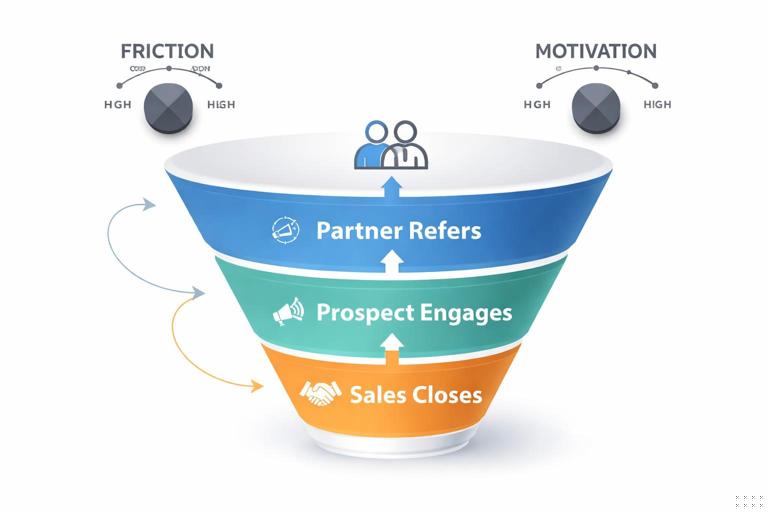
Conversion depends on friction and motivation at each step: the partner’s willingness to refer, the prospect’s willingness to engage, and your team’s ability to close. Incentives can reduce friction (e.g., making it easy to submit a referral and get paid) and increase motivation (e.g., meaningful rewards, fast payouts, status). But incentives cannot compensate for a weak offer, unclear qualification, or slow follow-up. Treat incentives as an amplifier of a working acquisition and sales process, not a substitute for one.
The Three-Part Model: Who You Reward, When You Reward, and What You Reward
1) Who you reward
Most programs reward only the referrer. Many high-converting programs reward both sides: the referrer and the referred customer. Dual-sided incentives increase acceptance rates because the prospect gets an immediate benefit for taking the first step. However, dual-sided incentives can be expensive; use them when your margins and lifetime value can support it, or when the market is crowded and switching costs are high.
- Listen to the audio with the screen off.
- Earn a certificate upon completion.
- Over 5000 courses for you to explore!

Download the app
2) When you reward
Timing is a conversion lever. Rewarding too late reduces partner motivation; rewarding too early increases fraud and low-quality submissions. Common reward moments include: at qualified meeting booked, at opportunity created, at first payment, after a retention period (e.g., 60–90 days), or on recurring revenue. The best timing depends on your sales cycle length and your risk tolerance for churn.
3) What you reward
Rewards can be cash, credits, discounts, upgrades, gift cards, donations, exclusive access, or co-marketing benefits. Cash is universal and clear, but can attract “bounty hunters.” Non-cash rewards can create stronger brand alignment and reduce abuse, but must be genuinely valuable to the partner. In B2B, partners often value predictable recurring revenue share, premium support for their clients, or services that make them look good (e.g., priority onboarding, co-branded materials).
Choosing the Right Referral Motion: Link, Lead Form, or Warm Intro
Referral programs convert best when the referral method matches partner behavior. There are three common motions:
- Tracked link: Best for partners with audiences (newsletters, communities, content creators). Low friction, scalable, but can be lower trust than a personal intro.
- Referral lead form: Best for agencies, consultants, and tools that want to submit leads without email intros. Requires clear fields and fast response.
- Warm introduction: Best for relationship-based partners. Highest trust and often highest close rate, but harder to scale and measure unless you standardize the process.
Many programs support all three, but you should define a “primary path” to reduce confusion. For example: warm intro for strategic partners, link for community partners, and lead form for everyone else.
Incentive Structures That Convert (with Use Cases)
Flat bounty per closed deal
This is the simplest structure: pay a fixed amount when a referred customer becomes a paying customer. It works best when your average contract value is consistent and your sales cycle is not too long. Example: a payroll SaaS pays $500 for each new business that completes its first paid month.
Conversion risk: if the bounty is high, you may attract low-quality referrals. Countermeasure: require a qualification gate (e.g., minimum company size) and pay only after payment clears.
Tiered bounty based on deal size
Tiering aligns partner effort with your revenue. Example: $300 for deals under $5k ARR, $800 for $5k–$20k ARR, $2,000 for $20k+ ARR. This structure encourages partners to refer better-fit accounts and can reduce the “spray and pray” effect.
Conversion benefit: partners become more thoughtful because the upside is meaningful for high-quality matches.
Revenue share (percentage of recurring revenue)
Revenue share is powerful when partners have ongoing influence (agencies managing the account, consultants advising the buyer, platforms embedded in workflows). Example: 15% of monthly subscription revenue for 12 months, or 10% ongoing. This can create long-term alignment and motivate partners to support retention.
Conversion benefit: partners may help you close because they see a durable upside. Operational requirement: you need accurate tracking and predictable payout schedules.
Milestone-based payouts (quality gates)
Milestones reduce risk and improve lead quality. Example: $100 when a qualified meeting occurs, $400 when the customer pays, and $500 after 90 days retained. This structure rewards early effort while protecting you from churn and fraud.
Conversion benefit: partners stay engaged through the funnel, and you can encourage better handoffs.
Dual-sided incentives (referrer + referred)
Dual-sided incentives increase acceptance and speed. Example: the referrer gets $300 after the first payment; the referred customer gets $300 credit applied to their second invoice. The delayed credit reduces “coupon-only” signups while still feeling generous.
Conversion benefit: the prospect has a reason to say yes quickly, and the partner feels they are doing their contact a favor.
Non-cash incentives (status, access, services)
In B2B partnerships, non-cash incentives can outperform cash when they enhance the partner’s brand. Examples: “preferred partner” directory placement, co-branded case study production, early access to features, dedicated partner support line, or free training seats for the partner’s team.
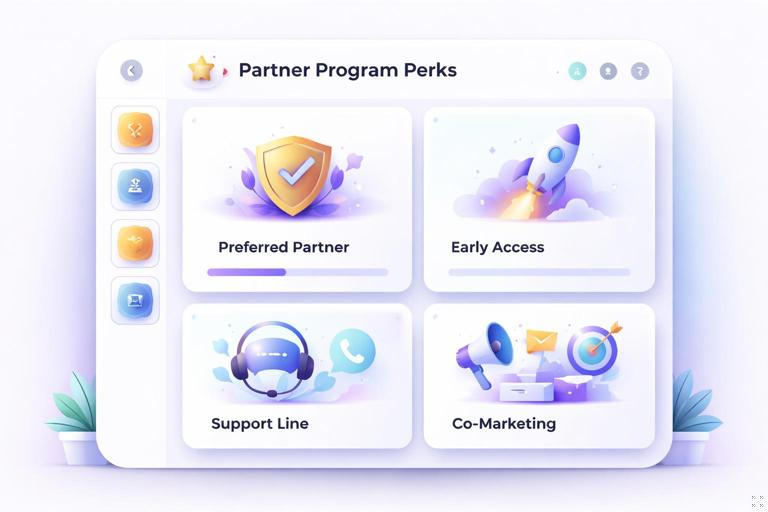
Conversion benefit: partners refer more when it strengthens their positioning and reduces delivery risk for their clients.
Step-by-Step: Designing a Referral Program That Converts
Step 1: Define the referral “unit” you want
Be explicit about what counts as a referral. Options include: a booked call, a qualified opportunity, a closed-won customer, or a retained customer after a set period. Choose one primary definition to avoid disputes. If you want conversion, define the unit close to revenue (e.g., first payment) and add a quality gate (e.g., retention milestone) if churn risk is high.
Step 2: Write qualification rules that partners can follow
Partners refer confidently when they know what “good” looks like. Create a short checklist: industry, company size, geography, tech stack, budget range, and the trigger problem you solve. Keep it simple enough to remember. If you need more nuance, provide “green flags” and “red flags” examples.
Example checklist for a B2B analytics tool: green flags include 20–500 employees, uses a modern data warehouse, has a dedicated ops or analytics owner, and is currently reporting manually. Red flags include no data owner, purely hobby usage, or a requirement for on-prem deployment if you do not support it.
Step 3: Choose an incentive structure that matches your economics and partner effort
Map the partner’s effort level to the reward. A warm intro to a decision-maker is high effort and high reputational risk; it deserves a higher payout than a link share. If you have multiple partner types, create two tracks: “intro partners” and “audience partners,” each with its own reward logic.
Practical rule: the reward should feel “worth it” to the partner after taxes and time, but it should still preserve your payback period. If you cannot pay enough cash to motivate, consider non-cash value that is cheap for you but valuable to them (priority support, co-marketing, training, product credits).
Step 4: Decide payout timing and build trust with speed
Partners convert better when they believe payouts are reliable. Publish payout timing (e.g., monthly net-15) and stick to it. If your sales cycle is long, consider a small early milestone payout to keep momentum. If fraud is a concern, delay the bulk of payout until after payment clears or after a retention window.
Step 5: Design the referral submission flow to remove friction
Every extra field reduces submissions. Ask only for what you need to act fast: prospect name, email, company, role, and a short context note. If you require more, make it optional. Provide templates for warm intros and a one-click way to submit link-based referrals.
Include a “what happens next” promise: response time, who will reach out, and how you will protect the partner’s relationship. For example: “We will respond within 1 business day, we will not add them to marketing lists without consent, and we will keep you copied on key milestones.”
Step 6: Create partner-facing assets that increase conversion
Partners refer more when you make them look competent. Provide: a one-paragraph positioning blurb, a short “who it’s for” list, a simple ROI example, and a FAQ that handles common objections. Keep assets modular so partners can paste them into emails, DMs, or community posts.
Example asset pack: (1) 3 intro email templates (soft intro, direct intro, and “forwardable” email), (2) a 5-bullet value summary, (3) a one-page PDF with outcomes and proof points, (4) a calendar link or booking instructions, and (5) a short compliance note about how data is handled.
Step 7: Set communication rules that protect relationships
Referral conversion drops when prospects feel spammed. Define contact policy: number of outreach attempts, channels allowed, and opt-out handling. For warm intros, confirm whether the partner wants to stay in the thread or prefers you to take over. For link referrals, ensure the prospect explicitly opts in before heavy follow-up.
Step 8: Build a simple tracking and dispute process
Nothing kills a program faster than “I sent you that lead and never got credit.” Establish rules for attribution: cookie window for links, lead ownership if the prospect is already in your CRM, and how to handle multiple referrers. Publish these rules in plain language.
Also define a dispute process: a single email address or form, required evidence (intro email, timestamp, or referral ID), and a resolution timeline. Even if disputes are rare, the existence of a fair process increases partner confidence.
Conversion Levers Beyond Money
Speed-to-lead and partner updates
Referral leads are time-sensitive because the partner’s credibility is “fresh” right after the introduction. Commit to fast response times and send partners status updates at key milestones (received, contacted, meeting set, closed). Updates reinforce that referrals matter and encourage repeat behavior.
Recognition and status tiers
Status can be a strong incentive, especially for agencies and consultants. Create tiers based on outcomes (not just volume): for example, “Certified Referral Partner,” “Preferred Partner,” and “Elite Partner.” Tie tiers to benefits like directory placement, priority support, or invitations to private roadmap sessions.
Enablement that reduces partner risk
Partners hesitate when they fear reputational damage. Reduce that risk with clear expectations: what your team will do, how you will treat their contact, and how you will handle pricing conversations. Provide a short “partner promise” that sets standards for professionalism and responsiveness.
Common Failure Modes (and Fixes)
Failure mode: Too many low-quality referrals
Fix by tightening qualification rules, adding milestone-based payouts, and increasing the reward for high-quality outcomes rather than raw submissions. Also provide examples of “great referrals” so partners can self-correct.
Failure mode: Partners forget the program exists
Fix with lightweight reminders: a monthly partner email with a single success story, a “who we’re looking for this month” snippet, and a quick link to submit referrals. Avoid long newsletters; keep it referral-focused.
Failure mode: Incentives feel unclear or unfair
Fix by publishing a one-page program policy: what counts, payout timing, attribution rules, and edge cases. Clarity increases trust and reduces back-and-forth.
Failure mode: Great referrals don’t convert because follow-up is weak
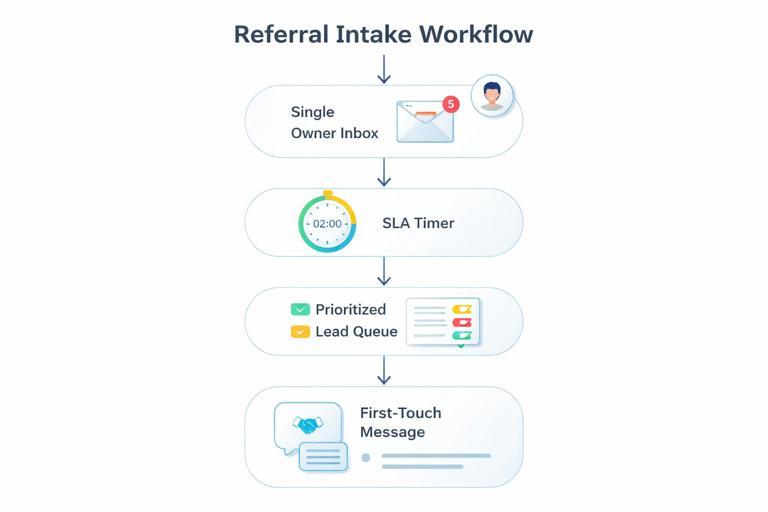
Fix by creating a dedicated referral intake workflow: a single owner, a response-time SLA, and a standard first-touch sequence that references the partner relationship. Referral leads should not enter the same queue as cold inbound without prioritization.
Practical Examples of High-Converting Referral Offers
B2B service business (agency or consultancy)
Offer: “$750 for each referred client who signs a project over $10,000, paid within 7 days of invoice payment.” Add a dual-sided perk: “Your referral gets a free strategy session or audit worth $500.” This converts because the prospect receives immediate value, and the partner sees a clear, fast payout.
B2B SaaS with monthly subscriptions
Offer: “20% of subscription revenue for 12 months, paid monthly, plus $200 bonus when the account stays active for 90 days.” This converts because partners can forecast earnings and are motivated to refer accounts that will stick.
Community-driven product
Offer: “Give $25, get $25” in credits, plus a tiered status badge for members who refer 5, 10, or 25 new paying users. This converts because the community sees visible recognition and the credit is easy to understand.
Templates You Can Implement Immediately
Warm intro email template (partner to prospect)
Subject: Intro: [Your Company] x [Prospect Company] — quick chat? Hi [Prospect Name], I’d like to introduce you to [Your Name], who helps teams like yours [primary outcome]. Reason I thought of you: [1–2 lines of context tied to prospect’s situation]. If helpful, you two can grab 20 minutes to see if it’s relevant. [Your Name], [Prospect Name] is [role] at [company] and is focused on [priority]. I’ll let you take it from here.Forwardable message (partner to prospect)
Hey [Name] — I know you mentioned [problem]. I’ve seen [Your Company] help with that by [how]. If you want, I can connect you or you can book directly here: [link]. You’d be in good hands; they’re responsive and practical.Referral intake form fields (minimum viable)
- Prospect name
- Prospect email
- Company name + website
- Role/title
- Why this is a fit (one sentence)
- Preferred referral method: warm intro / you reach out / link share