Why “Recycling” Matters More Than “Covering”
In a story-based Korean course, it’s easy to feel progress when you finish a new mini-fiction. But long-term retention comes less from finishing and more from revisiting—on purpose. “Recycling” means returning to previously learned language (words, expressions, sentence shapes, and story events) in a planned way so your brain strengthens retrieval pathways. The goal is not to re-study everything; the goal is to retrieve it with increasing speed and flexibility.
Recycling is different from simple review. Simple review often looks like re-reading and thinking “I remember this.” Recycling forces active recall: you try to produce meaning, form, or usage before you look. This creates “desirable difficulty,” which feels slightly effortful but produces durable memory. In everyday terms: if you can recall a phrase when you need it (not only when you see it), you own it.
Two Core Ideas: Retrieval Strength vs. Storage Strength
Long-term retention improves when you understand two kinds of “strength.”
- Storage strength: how well something is stored in memory. This grows slowly and needs repeated successful retrieval over time.
- Retrieval strength: how easy it is to pull it out right now. This can be high right after studying but drops quickly without recycling.
Many learners mistake high retrieval strength (right after reading a story) for long-term learning. Recycling schedules create repeated retrieval opportunities across days and weeks, which increases storage strength. That’s why a short, well-designed review plan beats long, random re-reading sessions.
What a “Review Checkpoint” Is
A review checkpoint is a planned moment where you test and refresh a specific set of story language. It has three features:
- Listen to the audio with the screen off.
- Earn a certificate upon completion.
- Over 5000 courses for you to explore!

Download the app
- Limited scope: you review a small set (for example, one story or two stories, or a single theme like “at the recycling station”).
- Active tasks: you recall, reconstruct, or apply language rather than passively re-reading.
- Decision rules: you decide what to keep, what to postpone, and what to relearn based on performance.
Checkpoints prevent two common problems: (1) endlessly reviewing what you already know because it feels comfortable, and (2) forgetting older material because you always chase new stories.
Recycling Targets: What Exactly Should You Revisit?
When you recycle story material, don’t treat the story as one big block. Break it into targets you can test quickly. Here are high-impact targets that work well for long-term retention:
- Story skeleton: the sequence of events (who did what, where, why).
- Key expressions: 6–12 phrases that carry the story (e.g., “분리수거를 하다,” “라벨을 떼다,” “헷갈리다”).
- Confusable items: words or phrases you mix up (e.g., “버리다” vs. “버려지다,” “비우다” vs. “비다”).
- Micro-structures: short chunks you want to say smoothly (e.g., “~인 줄 알았는데,” “~해야 하는데,” “~라서”).
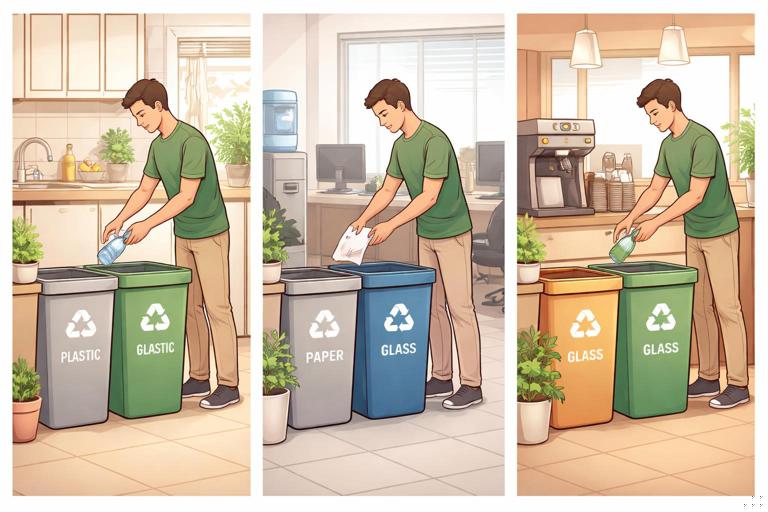
- Situation transfer: how the same language would appear in a different everyday context (recycling station → office trash sorting → café takeout disposal).
Notice what is not on the list: “everything.” Recycling is selective. You choose targets that give the biggest payoff for speaking and reading confidence later.
A Practical Recycling Schedule (Lightweight, Sustainable)
You can recycle without complicated systems. Use a simple schedule that fits real life. Here is a practical template you can apply to each mini-fiction:
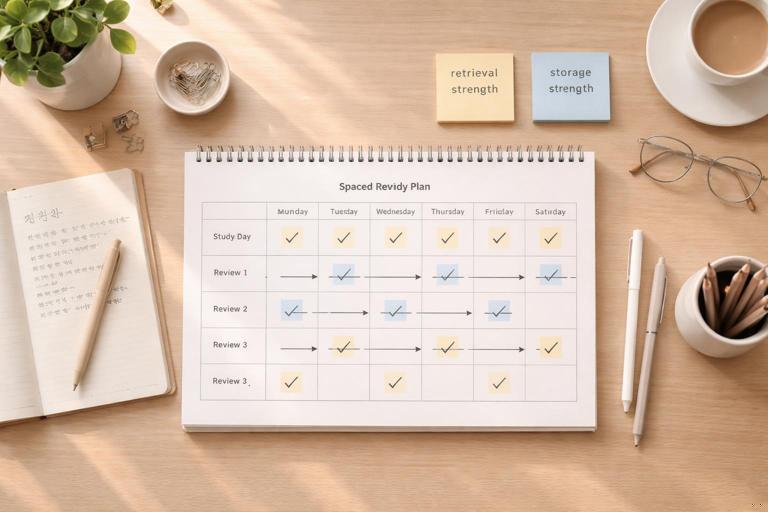
- Checkpoint 1 (same day or next day, 10–15 minutes): quick retrieval while the story is still fresh.
- Checkpoint 2 (3–4 days later, 10–20 minutes): first “gap” review; expect some forgetting.
- Checkpoint 3 (7–10 days later, 15–25 minutes): strengthen storage; focus on speed and accuracy.
- Checkpoint 4 (3–4 weeks later, 20–30 minutes): long-gap review; aim for flexible use in new situations.
If you miss a checkpoint, don’t “restart from zero.” Just do the next one and adjust. Consistency beats perfection.
Checkpoint Toolkit: Step-by-Step Tasks You Can Rotate
To keep reviews effective and not boring, rotate tasks. Each task below is designed to force retrieval. Pick 2–3 tasks per checkpoint.
Task A: Story Skeleton Recall (2–5 minutes)
Goal: retrieve meaning and sequence quickly.
- Step 1: Set a timer for 2 minutes.
- Step 2: Write (or say) the story in 5–7 bullet points in Korean or mixed Korean+English.
- Step 3: Check the original story and mark missing events or wrong order.
- Step 4: Repeat once, aiming to fix only the missing parts.
Tip: Keep it short. The point is retrieval, not perfect style.
Task B: Key Expression Flash Recall (5–8 minutes)
Goal: make phrases available on demand.
- Step 1: Choose 8 expressions from the story (not single words; use short chunks).
- Step 2: Cover the Korean and look only at a cue (English meaning, situation, or a picture cue).
- Step 3: Say the Korean chunk out loud.
- Step 4: Reveal and correct immediately.
- Step 5: Put a mark next to items that took more than 3 seconds.
Decision rule: anything that takes too long becomes a “priority item” for the next checkpoint.
Task C: Error Log Replay (5–10 minutes)
Goal: stop repeating the same mistakes.
- Step 1: Keep a small “error log” list for each story: 3–6 items you got wrong (meaning confusion, wrong particle, wrong verb choice, missing spacing, etc.).
- Step 2: For each item, write one correct example sentence connected to the story situation.
- Step 3: Say each sentence twice, slowly then naturally.
- Step 4: One week later, test yourself: can you produce the correct version without looking?
This turns mistakes into targeted learning rather than vague frustration.
Task D: Minimal-Pair Meaning Check (5–12 minutes)
Goal: reduce confusion between similar words/structures.
Pick one confusion set and create a tiny contrast test. Example sets related to recycling contexts:
- 버리다 (to throw away) vs. 버려지다 (to be thrown away)
- 비우다 (to empty something) vs. 비다 (to be empty)
- 헷갈리다 (to be confused) vs. 헷갈리게 하다 (to confuse someone)
Steps:
- Step 1: Write two short sentences that differ only in the target item.
- Step 2: Cover the target word and try to fill it in from meaning.
- Step 3: Say both sentences out loud and explain the difference in one line (in English or Korean).
1) 저는 플라스틱을 버렸어요. (I threw away the plastic.)
2) 플라스틱이 버려졌어요. (The plastic was thrown away.)
The point is not grammar theory; it’s fast, reliable choice under pressure.
Task E: “One Scene, Three Variations” (10–15 minutes)
Goal: make story language flexible so it transfers to real life.
- Step 1: Choose one scene (e.g., standing at the recycling bins, unsure where something goes).
- Step 2: Write or say it in a basic way (Version 1).
- Step 3: Change one variable each time: person (I → we), time (today → yesterday), or setting (apartment → office).
- Step 4: Keep the key expressions constant while changing the details.
Version 1: 오늘 분리수거를 하다가 헷갈렸어요.
Version 2: 어제 회사에서 분리수거를 하다가 헷갈렸어요.
Version 3: 오늘 우리 집에서 분리수거를 하다가 다 같이 헷갈렸어요.
This kind of controlled variation is a powerful form of recycling because it forces you to retrieve and adapt, not just repeat.
How to Build a “Recycling Bank” Across Stories
As you read more mini-fictions, you’ll notice recurring everyday themes: trash sorting, deliveries, neighbors, weather, convenience stores, commuting. A recycling bank is a running list that connects language across stories so older material stays alive.
Step-by-step: Create a Recycling Bank Page
- Step 1: Make one page (digital or paper) per theme, such as “Home chores,” “Apartment rules,” “Shopping,” “Recycling.”
- Step 2: Each time a story includes that theme, add 2–3 key expressions to the page.
- Step 3: Add one “anchor sentence” you can reuse in real life.
- Step 4: At weekly checkpoints, pick one theme page and do a 5-minute recall test: can you say 6 expressions without looking?
This prevents the “story silo” problem, where each story is remembered only inside itself.
Weekly and Monthly Checkpoints: A Simple System
Beyond per-story checkpoints, you need two higher-level checkpoints to keep the whole course material stable: weekly and monthly.
Weekly Checkpoint (30–45 minutes total)
Goal: keep recent stories active and stop early forgetting.
- Step 1 (10 min): Choose 2 stories from the last 7–10 days. Do Task A (story skeleton recall) for each.
- Step 2 (10–15 min): From those stories, test 10 key expressions (Task B).
- Step 3 (10–15 min): Pick 1 confusion set and do Task D.
- Step 4 (optional 5 min): Update your recycling bank with 3 new items.
Rule: If you score poorly (for example, you can’t recall more than half), don’t add new stories that day. Use the time to repair the weakest items.
Monthly Checkpoint (60–90 minutes total)
Goal: long-gap retrieval and transfer to new contexts.
- Step 1 (15 min): Choose 4 older stories (at least 3 weeks old). Do a fast story skeleton recall for each.
- Step 2 (20–30 min): Create a mixed quiz: 20 expressions pulled from those stories. Test recall out loud.
- Step 3 (15–25 min): Do Task E (one scene, three variations) for two scenes from different stories.
- Step 4 (10–15 min): Review your error logs and select the top 5 “still unstable” items for the next month’s focus.
The monthly checkpoint is where long-term retention is built. It’s normal for it to feel harder than weekly review.
Measuring Retention Without Over-Testing
Checkpoints should be informative, not exhausting. Use quick metrics that help you decide what to recycle next.
Three simple metrics
- Latency: how many seconds it takes to recall a phrase. Slow recall means it’s not automatic yet.
- Accuracy: whether you chose the right expression and used it correctly.
- Stability: whether you can recall it after a longer gap (one week, one month).
Instead of giving yourself a vague score like “good/bad,” tag items with a simple label:
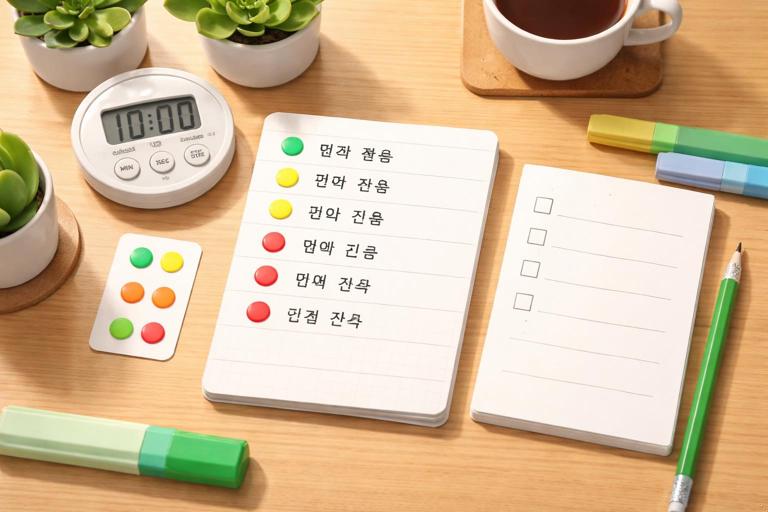
- Green: fast and correct (keep on long intervals).
- Yellow: correct but slow or shaky (review sooner).
- Red: wrong or blank (repair immediately with a short relearn session).
Repair Sessions: What to Do When You Fail a Checkpoint
Forgetting is not a sign of failure; it’s data. A repair session is a short, focused reset for red items.
Step-by-step Repair Loop (8–12 minutes per item set)
- Step 1: Re-expose: look at the original sentence(s) in the story and re-read them once for meaning.
- Step 2: Rebuild: write one new sentence that uses the same expression in a similar situation.
- Step 3: Retrieve: cover the expression and try to produce it from the cue.
- Step 4: Repeat retrieval 3 times, spacing attempts with 20–30 seconds of other items.
This loop is short but powerful because it ends with retrieval, not with re-reading.
Interleaving: Mixing Old and New for Stronger Recall
Many learners review in blocks: Story 1, then Story 2, then Story 3. That feels smooth but can create “context dependence,” where you remember only when the story is in front of you. Interleaving means mixing items from different stories in one session. It feels harder, but it improves discrimination and real-life retrieval.
How to interleave without chaos
- Choose 3 stories.
- Take 4 expressions from each (12 total).
- Shuffle them and test recall in random order.
- After the test, group mistakes by type (meaning confusion, wrong verb choice, missing chunk).
Interleaving is especially useful for similar everyday scenes (trash sorting vs. cleaning vs. organizing), where expressions can overlap.

Context Refreshers: Recreating the Situation Quickly
Sometimes you “know” an expression but can’t recall it because the situation is missing. A context refresher is a 30-second mental replay of the scene that triggers the language naturally.
Step-by-step Context Refresher
- Step 1: Name the location (e.g., apartment recycling area).
- Step 2: Name the object (e.g., plastic bottle with label).
- Step 3: Name the problem (e.g., unsure where to put it).
- Step 4: Retrieve 2 expressions that fit the scene.
This is a practical bridge between story memory and real-life speaking because real life always comes with context.
Designing Your Personal Checkpoint Map
Different learners forget different things. Your checkpoint map is a simple plan that tells you what to recycle and when, based on your performance.
Step-by-step: Build a Checkpoint Map in 10 minutes
- Step 1: List the last 8 stories you studied.
- Step 2: For each story, write 3 key expressions you want to keep.
- Step 3: Mark each story as Green/Yellow/Red based on how confidently you can recall the skeleton and key expressions.
- Step 4: Schedule the next 7 days: 1 red story (repair), 2 yellow stories (standard checkpoint), 1 green story (long-gap test).
This keeps your review workload realistic and prevents review from expanding endlessly.
Practical Example: A Recycling-Themed Mini-Review Set
Below is an example of how you might structure a checkpoint around a recycling-related story without re-reading the whole text first.
Example set (expressions and cues)
- Cue: “recycling” → 분리수거를 하다
- Cue: “remove the label” → 라벨을 떼다
- Cue: “rinse it” → 헹구다
- Cue: “I got confused” → 헷갈렸어요
- Cue: “throw away / be thrown away” → 버리다 / 버려지다
- Cue: “empty it first” → 먼저 비우다
10-minute checkpoint flow
- Minute 1–2: Task A (5 bullet story skeleton).
- Minute 3–6: Task B (flash recall of the 6 expressions out loud).
- Minute 7–9: Task D (버리다 vs. 버려지다 contrast sentences).
- Minute 10: Tag items Green/Yellow/Red and pick 2 for repair tomorrow.
This is short enough to do on busy days, but structured enough to build long-term retention.