Everyday Situations as a Progressive Skill Path
Instead of treating “daily Korean” as a random list of useful phrases, you can organize everyday situations into a progressive skill path. A skill path is a sequence where each situation trains a slightly more complex version of the same communicative ability: noticing what’s happening, choosing a goal, selecting the right level of politeness, and responding in real time. The key idea is that situations are not just topics (cafe, subway, office). They are repeatable interaction patterns (requesting, confirming, refusing, apologizing, negotiating, updating). When you order these patterns from simple to complex, you get a practical roadmap for reading and speaking with confidence.
This chapter shows how to build that roadmap and how to practice each step so that your ability grows predictably. You will focus on progression: from low-stakes, predictable exchanges to higher-stakes, multi-turn interactions with uncertainty, emotion, and negotiation.
1) What “progressive” means in everyday Korean

A progressive path increases difficulty by changing one or more of these variables:
- Number of turns: one-turn (request) → two-turn (request + confirmation) → multi-turn (request + clarification + adjustment).
- Predictability: fixed scripts (ordering) → semi-scripted (asking for help) → open-ended (complaint, negotiation).
- Information load: one detail (size) → multiple constraints (time, budget, preference) → conflicting constraints (urgent but cheap).
- Social risk: low (asking location) → medium (refusing) → high (disagreeing, complaining).
- Politeness control: consistent polite style → switching styles (formal to casual) → managing honorifics and indirectness.
- Error recovery: no repair needed → simple repair (“다시 말해 주세요”) → strategic repair (summarize, confirm, propose alternatives).
When you choose situations, you are really choosing which variables to train. A good path repeats the same core functions across different contexts so your brain stops treating each scene as new.
2) The core interaction functions that power most situations
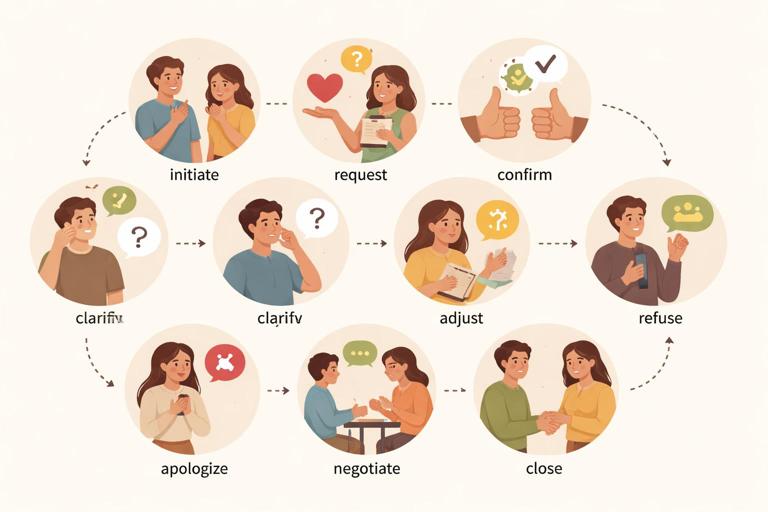
Many everyday scenes are built from a small set of functions. If you can do these reliably, you can handle most mini-fictions and real conversations.
- Listen to the audio with the screen off.
- Earn a certificate upon completion.
- Over 5000 courses for you to explore!

Download the app
- Initiate: start an interaction politely and clearly.
- Request: ask for an action or item.
- Ask for information: time, location, price, availability.
- Confirm: check understanding, repeat key details.
- Clarify: ask for repetition, explanation, or examples.
- Adjust: change the request (smaller, later, different option).
- Refuse: say no, soften, give reason, offer alternative.
- Apologize: acknowledge inconvenience, repair.
- Negotiate: propose options, compare, decide.
- Close: end politely, express thanks.
A progressive path trains these functions first in “clean” situations (few variables) and later in “messy” situations (multiple variables and emotions).
3) Build your situation ladder: a practical framework
Use a ladder with five levels. Each level includes typical everyday scenes, but the real goal is the interaction complexity.
Level 1: Single-goal, single-turn exchanges
Goal: produce one clear action or question without needing follow-up. Typical scenes: buying a small item, asking where something is, asking the time.
Training focus: clean openings, one request, one thanks.
- “이거 하나 주세요.”
- “화장실이 어디예요?”
- “지금 몇 시예요?”
Upgrade rule: when you can do this without hesitation, add one constraint (Level 2).
Level 2: One constraint + confirmation
Goal: add one detail (size, time, method) and confirm it. Typical scenes: ordering with options, booking a time, asking about availability.
Training focus: specifying and confirming.
- “아이스로 주세요.”
- “오늘 자리 있어요?”
- “내일 오전으로 가능할까요?”
Micro-skill: confirm the key detail before closing.
- “아이스 아메리카노 한 잔 맞죠?”
- “내일 오전 10시로 예약해 드릴까요?”
Level 3: Multi-turn with clarification and repair
Goal: handle a misunderstanding or missing information. Typical scenes: directions, delivery details, phone calls, asking for help in a store.
Training focus: clarification questions and repair phrases that keep the conversation moving.
- “죄송한데, 다시 한 번 말씀해 주실 수 있어요?”
- “그러면 여기에서 오른쪽으로 가는 거예요?”
- “주소가 ‘…’ 맞나요?”
Upgrade rule: once you can repair smoothly, add a preference trade-off (Level 4).
Level 4: Preferences, trade-offs, and soft negotiation

Goal: express preferences, compare options, and decide. Typical scenes: choosing a menu with constraints, discussing plans, shopping with budget.
Training focus: stating preferences politely and proposing alternatives.
- “매운 건 잘 못 먹는데, 덜 매운 메뉴가 있을까요?”
- “조금 비싸도 품질이 좋은 걸로 보고 있어요.”
- “그럼 이건 어떠세요?”
Micro-skill: show flexibility while keeping your goal.
- “그 시간은 어려우면, 조금 늦게도 괜찮아요.”
Level 5: High-stakes interactions (complaints, boundaries, conflict repair)
Goal: manage emotion and social risk while staying polite. Typical scenes: wrong order, noise complaint, returning an item, setting boundaries with a coworker.
Training focus: indirectness, calm tone, clear facts, and solution requests.
- “죄송한데요, 제가 주문한 것과 조금 다른 것 같아요.”
- “확인해 주실 수 있을까요?”
- “가능하면 교환/환불이 될까요?”
Micro-skill: separate facts from feelings and propose a solution.
- “제가 확인을 잘 못했을 수도 있는데, 영수증이 여기 있어요.”
4) Step-by-step: turn any everyday scene into a skill drill
Pick one situation (for example, “ordering at a cafe”) and run it through a consistent drill. The point is not to memorize a script, but to practice the same interaction functions with small variations.
Step 1: Define the communicative goal and the “must-say” items
Write the goal as an action: “I want to order X with Y option and pay.” Then list the must-say items (2–4 items only).
- Item: 아메리카노
- Option: 아이스/뜨거운
- Quantity: 한 잔
- Payment: 카드/현금
Step 2: Choose the politeness setting
Decide your default style for the scene. Most service situations use polite style. If the scene is with a friend, casual style may be natural. The skill is consistency: don’t mix styles randomly.
- Service: “주세요/할게요/있어요?”
- Friend: “먹을래?/갈래?”
Step 3: Build a 3-turn “minimum viable dialogue”
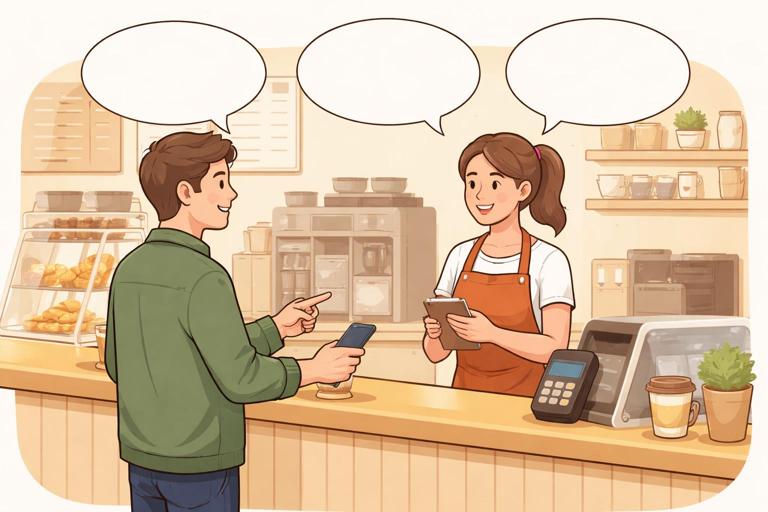
Create the smallest dialogue that completes the goal. Keep it short and repeatable.
손님: 아이스 아메리카노 한 잔 주세요. 직원: 네, 아이스로 한 잔 맞으세요? 손님: 네, 맞아요. 카드로 할게요.This is your base. You will expand it later with constraints and repairs.
Step 4: Add one variable at a time (controlled difficulty)
Change only one thing per practice round. Examples:
- Change quantity: “두 잔”
- Add size: “큰 사이즈로”
- Add time: “포장해 주세요”
- Add preference: “덜 달게 가능해요?”
By controlling variables, you train flexibility without overwhelming yourself.
Step 5: Add a predictable problem (repair practice)
Now introduce one common problem and practice a repair response. Choose problems that match your level.
- They didn’t hear you: “죄송한데, 다시 말씀드릴게요.”
- They ask a question you didn’t expect: “사이즈는 어떻게 하실까요?” → “미디엄으로 주세요.”
- They don’t have it: “그 메뉴는 오늘 품절이에요.” → “그럼 비슷한 걸로 추천해 주실 수 있어요?”
Step 6: Time pressure (realistic speed)
Do the same dialogue with a timer. Start with slow speed, then reduce preparation time.
- Round A: 20 seconds to prepare, speak once.
- Round B: 10 seconds to prepare, speak twice with different variables.
- Round C: no preparation, respond immediately to a prompt.
Time pressure is what turns “knowledge” into “skill.”
5) A sample progressive path (8-week structure)
Below is an example path that moves from predictable to complex. You can swap scenes, but keep the progression logic.
Weeks 1–2: Level 1 foundations (clean requests and questions)
- Convenience store: buying one item
- Street: asking location
- Building: asking where the restroom is
- Simple greetings + thanks in context
Performance target: one clear sentence without stopping; correct politeness choice.
Weeks 3–4: Level 2 constraints (options + confirmation)
- Cafe: temperature, size, to-go
- Restaurant: number of people, waiting list
- Clinic/pharmacy: availability, time
Performance target: add one constraint and confirm the key detail naturally.
Weeks 5–6: Level 3 repair (clarification and directions)
- Subway/bus: confirming the correct line/stop
- Delivery: confirming address and time
- Store: asking staff for help and clarifying options
Performance target: ask for repetition, confirm understanding, and continue without switching to another language.
Week 7: Level 4 negotiation (preferences and trade-offs)
- Planning with a friend: time/place changes
- Shopping: budget vs quality
- Food preferences: allergies, spice level, substitutions
Performance target: state a preference, accept or propose an alternative, and reach a decision.
Week 8: Level 5 boundaries and complaints (solution-focused)
- Wrong order: request correction
- Return/exchange: explain issue calmly
- Noise or schedule conflict: set a boundary politely
Performance target: describe the problem factually, request a solution, and close politely.
6) How to choose situations that match your real life
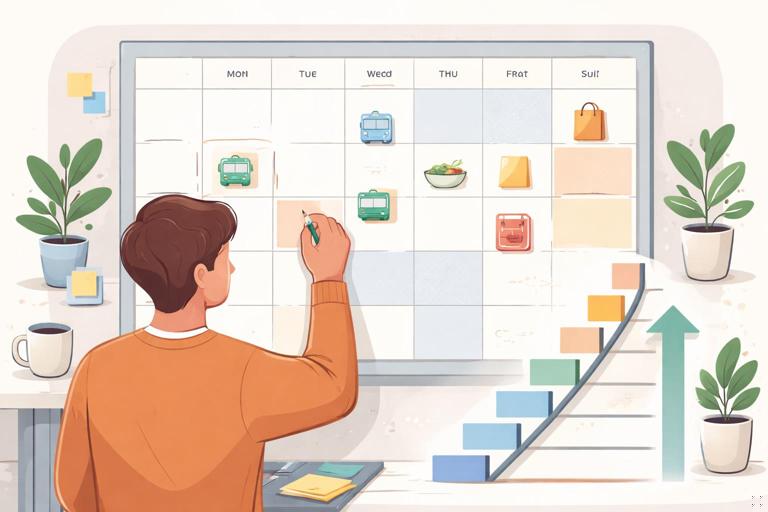
A progressive path works best when it mirrors your routine. Use these filters to pick scenes:
- Frequency: scenes you will actually face (commute, lunch, errands).
- Consequence: start with low consequence; save high consequence for later.
- Repeatability: scenes you can practice often (ordering, asking directions).
- Emotional load: avoid starting with conflict-heavy scenes if you freeze easily.
Then map each chosen scene to a level. If a scene feels too hard, don’t abandon it; downgrade it by removing variables (fewer constraints, fewer turns) and rebuild upward.
7) Practical templates you can reuse across many situations
To make progression efficient, reuse the same interaction skeleton in different contexts. Here are reusable templates that scale from Level 1 to Level 5 by adding details.
Template A: Request + option
죄송한데요, [N] [수량] [동사] 주세요. [옵션]으로요.- “죄송한데요, 물 한 병 주세요. 차가운 걸로요.”
- “죄송한데요, 영수증 한 장 더 주세요.”
Template B: Confirming details
[핵심 정보] 맞나요? / 그러면 [정보]로 하면 될까요?- “2번 출구 맞나요?”
- “그러면 내일 3시로 하면 될까요?”
Template C: Clarification and repair
죄송한데, [부분]을/를 잘 못 들었어요. 다시 말씀해 주실 수 있어요?- “죄송한데, 마지막 부분을 잘 못 들었어요.”
Template D: Soft refusal + alternative
그건 조금 어려울 것 같아요. 대신 [대안]은/는 어떨까요?- “오늘은 조금 어려울 것 같아요. 대신 내일은 괜찮아요.”
Template E: Complaint as a solution request
죄송한데요, [사실]인 것 같아요. [요청]해 주실 수 있을까요?- “죄송한데요, 제가 주문한 것과 다른 것 같아요. 다시 확인해 주실 수 있을까요?”
These templates are not meant to be recited mechanically. They are scaffolding: you start with them, then gradually personalize them as your speed and confidence grow.
8) Measuring progress: what to track at each level
Progress feels vague unless you track the right signals. Use level-appropriate metrics:
- Level 1: Can you start without hesitation? Can you finish one sentence cleanly?
- Level 2: Can you add one constraint and confirm it?
- Level 3: Can you recover from “I didn’t understand” without freezing?
- Level 4: Can you express preference and accept/offer alternatives?
- Level 5: Can you stay polite while being firm and solution-focused?
Also track latency (how long before you speak) and repair quality (do you keep the interaction moving). These are more meaningful than counting how many words you know.
9) Common pitfalls and how to fix them (without changing the path)
Pitfall: You memorize scripts but can’t adapt
Fix: practice “one-variable changes” (Step 4). If you always order the same drink, force a change: hot/iced, size, to-go, less sweet. Adaptation is the skill.
Pitfall: You avoid clarification because it feels embarrassing
Fix: treat clarification as a normal function, not a failure. Prepare two clarification lines you can say automatically, then continue.
- “죄송한데, 천천히 말씀해 주실 수 있어요?”
- “제가 잘 이해했는지 확인해도 될까요?”
Pitfall: You jump to high-stakes scenes too early
Fix: keep the same scene but reduce social risk. For example, practice a “wrong order” scenario as a calm check first (“확인 부탁드려요”), then later as a stronger request (“바꿔 주실 수 있을까요?”).
Pitfall: Your politeness level is inconsistent
Fix: decide the relationship first (staff, stranger, friend) and keep one style for the whole interaction. If you need to switch, do it intentionally (for example, from formal to casual when a stranger becomes friendly), not randomly.