What a Recovery Charter Is (and Why It Matters)
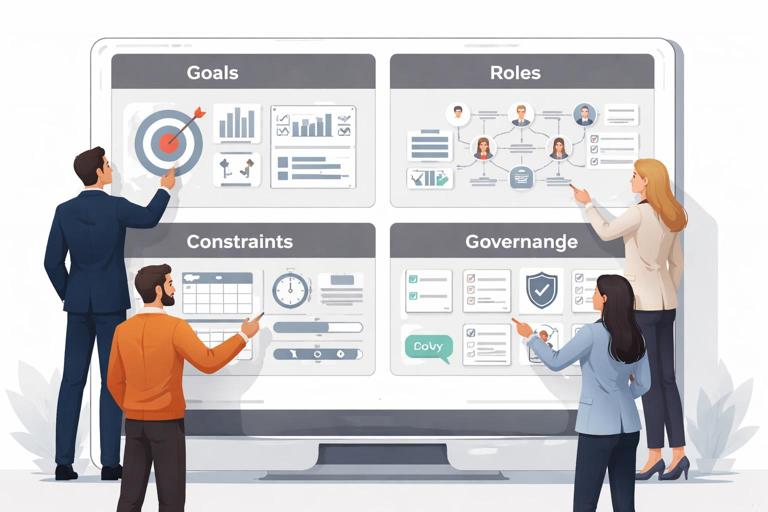
A recovery charter is a short, explicit agreement that resets how a troubled project will be run during the recovery period. It is not a rehash of the original project charter and it is not a detailed project plan. Instead, it is a practical operating contract that answers four questions in plain language:
- Goals: What outcomes are we trying to achieve during recovery, and how will we measure them?
- Roles: Who is accountable for what decisions and deliverables, and how do we resolve conflicts?
- Constraints: What boundaries are non-negotiable (time, budget, compliance, technology, capacity), and what is flexible?
- Governance: How will we make decisions, manage changes, escalate issues, and report progress?
In recovery, ambiguity is expensive. Teams often lose time because stakeholders disagree on what “success” means, who can approve changes, and what tradeoffs are allowed. The recovery charter reduces that ambiguity quickly. It creates a shared reference point so that when pressure rises, the team can point to an agreed rule rather than re-litigating decisions.
Think of the recovery charter as the “control panel” for the next phase: it defines the minimum viable alignment required to execute a recovery plan without constant negotiation.
When to Create It and How to Use It
Create the recovery charter immediately after you have enough evidence to propose a recovery direction (for example, a stabilization plan, a re-baseline, a phased release, or a controlled shutdown). The charter should be drafted quickly, reviewed with key decision-makers, and then treated as a living document with controlled updates.
Use it in three ways:
- Listen to the audio with the screen off.
- Earn a certificate upon completion.
- Over 5000 courses for you to explore!

Download the app
- Kickoff for recovery: Align the team and stakeholders on the new operating model.
- Decision reference: When a dispute arises (“Can we add this feature?” “Can we slip the date?”), use the charter to guide the answer.
- Governance anchor: Tie reporting, escalation, and change control to the charter so that governance is consistent and predictable.
Step-by-Step: Building a Recovery Charter in Practice
Step 1: Define the Recovery Window and Scope of the Charter
Start by stating the timebox and what the charter covers. Recovery often runs in a defined window (e.g., 30/60/90 days) with a specific focus (stabilize delivery, restore quality, regain stakeholder trust, or prepare for a re-launch).
- Recovery window: “This charter governs the project from Feb 1 to Apr 30.”
- Coverage: “Applies to all workstreams delivering Release 2.1 and all supporting activities (testing, security review, deployment readiness).”
- Exclusions: “Does not cover long-term roadmap planning beyond Release 2.1.”
This prevents the charter from becoming a catch-all document and keeps it focused on recovery execution.
Step 2: Set Recovery Goals That Are Measurable and Tradeoff-Aware
Recovery goals must be specific enough to drive decisions. Avoid goals like “get back on track” or “improve quality.” Instead, define outcomes, metrics, and thresholds. Include both delivery goals and health goals (quality, operational readiness, team sustainability).
Use a small set of goals (typically 3–7). For each goal, define:
- Outcome statement: What will be true if we succeed?
- Metric: How will we measure it?
- Target: What number or threshold indicates success?
- Measurement cadence: Daily/weekly/biweekly.
- Owner: Who reports it?
Example recovery goals (software delivery):

- Goal 1: Stabilize release scope. Metric: number of scope changes approved per week. Target: ≤ 2/week after Week 2. Owner: Product Lead.
- Goal 2: Restore predictable delivery. Metric: sprint commitment reliability (completed/committed). Target: ≥ 85% for 2 consecutive sprints. Owner: Delivery Lead.
- Goal 3: Reduce critical defects. Metric: open Sev-1/Sev-2 defects. Target: 0 Sev-1 and ≤ 3 Sev-2 before go-live. Owner: QA Lead.
- Goal 4: Improve deployment readiness. Metric: successful end-to-end deployment rehearsals. Target: 2 successful rehearsals with rollback tested. Owner: DevOps Lead.
- Goal 5: Protect team sustainability. Metric: average weekly overtime hours. Target: ≤ 5 hours/person after stabilization phase. Owner: Engineering Manager.
Include explicit tradeoff rules tied to goals. For example: “If quality targets are not met, schedule is negotiable; if regulatory deadline is fixed, scope is negotiable.” This prevents hidden priorities from derailing recovery.
Step 3: Define Roles Using Accountability, Not Job Titles
Troubled projects often suffer from role confusion: multiple people think they own the same decision, or nobody owns it. The recovery charter should define roles as decision rights and accountabilities, not as org chart labels.
A practical approach is to define:
- Recovery Sponsor: The executive who provides air cover, removes blockers, and owns the business outcome.
- Recovery Lead: The single accountable leader for executing the recovery plan day-to-day.
- Product/Business Owner: Owns scope priorities and acceptance criteria.
- Engineering Lead: Owns technical execution and engineering quality.
- Quality Lead: Owns test strategy, defect triage, and release readiness criteria.
- Operations/DevOps Lead: Owns deployment, monitoring, rollback, and operational readiness.
- Architecture/Security/Compliance: Owns non-functional constraints and approvals.
- PMO/Finance Partner: Owns budget tracking and reporting integrity.
Then, explicitly assign decision rights. A simple “decision table” is often more useful than a complex RACI.
Decision Area | Proposes | Approves | Consulted | Notes/Constraints
Scope change (feature add) | Product Lead | Recovery Sponsor | Eng, QA | Only if within timebox and quality gates
Scope cut/de-scope | Product Lead | Recovery Sponsor | Customer rep | Must preserve regulatory requirements
Release date change | Recovery Lead | Sponsor + Steering | Product, Eng | Requires impact analysis within 48 hours
Architecture exception | Eng Lead | Architecture Owner | Security | Documented risk acceptance required
Go/No-Go for release | Recovery Lead | Steering Committee | QA, Ops | Based on readiness checklist thresholds
Also define conflict resolution. For example: “If Product and Engineering disagree on feasibility, the Recovery Lead decides within 24 hours after reviewing evidence; unresolved escalates to Sponsor.” Recovery cannot tolerate long stalemates.
Step 4: Capture Constraints and Assumptions Explicitly
Constraints are the boundaries that shape the recovery plan. In distressed projects, constraints are often assumed but not written down, leading to surprise conflicts (e.g., “We can’t use that cloud service,” “We can’t hire contractors,” “We must launch before the audit”).
Organize constraints into categories and state whether each is fixed or negotiable:
- Time constraints: regulatory deadlines, seasonal launch windows, contract milestones.
- Budget constraints: remaining funds, approval thresholds, procurement lead times.
- Resource constraints: team capacity, key-person dependency, shared environments.
- Technical constraints: mandated platforms, integration dependencies, data residency.
- Quality and risk constraints: acceptable defect levels, performance thresholds, security requirements.
- Process constraints: change management requirements, documentation, audit trails.
Example constraint statements:
- “Go-live must occur by May 15 due to regulatory reporting cycle (fixed).”
- “No net-new vendor contracts can be signed this quarter (fixed).”
- “We can add up to 2 contract testers within 3 weeks if justified (negotiable with Sponsor approval).”
- “Customer data must remain in-region; no cross-border replication (fixed).”
- “Performance must support 2,000 concurrent users with p95 response time < 500ms (fixed).”
Include assumptions separately and treat them as items to validate. For example: “Assumption: Integration partner will deliver API v3 by March 10.” If an assumption fails, governance should specify how the plan is revisited.
Step 5: Establish Governance That Matches Recovery Speed
Governance in recovery must be tighter than normal delivery, but not bureaucratic. The goal is fast, transparent decisions with clear escalation paths. Define governance in four layers:
- Cadence: What meetings exist, how often, and who attends?
- Artifacts: What documents or dashboards are the source of truth?
- Decision mechanisms: How are decisions made and recorded?
- Escalation: What triggers escalation and how quickly must it be resolved?
Recommended meeting cadence (example):
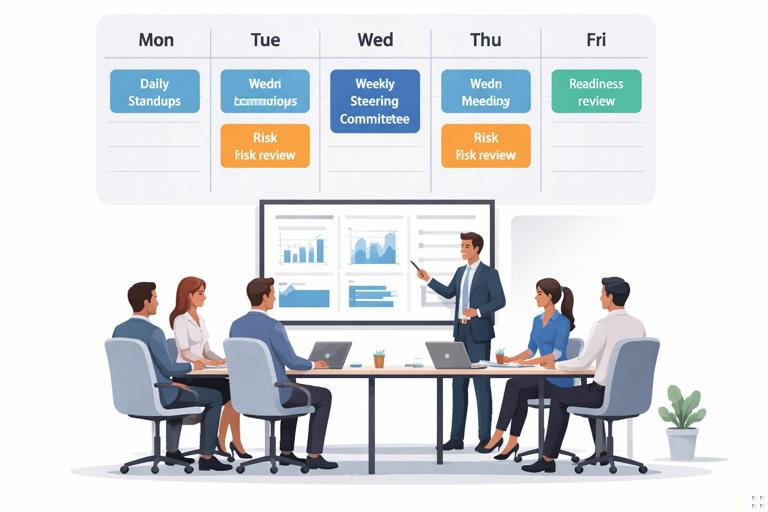
- Daily Recovery Standup (15 min): Recovery Lead + workstream leads. Focus: blockers, critical risks, today’s priorities.
- Twice-weekly Risk & Issue Review (30–45 min): Recovery Lead + Sponsor delegate. Focus: top risks/issues, mitigation status, escalations.
- Weekly Steering Committee (60 min): Sponsor, Recovery Lead, Product, Eng, QA, Ops, Finance. Focus: decisions, tradeoffs, scope/date/budget changes.
- Release Readiness Review (as needed, often weekly near go-live): QA + Ops + Security + Recovery Lead. Focus: readiness checklist and go/no-go criteria.
Governance artifacts (keep them minimal but strict):
- Recovery backlog: prioritized work with acceptance criteria and owners.
- Integrated milestone plan: a small set of milestones that matter (not a 500-line schedule).
- RAID log: risks, assumptions, issues, dependencies with owners and dates.
- Decision log: what was decided, by whom, when, and why.
- Status dashboard: goals/metrics, progress, and forecast.
Define how decisions are recorded: “No decision is effective until it is logged in the decision log and communicated to impacted leads.” This prevents “hallway decisions” from creating confusion.
Step 6: Define Change Control for Recovery (Fast but Disciplined)
Recovery fails when change control is either too loose (scope creep returns) or too heavy (team spends all day in approvals). The charter should define a lightweight change control mechanism with thresholds.
Include:
- Change categories: scope, schedule, budget, architecture, quality gates.
- Impact levels: minor/major/critical with clear definitions.
- Approval thresholds: who can approve each level.
- Required analysis: what must be provided before approval (impact on goals, risks, timeline).
- Turnaround time: how quickly a decision must be made.
Change Level Definitions (example)
Minor: < 2 days effort, no impact to milestones, no new risk class
Major: 2–10 days effort OR impacts a milestone OR adds a new dependency
Critical: > 10 days effort OR changes go-live date OR increases budget OR affects compliance

Approval (example)
Minor: Recovery Lead
Major: Recovery Lead + Product Lead
Critical: Steering Committee (Sponsor final)
Also define a “scope freeze” rule if appropriate: “After Milestone M3 (system test start), new features are not accepted; only defect fixes and compliance items.” Recovery often requires a deliberate narrowing of what is allowed late in the cycle.
Step 7: Specify Quality Gates and Readiness Criteria
In troubled projects, quality is frequently discussed but rarely operationalized. The recovery charter should define non-negotiable quality gates and who certifies them. These gates become part of governance and prevent premature releases driven by pressure.
Examples of readiness criteria you can include:
- Testing completeness: “100% of critical user journeys executed; pass rate ≥ 95%.”
- Defect thresholds: “No open Sev-1; Sev-2 only with documented workaround and Sponsor acceptance.”
- Performance: “Load test meets p95 response time target in production-like environment.”
- Security: “No critical vulnerabilities open; pen test exceptions require Security sign-off.”
- Operational readiness: “Monitoring dashboards live; on-call runbook approved; rollback tested.”
Assign owners: QA certifies test results, Security certifies vulnerability status, Ops certifies deployment readiness, and the Steering Committee makes the final go/no-go based on evidence.
Step 8: Build a Communication Plan That Reduces Noise and Surprises
Recovery creates anxiety. Stakeholders want frequent updates, but too many ad hoc requests distract the team. The charter should define a communication plan that is predictable and transparent.
- Audience map: executives, impacted business teams, external partners, customer representatives.
- Update frequency: weekly steering summary, twice-weekly risk highlights, daily internal notes if needed.
- Channels: email summary, dashboard link, brief recorded update, or live review.
- Message structure: goals/metrics, progress vs plan, key risks/issues, decisions needed, next milestones.
Include a rule for urgent communications: “Sev-1 incidents or critical dependency failures are communicated within 2 hours to Sponsor and impacted leads.” This avoids both under-communication and panic broadcasting.
Practical Template: Recovery Charter Sections
You can keep the charter to 2–6 pages if you focus on operational clarity. A practical structure:
- 1. Purpose and recovery window
- 2. Recovery goals and success metrics
- 3. Scope boundaries (in/out) for recovery
- 4. Roles and decision rights (decision table)
- 5. Constraints and assumptions
- 6. Governance cadence and artifacts
- 7. Change control thresholds
- 8. Quality gates and go/no-go criteria
- 9. Escalation paths and response times
- 10. Communication plan
Keep language direct and testable. If a statement cannot be used to make a decision, it probably does not belong.
Worked Example: Recovery Charter Excerpts (Condensed)
Scenario: A customer-facing billing portal is behind schedule, defect rates are high, and stakeholders disagree on what must ship. The team is entering a 60-day recovery period to deliver a safe, reduced-scope release.

Purpose & window: “This charter governs the Billing Portal Recovery from Mar 1 to Apr 30 to deliver a compliant, stable Release 1.0 to 20% of customers.”
Goals:
- “Deliver Release 1.0 to pilot group by Apr 30 with 0 Sev-1 defects and ≤ 5 Sev-2 defects.”
- “Achieve deployment success rate of 100% across two rehearsals in a production-like environment.”
- “Maintain sprint reliability ≥ 85% for two consecutive sprints by end of March.”
Scope boundaries:
- In: invoice viewing, payment processing, account profile, audit logging.
- Out: advanced analytics dashboard, multi-language support, promotional offers.
Decision rights: “Product Lead proposes scope changes; Recovery Sponsor approves any critical changes; Recovery Lead approves minor changes within thresholds.”
Constraints: “PCI compliance controls are fixed; no new payment provider integration; budget increase limited to $50k for temporary QA support.”
Governance: “Weekly Steering Committee every Tuesday; decision log updated within 24 hours; RAID reviewed twice weekly.”
Quality gates: “No-go if penetration test reports any critical vulnerability; no-go if rollback rehearsal not completed.”
Common Pitfalls and How to Avoid Them
Pitfall 1: Goals That Are Aspirational Instead of Operational
If goals are vague, governance becomes political: whoever speaks loudest wins. Fix this by attaching metrics and thresholds to each goal and by defining which goal dominates in a conflict (e.g., compliance over scope, quality over speed).
Pitfall 2: Too Many Decision Makers
Recovery needs a single accountable leader and a small set of approvers. If every stakeholder can veto, progress stalls. Use the decision table to limit approvals to the minimum necessary and define time limits for decisions.
Pitfall 3: Constraints Hidden in People’s Heads
Unwritten constraints surface late and cause rework. Force constraints into the charter early and label them fixed vs negotiable. If stakeholders disagree on whether something is fixed, that disagreement itself is a decision to resolve in governance.
Pitfall 4: Governance That Produces Reports but Not Decisions
Status meetings that avoid hard choices waste time. Ensure each governance forum has a purpose: steering is for decisions and tradeoffs; daily standup is for execution and blockers. Require that decisions are logged and communicated.
Pitfall 5: Change Control That Is Either a Free-for-All or a Brick Wall
Define thresholds so small changes can proceed quickly while major changes receive appropriate scrutiny. Make turnaround times explicit so the team is not stuck waiting indefinitely.
Facilitation Tips for Getting the Charter Approved
Approval is often the hardest part because recovery charters force explicit tradeoffs. Use facilitation techniques that keep discussion grounded:
- Pre-wire key stakeholders: Share a draft and discuss contentious points 1:1 before the group review.
- Use “either/or” framing: “If date is fixed, scope must flex. If scope is fixed, date must flex.”
- Bring examples: Show how a decision would be made under the charter (e.g., a late feature request) to prove it is workable.
- Timebox unresolved items: If a constraint or decision right is disputed, assign an owner and a deadline to resolve it, and document it as an open item in the charter.
The goal is not perfection; it is enough clarity to execute without constant renegotiation.