What a Partnership Pilot Is (and What It Is Not)
Definition and purpose: A partnership pilot is a time-boxed, low-risk collaboration designed to test a specific alliance hypothesis with real customer or operational signals before committing to a long-term agreement. It is the partnership equivalent of a product MVP: small enough to run quickly, structured enough to learn, and measurable enough to decide whether to scale, iterate, or stop.
What it is not: A pilot is not a vague “let’s collaborate” promise, a broad co-marketing calendar, or an open-ended referral arrangement with no tracking. It is also not a disguised attempt to lock in exclusivity or long-term commitments. A good pilot minimizes dependency, limits scope, and creates decision-grade evidence.
Why pilots matter in alliances: Partnerships fail most often because assumptions remain untested: assumptions about demand, partner execution, sales cycle impact, integration effort, compliance, and internal ownership. A pilot forces these assumptions into the open and converts them into measurable learning.
Minimum Viable Alliance (MVA): The Smallest Partnership That Produces a Reliable Signal
Concept: Minimum Viable Alliance design is the practice of defining the smallest set of partner activities, assets, and coordination needed to produce a reliable signal about whether the alliance can create value at scale. “Minimum” refers to scope, time, and operational complexity. “Viable” means it still produces meaningful outcomes and learning, not just activity.
Three pillars of an MVA:
- Listen to the audio with the screen off.
- Earn a certificate upon completion.
- Over 5000 courses for you to explore!

Download the app
- Minimum scope: One use case, one segment, one channel motion, one primary metric.
- Viable execution: Clear owners, defined assets, a simple workflow, and a realistic timeline.
- Alliance signal: Evidence that the partnership can repeatedly create value (pipeline, retention lift, activation rate, cost reduction, or time-to-value improvements).
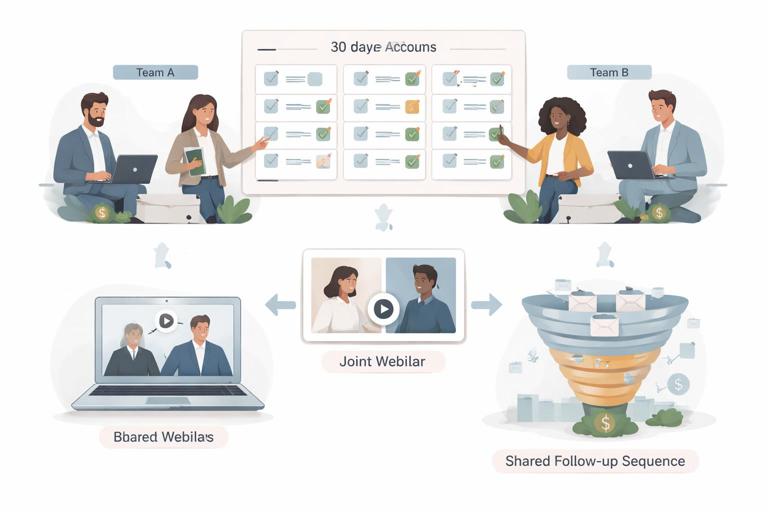
Practical example: Instead of “co-sell together,” an MVA might be “run a 30-day co-sell sprint targeting 20 shared accounts in one vertical, with one joint webinar and a shared follow-up sequence, measuring meetings booked and qualified pipeline created.”
Start With a Pilot Hypothesis (Make It Testable)
What you are testing: A pilot should test one primary hypothesis and a small number of supporting assumptions. If you try to test everything at once, you will learn nothing clearly.
Common partnership hypotheses:
- Demand hypothesis: “Partner X’s audience has a high-intent subset for our offer.”
- Distribution hypothesis: “Partner X can reliably drive introductions at a predictable rate.”
- Conversion hypothesis: “Joint positioning improves conversion versus our baseline.”
- Implementation hypothesis: “A lightweight integration or workflow reduces onboarding time by Y%.”
- Economics hypothesis: “The CAC-to-LTV profile of partner-sourced deals is better than baseline.”
Turn a hypothesis into a test statement: Use a format like: “If we do [pilot action] for [segment] over [time], then we expect [metric] to reach [threshold], because [reason].” Example: “If we run a co-branded workshop for mid-market finance leaders and follow with a joint outbound sequence over 21 days, then we expect at least 8 sales-qualified meetings, because the partner’s community has recurring compliance pain we solve.”
Step-by-Step: Designing a Partnership Pilot in 10 Steps
Step 1: Choose the pilot type (one motion only)
Pick a single motion: The pilot type determines assets, stakeholders, and measurement. Choose one of these common pilot motions:
- Co-marketing pilot: One event, one content asset, one campaign.
- Co-selling pilot: Joint account mapping + introductions + shared deal support.
- Referral pilot: Defined referral workflow and incentive, with tracking.
- Product/integration pilot: A minimal integration, embedded workflow, or data exchange.
- Service delivery pilot: Partner delivers implementation or a packaged service add-on.
Rule: If the pilot requires more than one cross-functional team on each side to start, it is probably not minimum viable yet.
Step 2: Define the narrowest use case and segment
Scope discipline: Specify one use case and one segment so results are interpretable. Examples: “HR onboarding automation for companies 200–1000 employees” or “security audit readiness for SaaS startups.”
Anti-pattern: “SMB and mid-market across all industries” creates noisy outcomes and makes it easy for both sides to blame the segment rather than the motion.
Step 3: Set a time box and a cap on effort
Time box: Typical pilots run 2–8 weeks depending on sales cycle. Shorter is better if you can still observe a signal.
Effort cap: Define maximum hours per week per owner and maximum number of assets. Example: “No more than 6 hours/week from each partner manager; one landing page; one email; one enablement doc.”
Step 4: Define success metrics and decision thresholds
Metrics hierarchy: Separate leading indicators (activity and early conversion) from lagging indicators (revenue). For many pilots, revenue is too slow; you need decision-grade leading indicators.
Example metric set for a co-marketing pilot:
- Primary metric: Sales-qualified meetings booked (SQMs).
- Secondary metrics: Registrations, attendance rate, MQL-to-SQM conversion, cost per SQM.
- Quality metric: % of SQMs matching ICP criteria.
Decision thresholds: Define “scale,” “iterate,” and “stop” thresholds in advance. Example: Scale if ≥10 SQMs and ≥60% ICP match; iterate if 5–9 SQMs or ICP match 40–59%; stop if <5 SQMs or ICP match <40%.
Step 5: Map responsibilities with a simple RACI
Why it matters: Pilots fail due to ambiguity more than strategy. Use a lightweight RACI (Responsible, Accountable, Consulted, Informed) for each deliverable.
Example deliverables: landing page, email send, speaker prep, lead handoff, follow-up sequence, reporting dashboard, weekly check-in.
Deliverable: Webinar landing page R: Your marketing ops A: Your partner lead C: Partner marketing I: Sales managersTip: Assign exactly one accountable owner per deliverable. Shared accountability becomes no accountability.
Step 6: Design the workflow (handoffs and SLAs)
Workflow over promises: Define how leads, intros, or requests move between teams. Include response-time expectations and what “accepted” means.
Example referral workflow:
- Partner submits referral via form with required fields (company, contact, pain, urgency).
- Your team responds within 24 business hours confirming acceptance or requesting info.
- If accepted, your AE schedules discovery within 5 business days.
- Status updates sent to partner at defined stages (scheduled, qualified, proposal, closed).
SLAs: Keep them realistic. A pilot SLA is a test of operational compatibility; overly aggressive SLAs create false negatives.
Step 7: Create minimum viable enablement assets
Minimum viable enablement: Provide just enough for the partner to execute accurately. Typical assets include:
- One-page positioning sheet: who it’s for, problem, outcome, proof, disqualifiers.
- Talk track: 5–7 bullet points and 3 discovery questions.
- Referral or intro template: a short email/script.
- FAQ and objection handling: top 5 objections with responses.
Example disqualifiers: “Not a fit if they require on-prem deployment” or “Not a fit if they have fewer than 50 employees.” Disqualifiers protect both brands and improve signal quality.
Step 8: Instrument tracking and attribution (simple but consistent)
What to track: You need to attribute outcomes to the pilot without building a complex system. Use consistent tags and a shared reporting cadence.
Practical tracking methods:
- CRM source fields: “Partner Pilot: [Name]” as a required field for pilot leads.
- UTM parameters: for co-marketing links.
- Shared spreadsheet: for intros with status and timestamps.
- Unique scheduling link: for pilot meetings to track conversions.
Anti-pattern: Relying on “we’ll recognize the names” or informal Slack messages. That produces stories, not evidence.
Step 9: Run the pilot with a weekly operating rhythm
Operating rhythm: A pilot needs a cadence that is frequent enough to correct course but light enough to stay “minimum.” A common rhythm is:
- Weekly 30-minute check-in: review metrics, blockers, next actions.
- Mid-pilot adjustment: one allowed change (e.g., messaging tweak or list refinement) to avoid endless iteration.
- Shared action log: who does what by when.
What to watch in real time: lead quality, response times, partner follow-through, and friction points in handoffs. These operational signals often predict scale success better than early pipeline.
Step 10: Hold a decision review and document learnings
Decision review agenda: Compare results to thresholds, identify what drove outcomes, and decide: scale, iterate, or stop. Capture learnings in a reusable format so future pilots improve.
Learning capture template:
- Hypothesis tested and outcome
- What worked (repeatable behaviors)
- What failed (root causes)
- Operational friction (handoffs, SLAs, tools)
- Next pilot design changes
Pilot Design Patterns (Choose One and Keep It Tight)
Pattern 1: The “Single Asset + Follow-Up” Co-Marketing Pilot
When to use: You need to test audience resonance and lead quality quickly without heavy sales coordination.
Minimum viable setup: one co-branded webinar or guide, one landing page, one email send from each partner, one follow-up sequence.
Example: A payroll platform and an HR compliance consultancy run a 45-minute workshop on “Avoiding misclassification penalties,” then route attendees to a joint calendar link for a free assessment. Success is measured by qualified assessments booked, not by registrations alone.

Pattern 2: The “20 Accounts, 2 Intros Each” Co-Sell Sprint
When to use: You want to test whether joint selling improves access and conversion in a defined segment.
Minimum viable setup: a shared list of 20 accounts, a short joint value narrative, and a commitment to attempt two warm paths per account (e.g., partner champion + mutual connection).
Metrics: intros secured, meetings held, opportunities created, stage progression speed versus baseline.
Example: A cloud cost optimization tool partners with a managed service provider. They target 20 SaaS companies with rising infrastructure spend. The MSP opens doors; the tool provides a diagnostic report used in discovery. The pilot tests whether the report increases second-meeting rate.

Pattern 3: The “Workflow Bridge” Integration Pilot
When to use: You suspect product adjacency but need to validate integration effort and adoption.
Minimum viable setup: a single-direction data sync or a lightweight embedded action (e.g., “Create ticket in Partner app”). Avoid multi-object syncs and complex permissions in the pilot.
Metrics: activation rate of the integration, time-to-first-value, support tickets, retention lift among integrated users.
Example: A customer support platform builds a minimal integration to push high-priority tickets into a project management tool. The pilot tests whether teams resolve tickets faster and whether that correlates with renewal likelihood.
Pattern 4: The “Partner-Delivered Package” Service Pilot
When to use: You need to test whether a partner can deliver a repeatable service that increases adoption or reduces churn.
Minimum viable setup: one packaged service offering, one pricing model, one delivery checklist, and a cap on the number of customers (e.g., 3–5).
Metrics: onboarding time reduction, NPS for implementation, expansion opportunities created.
Example: A CRM vendor partners with a boutique agency to deliver a “14-day CRM cleanup and automation sprint” for three customers. The pilot tests delivery quality and whether customers adopt key features faster.
Risk Management in Pilots: Guardrails That Keep “Small” From Becoming “Dangerous”
Brand and customer experience guardrails: Define what each party can say publicly, how customer data is handled, and how support escalations work. Keep approvals lightweight but explicit.
Commercial guardrails: If any revenue sharing, discounts, or incentives are involved, define them for the pilot only. Avoid long-term pricing commitments during a pilot.
Operational guardrails: Cap the number of leads, accounts, or customers included. A pilot that “goes viral” without capacity can damage both brands; set a maximum volume and a waitlist plan.
Common Failure Modes (and How to Prevent Them)
Failure mode 1: Measuring activity instead of signal
Symptom: The pilot reports “we did a webinar” or “we sent emails,” but cannot answer whether the alliance should scale.
Prevention: Choose one primary metric tied to value (qualified meetings, activation, retention lift) and set thresholds before launch.
Failure mode 2: Too many stakeholders too early
Symptom: The pilot requires approvals from legal, product, finance, and multiple sales teams, causing delays and diluted ownership.
Prevention: Redesign to a smaller motion that can run with one owner per side and minimal dependencies. If legal review is required, use a short pilot addendum rather than a full partnership agreement.
Failure mode 3: Unclear handoffs and slow follow-up
Symptom: Leads go cold, partners feel ignored, and results underperform despite interest.
Prevention: Define SLAs, acceptance criteria, and status updates. Track timestamps so you can see where the process breaks.
Failure mode 4: Changing too many variables mid-pilot
Symptom: Messaging, segment, and offer change every week, making results uninterpretable.
Prevention: Allow one mid-pilot adjustment only, and document it. Otherwise, run a second pilot iteration with a new hypothesis.
Scaling Criteria: When a Pilot Becomes a Real Alliance Motion
Scale readiness checklist: A pilot is ready to scale when you can answer “yes” to most of these:
- Repeatability: The partner can execute the motion without heroic effort.
- Signal strength: Primary metric meets or exceeds threshold with acceptable quality.
- Operational fit: Handoffs, SLAs, and tooling friction are manageable.
- Economics: The cost (time, incentives, discounts) is justified by expected outcomes.
- Internal pull: Sales, CS, or product teams see value and will support expansion.
What “scale” looks like: Scaling does not mean “do more of everything.” It means increasing volume along the same motion while standardizing assets and workflows. For example, moving from 20 accounts to 100 accounts with the same co-sell sprint structure, or from one webinar to a quarterly series with the same follow-up engine.
Minimum Viable Alliance Documentation: The One-Page Pilot Brief
Why a one-page brief: It aligns both teams and prevents scope creep. Keep it short enough that people actually read it.
One-page pilot brief fields:
- Pilot name and dates
- Hypothesis
- Motion type
- Segment and use case
- Offer and CTA
- Assets to be created (max 3–5)
- Workflow and SLAs
- Primary metric + thresholds
- Owners and weekly cadence
- Risks and guardrails
Example excerpt: “Primary metric: 10 SQMs in 30 days; scale if ≥10 with ≥60% ICP match; stop if <5 or ICP match <40%. SLA: respond to partner-submitted leads within 24 business hours; schedule within 5 business days.”